
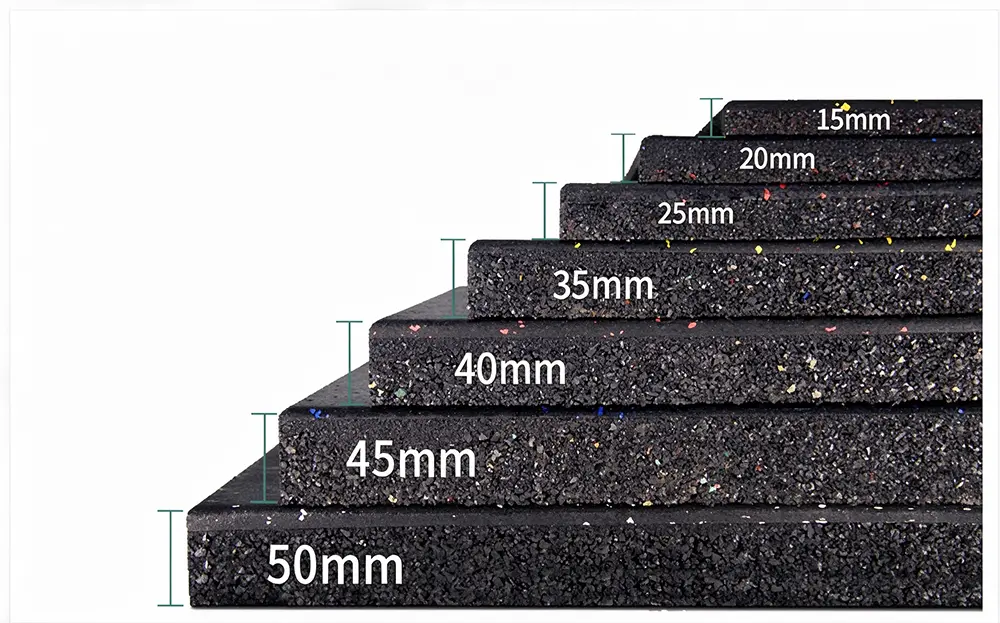
Rubber gym flooring thickness typically ranges from 15mm to 50mm for many commercial tile systems. A 15–20mm tile may suit general fitness and lighter training areas, while 20–30mm options are worth considering for free-weight zones. Dedicated weightlifting and high-impact areas may require 30–50mm heavy-duty flooring or an additional lifting platform. The right choice depends on equipment loads, dropping height, flooring construction, and subfloor conditions.
These are general selection guidelines, not universal load-bearing standards. In this guide, we break down how thickness affects performance, recommend thicknesses by training zone, and explain what else you should evaluate before finalizing your flooring order.
1. Why Does Rubber Gym Flooring Thickness Matter?
Impact Absorption and Floor Protection
Dumbbells, barbells, and strength equipment deliver concentrated impact and static load to the floor with every drop, controlled set-down, or rep. Quality rubber gym flooring absorbs and disperses this energy through elastic deformation, reducing the force that reaches the underlying subfloor.
All else being equal (same material formula and internal structure), a thicker rubber tile generally provides greater impact cushioning. If the flooring is too thin for the intensity of use, repeated heavy drops can damage concrete, tile, or wood subfloors over time, leading to costly structural repairs. For high-traffic free-weight areas, sufficient thickness is a critical layer of protection for both your facility base and your fitness equipment.
Noise and Vibration Reduction
Gym environments produce two distinct categories of sound:
- Impact sound: the sharp, percussive noise generated when weights strike the floor surface.
- Airborne sound: general gym noise, equipment hum, and music that travels through the air.
Rubber flooring is highly effective at reducing impact sound and dampening vibration from treadmills, weight stacks, and dropped weights. For upstairs gyms, hotel fitness centers, or gyms located within residential buildings, thicker, high-density rubber can help lower vibration transfer to lower floors and reduce noise complaints.
That said, rubber flooring alone is not a complete soundproofing system. For strict acoustic requirements, you will need to combine appropriately specified rubber flooring with building-level acoustic design and dedicated subfloor treatment.
Comfort and Stability During Exercise
Training on an overly hard surface can cause muscular fatigue and joint stress over long workouts. A reasonable amount of elasticity in rubber flooring improves underfoot comfort and reduces impact on knees and ankles during bodyweight training and cardio movement.
However, more thickness does not always equal better performance. Excessively soft or thick flooring can reduce stability during heavy lifts, making it harder to maintain proper lifting form and increasing injury risk. Different movements call for different balances of cushion and support: cardio and functional training benefit from more give, while heavy strength work requires a firm, stable base.
2. Recommended Rubber Gym Flooring Thickness for Different Training Areas
Below is a quick reference for common gym zones. These are general guidelines for typical commercial interlocking rubber tile systems, not universal load ratings.
| Thickness | Best For | Typical Gym Zones |
|---|---|---|
| 15mm | Light activity, cardio equipment | Treadmill rooms, stretching areas, light fitness studios |
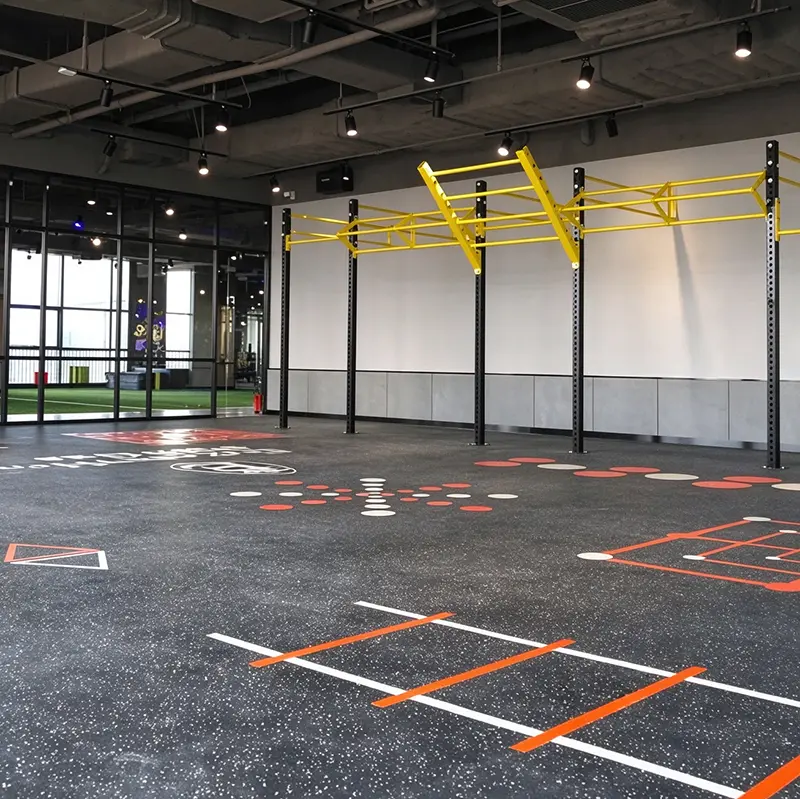
| 20–25mm | General strength and moderate free weights | Weight machine areas, dumbbell zones, functional training |
| 30mm | Heavy strength training and regular controlled drops | Heavy dumbbell areas, powerlifting sections, cross-training zones |
| 40–50mm | High-impact drops and Olympic lifting | Olympic weightlifting platforms, CrossFit drop zones, heavy barbell training areas |
15mm Rubber Flooring for Cardio and Light Fitness Areas
A 15mm rubber tile is a practical and cost-effective choice for low-to-moderate impact zones. It provides basic vibration damping for stationary cardio machines and a comfortable, slip-resistant surface for warm-ups and stretching.
Common applications:
- Treadmills, exercise bikes, and elliptical machines
- Stretching and warm-up areas
- Light fitness and bodyweight training spaces
- Home gyms with minimal free-weight use
This thickness balances affordable material cost, simple snap-fit installation, and sufficient protection for equipment that stays in place and produces steady vibration rather than heavy impact.
20–25mm Rubber Flooring for General Strength Training
For most commercial gym strength sections, 20mm to 25mm rubber flooring is the most widely used and versatile range. It offers noticeably better impact absorption than 15mm options, while still maintaining good stability for compound lifting movements.
Common applications:
- Selectorized weight machine areas
- Light-to-moderate dumbbell zones
- General functional training areas
- All-purpose mixed-use commercial gym floors
This thickness range handles regular dumbbell set-downs and everyday strength training well, making it a reliable middle-ground choice for facilities with mixed training styles.
30mm Rubber Flooring for Heavy Strength Training
30mm rubber gym flooring is engineered for heavier loads and more frequent impact. It provides robust subfloor protection for zones where heavy dumbbells and loaded barbells are regularly placed or dropped from low heights.
Common applications:
- Heavy dumbbell training zones
- Powerlifting areas with controlled drops
- High-intensity cross-training sections
- Areas with large, heavy plate-loaded strength equipment
For facilities that prioritize free-weight training but do not host frequent high-level Olympic lifting, 30mm interlocking tiles are often the sweet spot between long-term performance and overall project budget.
40–50mm Rubber Flooring for Olympic Weightlifting and High-Impact Zones
For zones where heavy barbells are dropped from overhead—such as Olympic lifting and dedicated CrossFit drop areas—40mm to 50mm heavy-duty rubber flooring delivers maximum impact absorption.
Common applications:
- Olympic weightlifting platform surfaces
- Dedicated CrossFit drop zones
- Heavy barbell training areas with frequent overhead drops
- High-impact functional training zones
3. 15mm vs 20mm vs 25mm vs 30mm vs 40mm vs 50mm: What Are the Differences?
| Thickness | Typical Use Case | Relative Impact Absorption | Floor Stability | Relative Material Cost |
|---|---|---|---|---|
| 15mm | Cardio / light fitness | Basic | Firm | Low |
| 20mm | General fitness / light weights | Moderate | Very stable | Low–medium |
| 25mm | Mixed strength training | Good | Stable | Medium |
| 30mm | Heavy strength / controlled drops | Very good | Stable | Medium–high |
| 40mm | Heavy drops / weightlifting | Excellent | Moderately firm | High |
| 50mm | High-impact drop zones | Highest | Firmness depends primarily on density | Highest |
Impact Absorption
Within the same product series with identical material composition and internal structure, increasing thickness usually improves impact absorption.
A well-engineered 25mm tile with a layered cushioning structure may outperform a cheap, low-density 30mm tile. Always verify impact performance against published technical test data, not just thickness alone.
Floor Stability
Thicker flooring is not always more stable. Stability depends heavily on rubber density, compression set, and overall construction. A high-density 25mm tile can provide a firmer, more stable lifting surface than a low-density 40mm tile that compresses easily under load.
For heavy strength and Olympic lifting, you need a surface that absorbs drop impact without feeling spongy underfoot during standing lifts like squats and deadlifts.
Installation and Cost
Thicker tiles use more raw material per square meter, so they come with higher material costs. They are also heavier per tile, which increases shipping costs and makes handling and installation more labor-intensive.
Additionally, thicker flooring raises the finished floor height. This may require transition strips at doorways, adjustments to equipment rack height, and careful planning around bathroom thresholds or existing fixed structures in the facility.
4. What Else Affects Gym Flooring Performance?
Rubber Density
Rubber gym flooring density refers to the mass of material per unit of volume, usually measured in kg/m³. It is one of the most important specs that determine how a floor feels and performs under load.
- Higher-density rubber tends to be firmer, more compression-resistant, and more durable under heavy static loads.
- Lower-density rubber can feel softer and offer more initial cushion, but may develop permanent indentations more easily over time.
Higher density does not always mean better impact absorption. The best performing floors balance thickness, density, and elastic rebound to absorb drops while remaining stable. When comparing products, look beyond thickness and ask for density specifications.
Rubber Composition and Material Structure
The raw materials and layered design of a tile have a huge effect on real-world performance.
Most commercial gym tiles are made from a blend of rubber granules and binding agents, often enhanced with EPDM granules for improved color stability, weather resistance, and consistent elasticity. Tiles may have a single-layer homogeneous structure or a multi-layer composite design.
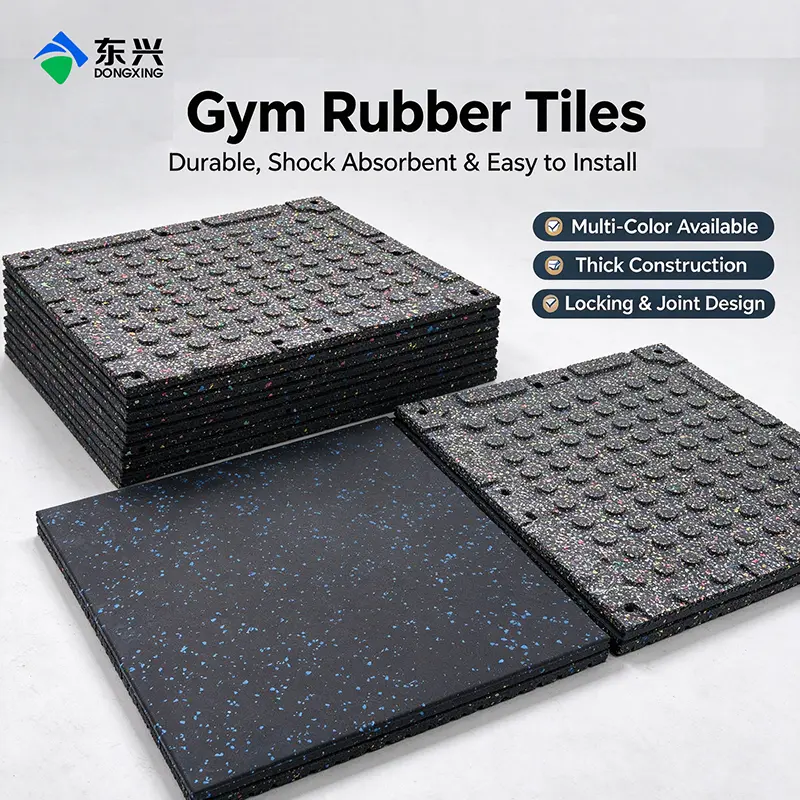
For example, DONGXING rubber gym flooring tiles are crafted from eco-friendly rubber and EPDM granules. Many models feature a three-layer composite structure:
- A wear-resistant top layer for long-term durability and easy daily cleaning
- A high-density compressed cushioning middle layer for strong, consistent resilience
- A granular shock-absorbing base layer for even impact dispersion
This purpose-built layered design delivers better all-around performance than a simple single-layer tile of the same total thickness.
Compression Resistance and Resilience
Two often-overlooked but critical specs are compression set and resilience.
- Compression set measures how much the rubber stays permanently deformed after being under sustained pressure. A high compression set means heavy equipment racks and machines can leave permanent indentations in the floor.
- Resilience measures how quickly and fully the rubber bounces back after impact. Good resilience ensures consistent cushioning performance over years of heavy use.
For gyms with heavy, stationary machines and frequent weight drops, low compression set and high resilience are essential to maintain a flat, even, and high-performing floor long-term. Always check relevant test data when evaluating heavy-duty flooring options.
5. Should You Use the Same Rubber Flooring Thickness Throughout the Gym?
Not necessarily. For most commercial and semi-commercial facilities, using a single thickness everywhere is rarely the most cost-effective or high-performance solution.
Different zones have very different demands:
- Cardio areas produce mostly steady vibration, not heavy impact, so they do not need the same thickness as free-weight zones.
- Strength and dumbbell areas see regular moderate-to-heavy drops and need stronger impact protection.
- Olympic lifting and drop zones have the highest impact loads and deserve dedicated heavy-duty flooring or platform systems.
6. How to Choose the Right Rubber Gym Flooring Thickness for Your Project
Step 1: Identify Your Training Activities and Zones
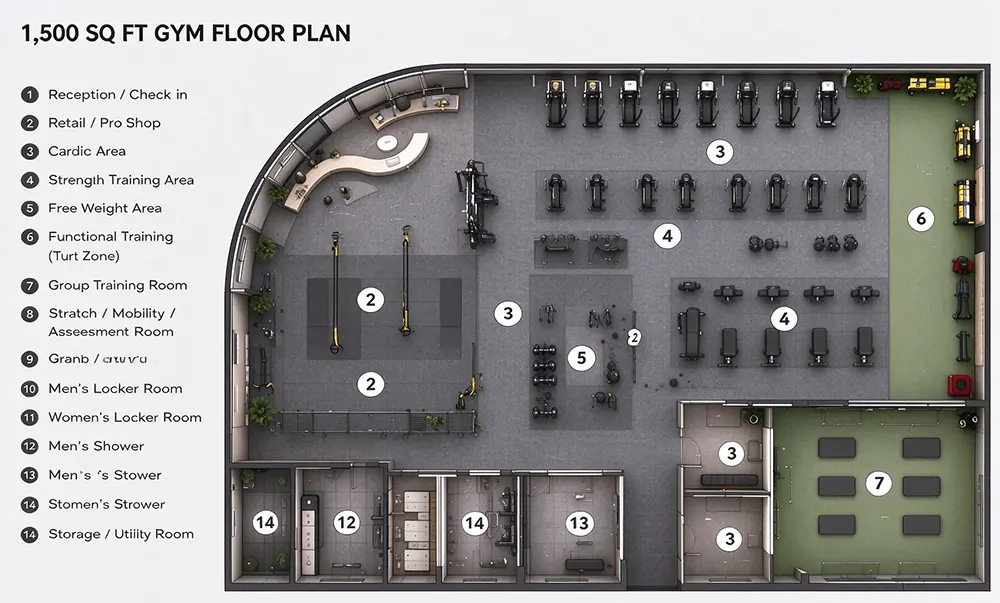
Start by mapping out your gym layout:
- What percentage of the space is dedicated to cardio equipment?
- How much area is reserved for strength machines, free weights, and functional training?
- Will you have a dedicated Olympic lifting or CrossFit drop zone?
Match each zone to its typical impact level, then select an appropriate thickness range accordingly.
Step 2: Evaluate Equipment Weight and Impact Levels
Consider the heaviest items and usage intensity in each zone:
- What is the maximum weight of dumbbells and loaded barbells that will be used?
- Will weights be dropped from overhead, or only set down from waist height?
- How many hours per day will the zone see heavy training use?
Higher weights, greater drop heights, and higher usage frequency all call for thicker, denser flooring.
Step 3: Check Your Subfloor and Building Conditions
Rubber gym flooring can generally be laid directly over an existing hard surface such as concrete, tile, or another suitable subfloor. However, before installation, you must ensure that the existing surface is clean, dry, stable, and sufficiently level.
If your gym is on an upper floor, or if the subfloor is wood rather than concrete, you may need thicker or higher-density flooring to reduce vibration transfer and protect the building structure. Always confirm the subfloor’s load capacity before selecting heavy-duty flooring.
Step 4: Compare Full Product Specifications, Not Just Thickness
Do not shop by thickness alone. Compare products on:
- Rubber density and material composition
- Layered structure and wear-layer design
- Compression set and resilience test data
- Installation method (interlocking, glue-down, loose-lay)
A well-built 25mm tile may outperform a poorly made 30mm tile in both durability and shock absorption.
Step 5: Request Technical Datasheets and Product Samples
Spec sheets tell part of the story, but physical samples let you feel the density, surface texture, and build quality firsthand. Reputable suppliers will provide detailed technical datasheets and samples so you can verify performance before placing a large order.
If you are sourcing flooring for a commercial gym, fitness center, or strength training facility, you can explore our full line of interlocking rubber gym tiles on our Rubber Gym Flooring Tiles page. We offer thicknesses from 15mm to 50mm in multiple speckled color and surface options, and can provide detailed technical specs and custom quotations tailored to your project.