
If you’re looking to build a standard pickleball court, whether for a commercial venue, recreational facility, indoors or outdoors, adhering to internationally standardized pickleball court dimensions is crucial for fairness and the choice of surface materials. Combining the standards of the United States Pickleball Association (USAPA) and the International Pickleball Federation (IFP), along with our court design solutions for PVC or Acrylic flooring, we provide a complete dimensional guide.
Standard Pickleball Court Dimensions
All standard pickleball courts follow the universal dimensions established by the United States Pickleball Association (USAPA) and the International Pickleball Federation (IFP). Dimensions are standardized for both singles and doubles, with strict regulations regarding the placement and measurement of the court lines. The core length is the same for both game formats; only the width is adjusted for singles.
Double (Most Popular)
Double is the most popular game format, and its court dimensions serve as the global benchmark for all court construction.
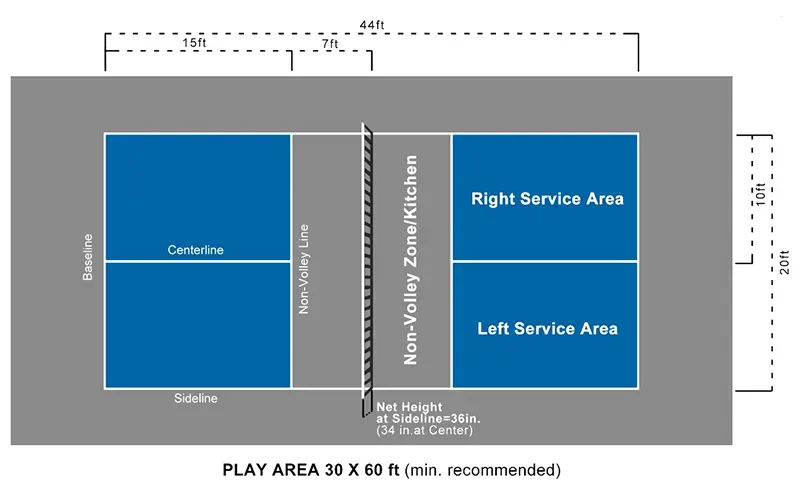
The total length is 44 feet (13.41 meters), and the total width is 20 feet (6.10 meters) (usapickleball.org), with a singles width of 17 feet (5.18 meters). This area is almost identical to a standard doubles badminton court, making it a popular and affordable option if you own a badminton court and want to convert it to a Peak court.
Recommended reading: Dongxing Pickleball court surface materials
Court Functional Area Dimensions
Boundary Lines:
The distance between the outer edges of the two baselines is 44 feet, and the distance between the outer edges of the two sidelines is 20 feet. It’s important to note that all dimensions are based on the outer edges of the sidelines, which are themselves considered part of the legal playing area. This is one of the easily overlooked mistakes: many DIY enthusiasts and some builders draw lines outside the 44-foot x 20-foot measurement area, resulting in a court size that is too small for official matches.
Non-Volley Zone:
Located on both sides of the net, with a depth of 7 feet (2.13 meters). The non-volley line (marked behind the volley line) is parallel to the net, with a distance of exactly 7 feet between the net line and the outer edge of the non-volley line. Like the boundary lines, the non-volley line is itself part of the non-volley zone—even if a toe touches this line during a volley, it is a foul. The maximum permissible dimensional tolerance for the non-volley zone is ±1/8 inch.
Service Courts and Center Line:
The center line is perpendicular to the net, extending from the midpoint of each baseline to the midpoint of each non-volley line, dividing the court into two equal service courts. Each service court is 10 feet wide (half the width of a 20-foot court) and 15 feet long (22-foot half-court length minus 7 feet of non-volley depth). A serve is legal if it lands in the opponent’s service court diagonally opposite to the net and cannot touch the non-volley line.
Net Dimensions:
The net divides the court into two equal 22-foot halves, with standard heights of 36 inches (0.91 meters) at the sidelines and 34 inches (0.86 meters) at the center line (International Pickleball Federation). Net posts should be placed 12 inches outside the sidelines, spaced 22 feet apart to ensure proper net tension.
Line Width and Measurement Standards: All standard pickleball courts require 2-inch (5.08 cm) wide lines, painted in a high-contrast color (usually white) to ensure optimal visibility. For permanent courts, durable, weather-resistant court paint should be used; for temporary courts, 2-inch wide paint tape or specialized court tape may be used.
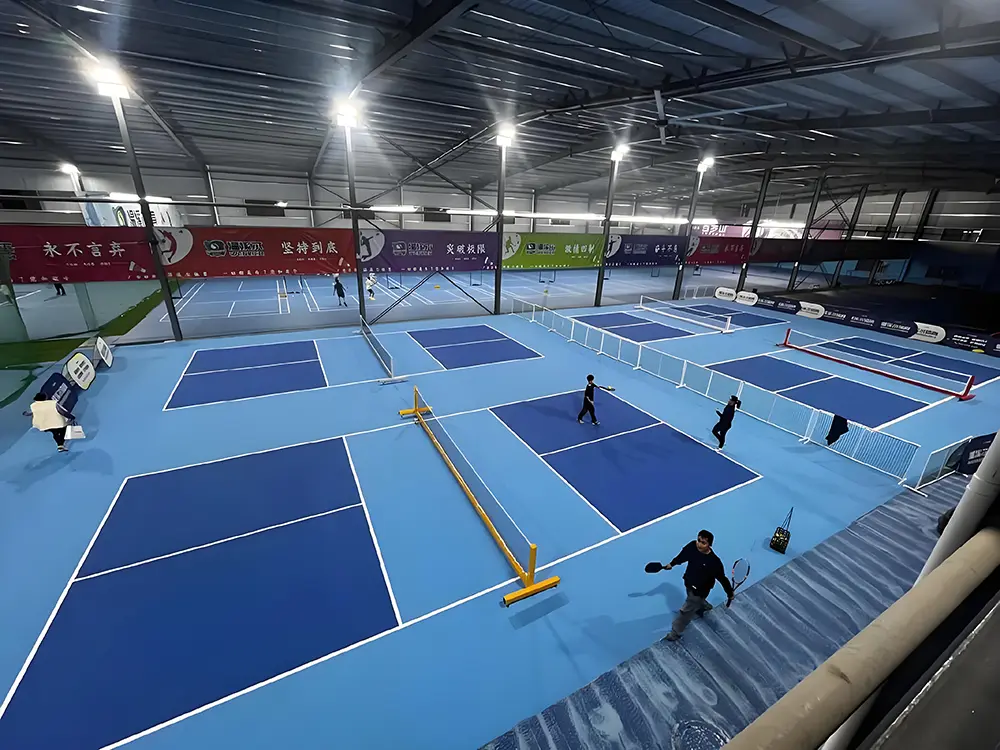
Pickleball Court Line Clearance:
Professional Level:
At least 10 feet (3.05 meters) of clearance beyond each sideline, 12 feet (3.66 meters) recommended. This space accommodates the referee’s chair, scoreboard, players’ rest area, and television broadcasting equipment, while providing ample space for players to chase long-range shots.
Commercial/Community Recreation Venue Level:
At least 6 feet (1.83 meters) of clearance beyond each sideline, 8 feet (2.44 meters) recommended.
Backyard/Recreational Family Court:
At least 5 feet (1.52 meters) of clearance beyond each sideline. For courts with adjacent walls or fixed structures, the clearance height must never be lower than this standard, because when sliding left and right or receiving the ball from a distance, players are easily able to brush past obstacles if there is insufficient clearance.
For large, multi-pickball court facilities
here’s a tip: for side-by-side courts, combine shared sideline clearance. For example, instead of reserving 8 feet of clearance for each adjacent court, share 12 feet of space between them, giving each court 6 feet of usable clearance and saving a total of 4 feet of space per pair of courts. This allows most standard tennis courts to accommodate 4 standard pickleball courts instead of 3, significantly improving return per square foot.
Standard Pickleball Court Dimensions
When constructing a pickleball court, whether indoor or outdoor, the flooring material must typically include the dimensions outside the standard court lines, and there are also relevant standards for the clearance outside the lines. A standard size can be summarized in one sentence: 18 meters long and 9 meters wide.
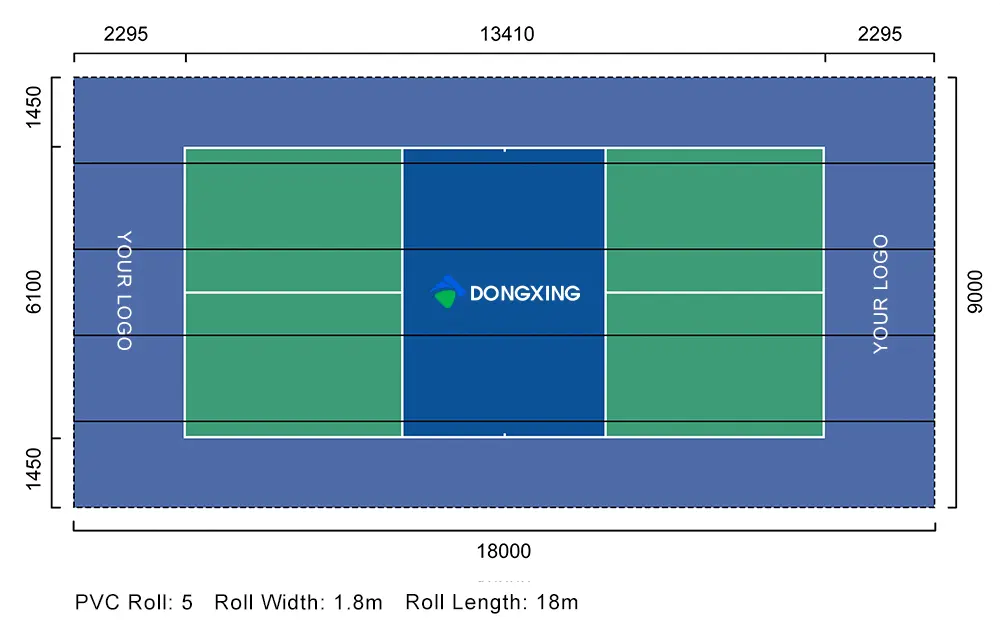
Based on our custom-printed PVC or acrylic pickleball flooring, the court lines, colors, and patterns are all produced, drawn, and customized by us. For most pickleball courts, we use the latest US size of 30*60 feet, which is 9.144*18 meters. Approximately 4-6 rolls of flooring material are needed to complete the installation.
For Dongxing Sports Flooring Factory, our PVC rolls are produced in widths of 1.42 meters, 1.5 meters, 1.8 meters, and 2.0 meters, and lengths ranging from 10 to 20 meters to adapt to different sports courts.
Here are some commonly used roll mat installation solutions for reference:
In summary:
Regarding court lines and flooring dimensions, we can provide accurate line markings and pattern printing. We offer detailed standards for converting badminton and tennis courts into pickleball courts. For operators and builders, it’s more important to focus on the overall area of your court and how many standard pickleball courts it can accommodate. Refer to the most suitable allowance outside the court lines to accommodate as many as possible. We will provide suitable court design and roll mat installation solutions for your needs.