
Introduction
The UAE’s healthcare sector continues to expand, driven by growing demand, a booming medical tourism industry, and government-led infrastructure development in Dubai, Abu Dhabi, and Sharjah.
For healthcare facilities, project contractors, and procurement teams across the UAE, choosing the right flooring solution is a long-term investment. Hospital vinyl flooring is currently the leading material in the industry, outperforming ceramic tile, rubber, and linoleum.
As a vinyl flooring manufacturer, we offer a comprehensive sourcing guide to help you make compliant, cost-effective, and durable choices.
1. Why is Hospital Flooring Important?
1.1 Healthcare Infrastructure in the UAE
The UAE has solidified its position as a regional healthcare hub. In line with the national healthcare development strategy, it has continuously invested heavily in expanding healthcare capacity to meet Joint Commission International (JCI) and other global accreditation standards, attracting international patients.
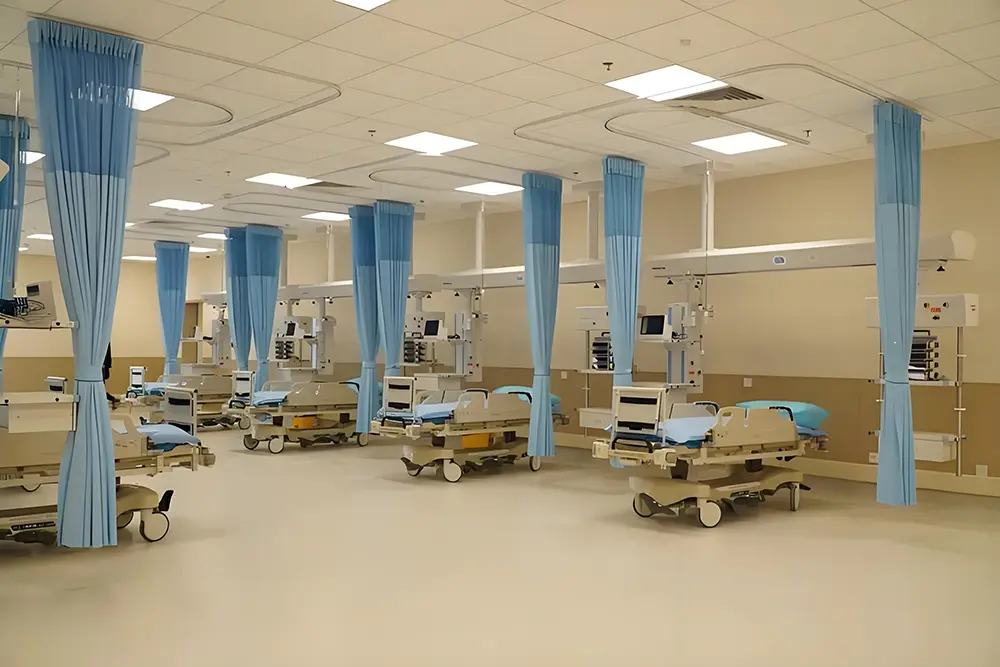
Unlike ordinary commercial spaces, healthcare facility floors need to withstand 24/7 traffic of people and vehicles, frequent chemical disinfection, liquid leaks, and stringent infection control requirements. Under these conditions, ordinary flooring materials are easily damaged, leading to higher replacement costs and safety hazards.
1.2 Why Vinyl (PVC) Flooring?
Traditional flooring has significant drawbacks: tile grout is prone to bacterial growth and feels hard underfoot; rubber flooring has high initial investment costs and complex installation; linoleum flooring requires frequent waxing and is susceptible to chemical damage.
Today, vinyl flooring achieves a clever balance between hygiene, durability, patient comfort, and total cost of ownership, making it the best choice for the region’s hot and humid climate and high-traffic healthcare facilities.
2. Flooring Requirements in Healthcare Facilities
No single material is suitable for all areas of a hospital. Different areas have different requirements for hygiene, slip resistance, durability, and antimicrobial properties. Understanding these requirements is the first step in sourcing commercial vinyl flooring.
2.1 Patient Wards
Patient wards require quiet, warm-feeling, and easy-to-clean floors. Patients need a low-microbial environment, while wheelchairs and bed frames require slip-resistant surfaces. Good sound insulation can help patients rest and recover.
2.2 Operating Rooms (OR)
Operating rooms have extremely high hygiene requirements. The floors must be completely seamless, non-porous, and resistant to strong disinfectants, blood, and bodily fluids. They must also be able to withstand the weight of heavy surgical equipment and provide sufficient cushioning to reduce fatigue for surgical teams who stand for long periods.
2.3 Intensive Care Units (ICU)
ICUs have even higher infection control requirements. The floors must be seamlessly installed, withstand deep cleaning with strong chemicals, and withstand the pressure of heavy medical equipment without leaving indentations.
2.4 Laboratories
Medical and diagnostic laboratories handle a wide variety of chemical reagents, stains, and biological samples. Floors in these areas should be chemically and stain-resistant, with seamless surfaces to prevent liquid leakage.
2.5 Emergency Departments (EDs) and Hospital Corridors
Emergency departments are among the busiest and most unpredictable areas in any hospital. Floors must be highly abrasion-resistant, impact-resistant, and provide reliable slip resistance.
3. Why Choose Medical Vinyl Flooring
3.1 Dense Surface
Vinyl composite flooring features a dense, non-porous surface with excellent antibacterial properties, which is especially important in the hot and humid climate of the UAE.
3.2 Seamless Installation
High-quality hospital vinyl flooring uses a thermoplastic welding installation method to create a continuous, seamless floor, which is waterproof and liquid-proof, meeting hospital hygiene standards.
3.3 Easy Cleaning
Hospital vinyl flooring can be quickly cleaned with standard disinfectants, eliminating the need for waxing or polishing. This reduces cleaning time and labor costs.
3.4 Chemical Resistance
The medical field commonly uses various disinfectants, alcohol solutions, and other chemical reagents. Vinyl flooring uses a special raw material ratio and process to resist chemical damage, discoloration, and degradation.
3.5 Slip Resistance
Patient and healthcare staff slipping is one of the most common safety accidents in hospitals. The surface of vinyl flooring features anti-slip textures and patterns, providing stable slip resistance in both dry and wet environments.
3.6 Long service life
For key areas such as operating rooms and ICUs, homogeneous vinyl flooring is highly wear-resistant and resistant to high-frequency rolling. It can be polished and refinished, extending its service life to 10 years or more.
4. Types of Medical Vinyl Flooring
Not all medical flooring is created equal. Choosing the right type based on the specific needs of each area balances cost and performance.
4.1 Homogeneous Flooring
Homogeneous PVC flooring is made from a single, uniform PVC composition. It boasts exceptional durability and abrasion resistance, offers the highest level of hygiene, and allows for seamless installation.
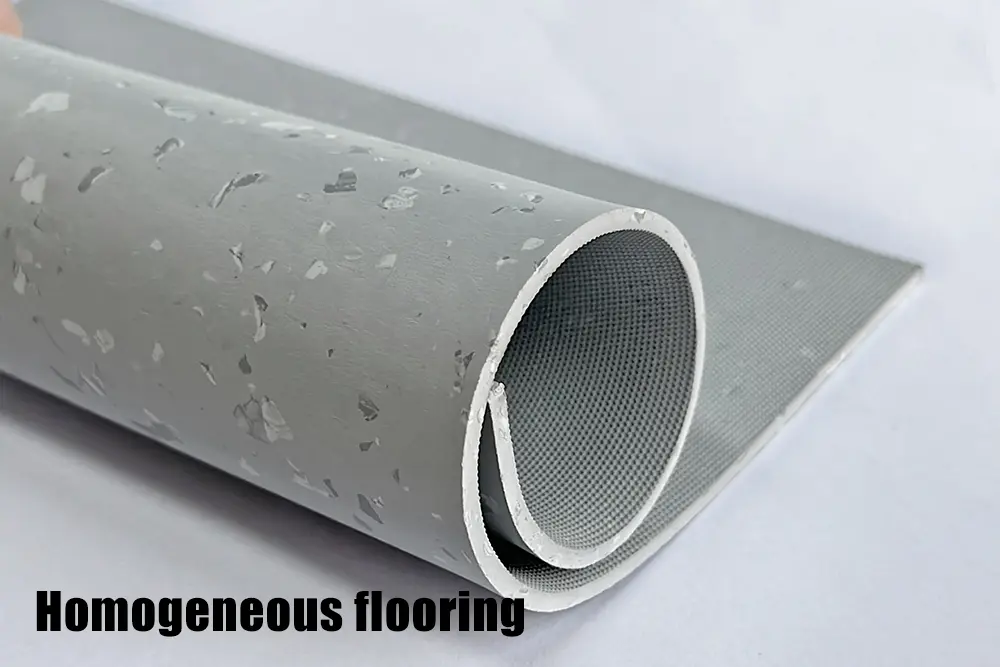
Best suited for: Operating rooms, intensive care units (ICUs), clinical laboratories, sterilization supply rooms, and other high-hygiene, high-traffic clinical areas.
4.2 Heterogeneous Flooring
Heterogeneous PVC flooring features a multi-layered composite structure. The outermost layer is a transparent, abrasion-resistant layer, followed by a decorative printed layer, and then a dense PVC base layer. It offers a wider selection of colors and patterns, creating a warm and comfortable medical environment.
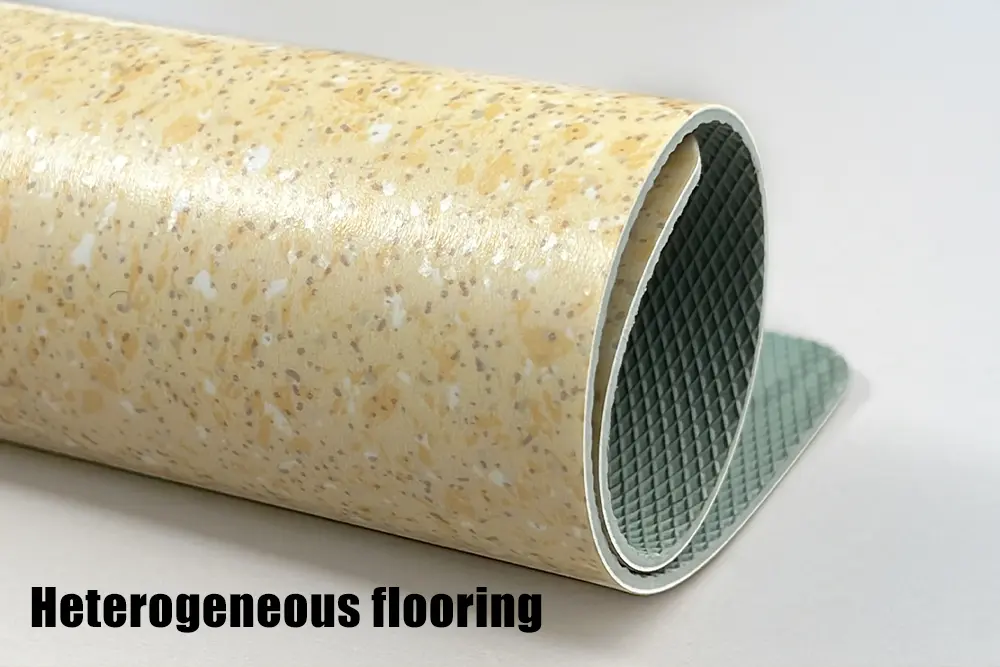
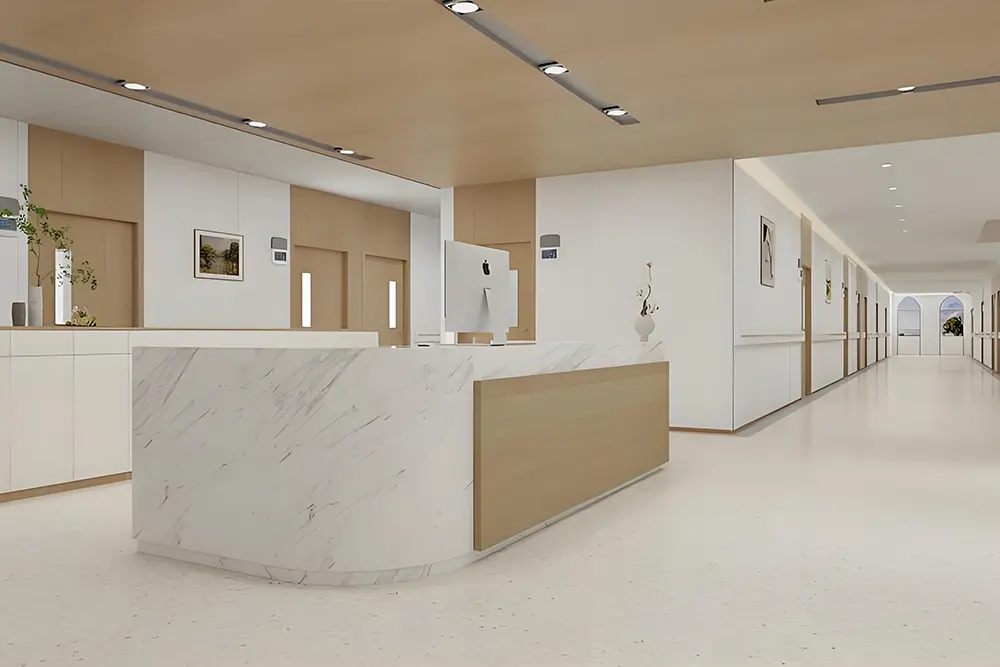
Best suited for: Hospital reception halls, waiting areas, doctors’ offices, administrative office areas, and general ward corridors.
4.3 Safety Type
Safety type vinyl flooring uses a special formula with enhanced anti-slip properties, typically achieving an R11-R13 rating in DIN 51130 testing.
Most suitable for: Hospital bathrooms and shower rooms, damp utilities, emergency rooms, and physiotherapy areas where liquid spills are likely to occur.
4.4 Antistatic (ESD) Vinyl Flooring
It prevents static electricity buildup, avoiding damage to sensitive medical electronic equipment or interference with diagnostic equipment, while also reducing dust adsorption in clean environments.
Most suitable for: Medical equipment rooms, radiology departments (MRI, CT, X-ray), operating rooms equipped with precision surgical instruments, and biomedical laboratories.
5. Standards and Certifications
Healthcare facilities in the UAE must adhere to rigorous international safety and quality standards, which generally align with EU requirements and JCI (Joint Commission International) guidelines. It is recommended to verify the following certifications when selecting suppliers:
- ISO 9001 (Quality Management System)
- ISO 14001 (Environmental Management System)
- EN 649 / EN ISO 10582
- Fire Rating: In accordance with the EN 13501-1 standard, healthcare projects in the UAE typically require a minimum fire rating of Bfl-s1 (low flammability, low smoke emission).
- Slip Resistance: Evaluated based on DIN 51130 (R-rating for shod traffic) and DIN 51097 (A/B/C rating for barefoot traffic). General clinical areas typically require a minimum of R9–R10, while wet areas require R11 or higher.
- VOC (Volatile Organic Compounds) and Indoor Air Quality: Hospital flooring materials must comply with strict low-VOC emission standards (such as EMICODE EC1+, Eurofins Indoor Air Comfort Gold, or ISO 16000)
6. Why Source Vinyl Flooring from China?
6.1 Highly Competitive Costs
Thanks to mature upstream supply chains, automated production, and economies of scale, Chinese manufacturers can offer products that meet equivalent international certification standards at prices 30%–50% lower than European brands.
6.2 Large-Scale Production Capacity
Comprehensive, large-scale manufacturing facilities can fulfill high-volume orders for entire hospital projects and ensure timely delivery.
6.3 Customization Options for Color, Thickness, and Formulation
Chinese factories typically offer customization services—including color, pattern, thickness, and wear layer depth—to precisely meet specific project requirements.
6.4 Proven Project Experience
Suppliers have provided flooring for hundreds of healthcare projects worldwide, including numerous hospitals and clinics in the Gulf Cooperation Council (GCC) region. They possess a deep understanding of local climatic conditions, building code requirements, and the specific performance demands of flooring in medical environments.
6.5 Mature Export and Logistics Capabilities
Dedicated export teams handle all documentation, customs clearance assistance, and freight coordination. They are well-versed in UAE import regulations and provide all necessary certification documents required for project approval.
7. How to Choose a Supplier of Hospital Vinyl Flooring?
- Manufacturing experience
- Verifiable hospital project references
- Valid certifications and qualifications
- OEM/ODM capabilities
- Production capacity and output
- Transparent delivery timelines
- Technical support and installation guidance
- Product warranty
Conclusion
For hospital vinyl flooring projects in Saudi Arabia and the UAE that require high quality, cost-effectiveness, certified products, and proven project experience, partnering with a professional Chinese manufacturer like Dongxing Plastic ensures a satisfactory solution tailored to your needs.