
If you own, install, or maintain PVC pickleball court flooring, you have likely encountered one or more of these frustrating surface issues:
- The acrylic top coating begins to peel, flake off, or form raised blisters across the playing surface.
- Separation develops between the surface layer and the underlying PVC core of the flooring.
- After months of regular use, fine cracks spread across the surface, followed by localized chipping and patchy delamination.
- Coating damage becomes noticeably worse after periods of high heat, direct sun exposure, or intensive daily play.
Acrylic coating peeling from PVC pickleball court flooring is not always caused by poor coating quality. It can result from material incompatibility, insufficient surface preparation, plasticizer migration, improper curing, or repeated thermal stress. Understanding the real root causes helps buyers select durable products and avoid premature court surface failure.
1. Understanding Acrylic Coating Delamination on Pickleball Court Flooring
Before diagnosing why peeling happens, it is important to clarify exactly where the failure occurs and what type of damage you are seeing.
What Is Acrylic Coating Peeling?
Surface failures on PVC sports flooring fall into four distinct categories, each with different root causes:
- Peeling: The acrylic top layer lifts and separates cleanly from the underlying PVC substrate. Failure occurs directly at the bond interface between the coating and the base material.
- Delamination: A broader term describing separation between any two material layers within the flooring structure, not limited to the acrylic surface.
- Blistering: Raised bubbles form beneath the acrylic coating or between internal layers, caused by trapped gases, contamination, or weakened adhesion. Blisters usually rupture and turn into peeling under foot traffic.
- Cracking: Fine or deep fractures appear in the acrylic surface. Cracking does not always mean full delamination has occurred, but it signals compromised coating integrity and is often a precursor to peeling.
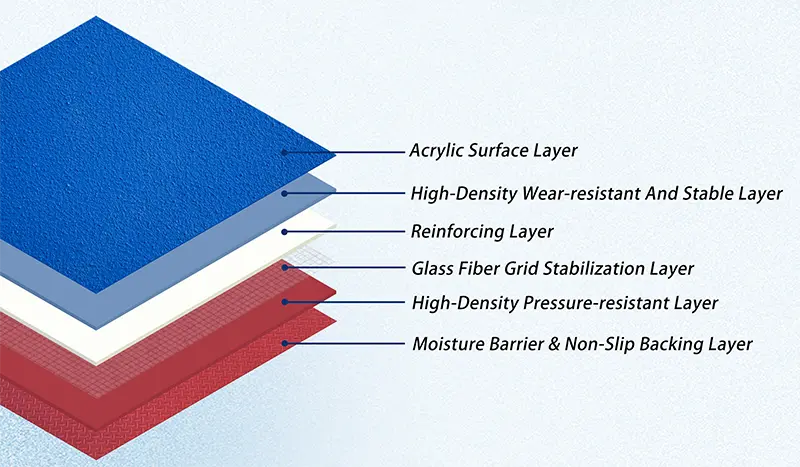
How Is Acrylic Pickleball Court Flooring Structured?
Unlike traditional site-painted acrylic courts that are applied in multiple layers over concrete, prefabricated PVC pickleball flooring is a factory-manufactured roll product with a consistent, integrated structure. A standard high-quality PVC pickleball mat typically includes three core layers:
- Acrylic wear-resistant surface layer: A thin, engineered acrylic coating formulated for controlled slip resistance, UV stability, and abrasion resistance during play.
- PVC functional core layer: The main body of the flooring, made of flexible PVC compound with calibrated hardness, shock absorption, and dimensional stability.
- Reinforced backing layer: Usually a fiberglass mesh or structured PVC backing to limit thermal expansion, improve flatness, and enhance installation adhesive grip.
Why Is the Bond Between Acrylic and PVC Important?
The adhesive bond between the acrylic coating and PVC substrate directly defines the flooring’s real-world performance and service life. A strong, stable interface ensures:
- Long-term surface durability under constant foot traffic and ball impact
- Consistent abrasion resistance without premature wear-through
- Sustained flexibility to withstand repeated bending, rolling, and foot movement
- Overall surface integrity against cracking, chipping, and moisture intrusion
- Reliable performance across the full rated service life of the product
Blaming every surface failure on “bad PVC quality” oversimplifies the issue. In many cases, the problem lies in how the coating and PVC are combined, not the base material itself.
2. Seven Common Reasons Why Acrylic Coating Peels from PVC Flooring
1. Poor Adhesion Between Acrylic Coating and PVC Substrate
The most direct cause of peeling is weak interfacial adhesion between the acrylic coating and the PVC base. PVC is an inherently low-surface-energy material, meaning liquid coatings do not wet out evenly across its surface without proper preparation.
Common contributors to poor acrylic coating adhesion to PVC include:
- Naturally low surface tension of untreated PVC, which prevents the coating from forming intimate molecular contact
- Mismatched acrylic resin chemistry that does not form strong bonds with PVC polymer chains
- Absence of a dedicated interface treatment or primer layer between the two materials
- Coating formulations designed for rigid substrates, not optimized for flexible PVC flooring
Real-world scenario: On roll goods, peeling often first appears along cut edges or after the flooring is unrolled and flexed. The mechanical stress of bending overwhelms the weak bond, causing the acrylic layer to lift away from the PVC along the edge line.
2. Plasticizer Migration from Flexible PVC
This is one of the most overlooked yet critical causes of long-term coating failure on flexible PVC sports flooring.
To keep PVC soft, flexible, and impact-absorbent, manufacturers add chemical plasticizers to the PVC compound during production. Over time — and accelerated by heat and UV exposure — some of these plasticizer molecules can migrate upward to the surface of the PVC core. This slow, gradual process is known as PVC plasticizer migration.
When plasticizers reach the coating interface, they can:
- Create a thin, oily surface contamination layer between PVC and acrylic
- Gradually degrade interfacial bond strength
- Soften the underside of the acrylic coating, reducing its hardness and adhesion
- Cause slow, progressive loss of adhesion over months or years of use
Plasticizer migration in PVC flooring is a leading cause of delayed PVC coating delamination — floors that perform perfectly at first may start peeling 1–3 years after installation as migration progresses.
3. Incompatible Acrylic Coating and PVC Formulations
Not all acrylic coatings are suitable for application onto flexible PVC. A coating that performs excellently on concrete, wood, or rigid plastic may fail rapidly on a flexible PVC substrate.
Material compatibility depends on multiple factors:
- Acrylic resin polymer type and glass transition temperature (Tg)
- Specific plasticizer types used in the PVC formulation
- Elongation and flexibility ratings of the cured coating
- Chemical resistance between coating polymers and PVC additives
- Interfacial bonding characteristics under thermal and mechanical stress
Key industry insight: A coating system must be formulated and validated specifically for the PVC substrate rather than selected based only on its general acrylic coating properties. Off-the-shelf acrylic coatings almost never deliver reliable long-term adhesion on flexible sports flooring.
4. Improper Surface Preparation Before Coating
Even with fully compatible materials, poor surface preparation before coating application will almost guarantee eventual peeling. During PVC sheet production, the surface can pick up contaminants that interfere with adhesion.
Common preparation defects include:
- Residual dust, release agents, or processing oils left on the PVC surface
- Remaining slip agents or mold release compounds from extrusion
- Microscopic surface irregularities that reduce effective contact area
- Inadequate cleaning or wiping prior to coating application
- Insufficient surface activation treatment
Manufacturers may use mechanical abrasion, corona treatment, plasma treatment, or dedicated PVC primers to improve bond strength. However, no single treatment works universally — the correct method depends on the exact PVC formulation and coating system being used. Applying the wrong treatment can do more harm than good.
5. Incorrect Coating Thickness and Curing Conditions
Many buyers assume a thicker acrylic coating means better wear resistance. In reality, improper thickness and poor curing are frequent causes of coating failure.
Problems arise when:
- Coating thickness is inconsistent across the roll, with thick and thin spots
- Drying or curing time is too short, trapping solvents or residual monomers in the coating
- Curing oven temperature is uneven or incorrectly set
- Coating is applied too heavily, increasing internal stress as it cures
- Residual moisture or volatile substances become trapped at the interface
An excessively thick acrylic layer tends to be stiffer and more brittle. It cannot flex with the PVC substrate under movement and thermal changes, leading to cracking and delamination. Full, proper curing is just as important as coating chemistry itself.
6. Temperature Fluctuations and Repeated Thermal Stress
Outdoor pickleball courts face extreme environmental stress that accelerates coating failure — and it is rarely the heat alone that causes peeling.
Outdoor exposure subjects the flooring to:
- Prolonged direct sunlight and UV radiation
- Wide day-to-night temperature swings
- Repeated thermal expansion and contraction of the PVC core
- Cyclic bending and stress from thermal cycling
- Mismatched flexibility and thermal expansion between the acrylic coating and PVC substrate
Core principle: When the acrylic coating and PVC substrate have mismatched flexibility and thermal deformation behavior, long-term repeated temperature changes build up persistent stress at the bond interface. Over hundreds of thermal cycles, this stress weakens adhesion, causes surface cracking, and eventually leads to widespread peeling. This is why outdoor courts fail faster than indoor ones, even when using the same flooring product.
7. Poor Manufacturing Quality Control
Not all PVC flooring manufacturers produce to the same standard. Inconsistent production processes are a silent cause of variable coating performance.
Common quality control failures include:
- Inconsistent raw material formulations from batch to batch
- Unstable coating application speed or gap settings
- Poor temperature control in drying and curing ovens
- Drifting production parameters without regular calibration
- No routine adhesion testing on finished rolls
- Lack of batch-to-batch quality consistency verification
When quality control is weak, two rolls from the same supplier can perform very differently. This is why working with an experienced sports flooring manufacturer with validated, controlled production processes matters significantly.
3. How to Identify the Root Cause of Acrylic Coating Peeling
Visual Inspection of Peeling and Delamination
You can learn a great deal about the failure mode from careful visual examination:
- Surface peeling with a clean underside: If the back of the peeled coating is smooth and free of PVC residue, the failure is at the acrylic-PVC adhesion interface.
- Blistering with oily residue: Often points to plasticizer migration or trapped solvents beneath the coating.
- Edge lifting along seams and cuts: Typically indicates weak adhesion aggravated by mechanical stress.
- Cracking followed by flaking: Suggests coating brittleness, thermal stress, or excessive coating thickness.
How to Distinguish Coating Failure from Installation Problems
A very common mistake is confusing coating delamination with installation adhesive failure. These are two completely different issues occurring at separate interfaces:
- Acrylic coating–PVC interface: This bond is formed during factory production. Failure here means the top acrylic layer separates from the PVC body of the flooring itself.
- PVC sports flooring–subfloor interface: This bond is created on-site during installation, when the PVC sheet is glued to concrete or another base.
If an entire sheet of PVC flooring pulls away from the concrete subfloor — with the acrylic layer still firmly attached to the PVC — this is an installation failure, not an acrylic coating peeling problem. Correctly identifying which interface has failed prevents incorrect blame and wasted troubleshooting.
4. How Do Manufacturers Prevent Acrylic Coating from Peeling?
Select Compatible Acrylic and PVC Materials
Reliable adhesion starts with material science. Reputable manufacturers take a systematic approach:
- Source acrylic coating formulations purpose-built for flexible PVC substrates
- Evaluate plasticizer compatibility between PVC compound and coating resin
- Match the elongation and flexibility of the coating to the PVC core
- Run full accelerated aging and compatibility testing before mass production
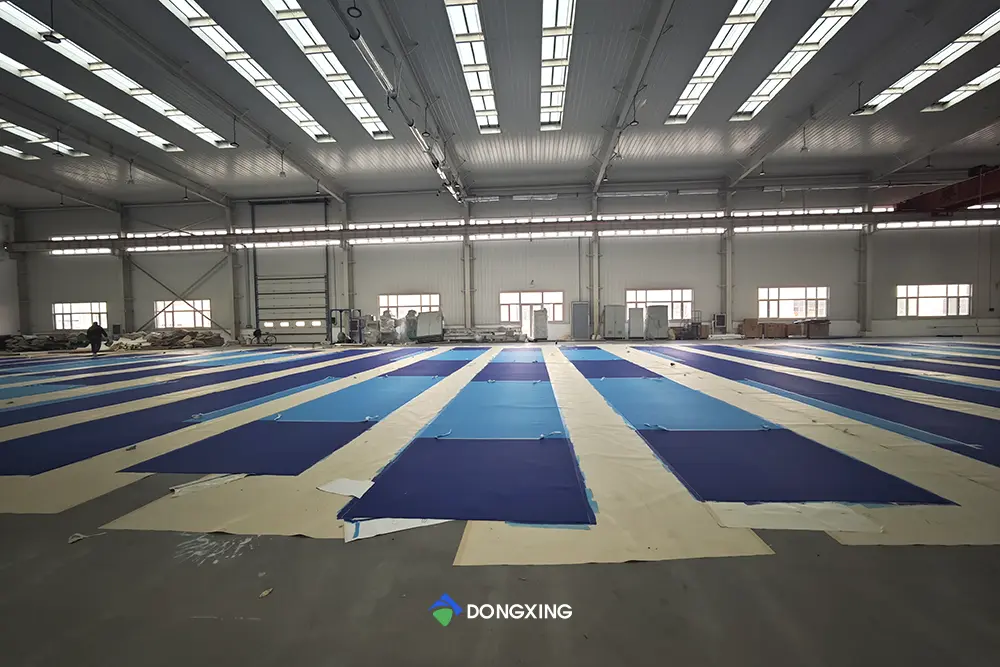
At Dongxing Plastic, every new coating formula undergoes 6+ months of lab and field validation on our specific PVC compounds to confirm long-term bond stability and plasticizer migration resistance.
Apply Proper PVC Surface Treatment
A clean, activated surface is the foundation of strong adhesion. Best practices include:
- Thorough surface cleaning to remove all processing oils and contaminants
- Controlled surface activation via corona or plasma treatment to raise PVC surface energy
- Selection of a compatible primer layer when required by the material system
- Consistent, monitored surface preparation parameters across every production run
There is no universal “best” treatment — the right process is always matched to the specific PVC and coating combination.
Maintain Consistent Coating and Curing Processes
Stable production delivers consistent performance. Manufacturers should:
- Maintain precise, uniform coating thickness across the full web width
- Control oven temperature profiles and line speed for complete curing
- Allow sufficient drying and curing time before winding or packaging
- Calibrate coating and curing equipment on a scheduled basis
- Perform regular adhesion testing on finished production rolls
Strict process control eliminates most preventable coating failure modes.
5. What Should Buyers Check Before Purchasing Acrylic Pickleball Court?
To avoid buying flooring that will peel prematurely, ask suppliers for specific evidence, not just general performance claims. Prioritize suppliers that can provide:
- Formal adhesion test reports (such as cross-cut or peel adhesion test data)
- Accelerated aging and sample testing results
- Photographs of known failure modes from testing
- Clear documentation of test methods and test conditions
In particular, evaluate the supplier’s capabilities in these four areas:
- Acrylic coating and PVC material compatibility
- Plasticizer migration control technology
- PVC surface treatment methods and validation
- Coating application and curing process control
Recommended Reading:
6. Frequently Asked Questions
Does plasticizer migration cause PVC flooring delamination?
Yes, it is a common long-term cause. Migrating plasticizers can contaminate the bond interface and gradually reduce adhesion. Confirmation requires inspection of the failure interface and material testing.
Can high temperatures cause acrylic coating to peel?
Heat alone rarely causes peeling directly. However, sustained high temperatures accelerate plasticizer migration, increase thermal stress, and amplify the effect of material mismatches, raising delamination risk over time.
How can manufacturers improve acrylic coating adhesion to PVC?
Key strategies include using PVC-optimized coating formulas, controlling plasticizer migration, applying proper surface activation, maintaining precise curing processes, and conducting regular adhesion quality testing.
Looking for Acrylic-Coated PVC Pickleball Court Flooring?
Whether you are a sports flooring distributor, importer, contractor, or pickleball court project developer, Dongxing Plastic can help you find suitable flooring solutions.
- Factory-direct supply
- Customized flooring specifications
- Product samples for evaluation
- Bulk order support
Request a free sample of our acrylic pickleball flooring!