
Not every pickleball facility requires a permanent court. Sports facilities often need to accommodate multiple sports—such as basketball and tennis—making permanent court installations unsuitable. This is particularly true for temporary events, seasonal sports, or spaces like warehouses and exhibition centers that require multi-functional versatility. Portable pickleball court flooring meets these specific needs perfectly. In this guide, we will cover product types, selection criteria, and performance characteristics to help you choose the right flooring for your requirements.
1. What Is Portable Pickleball Court Flooring?
Many people assume:
Portable pickleball court = portable net + court lines
However, in reality:
A portable net only defines the game boundaries, whereas portable flooring creates the actual playing surface.
1.1 Roll-Out Pickleball Flooring
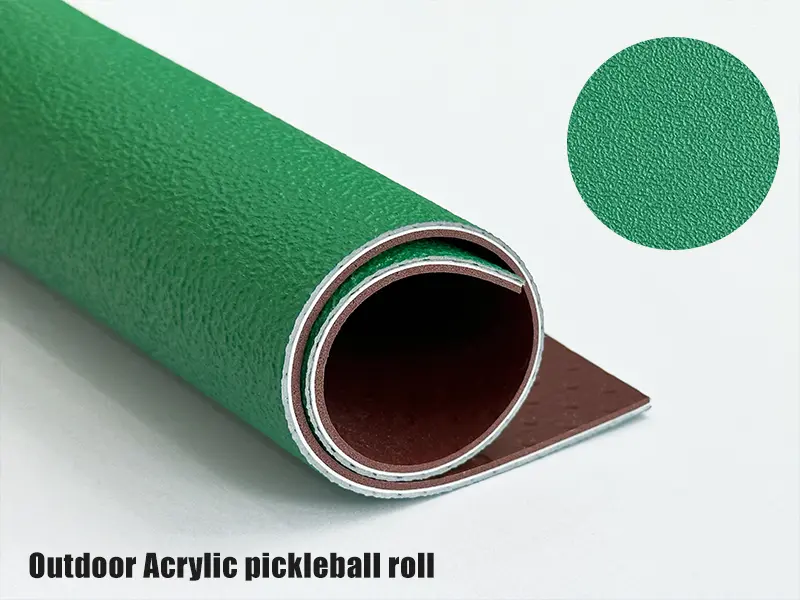
These floors—typically made of PVC or acrylic-coated PVC—feature a factory-integrated sports surface and standard court markings. They come in rolls that can be simply unrolled for use and rolled back up for storage. They offer a feel similar to traditional permanent sports flooring, featuring minimal seams and excellent flatness. Beyond standard color customization, the entire court surface can be customized with patterns and logos; this falls under our category of custom-printed pickleball flooring.
1.2 Interlocking Pickleball Court Tiles
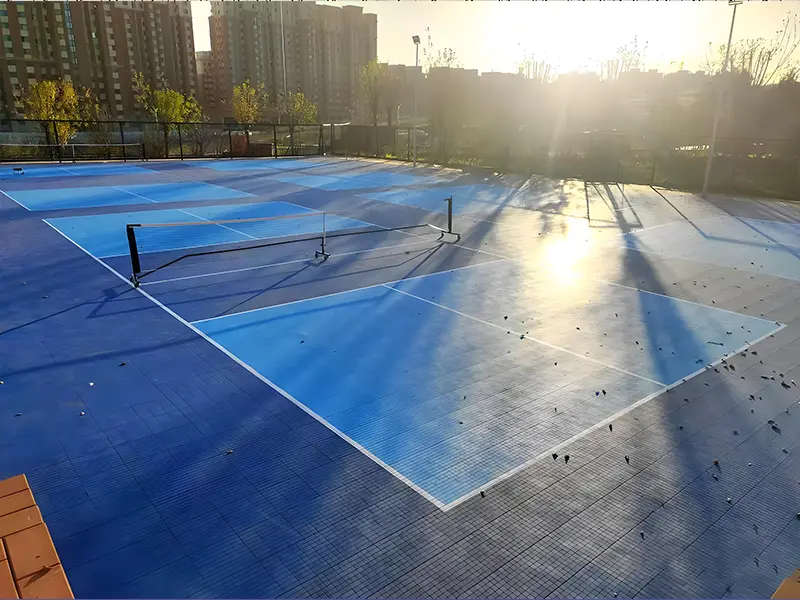
Made from PP (polypropylene) material, these tiles feature an interlocking installation system. They are ideal for outdoor venues, offering modular flexibility for DIY setups and installation on irregularly shaped sites. Highly weather-resistant and suitable for various climates, they are the top choice for temporary outdoor pickleball courts.
1.3 Temporary Court Surfaces
Another low-cost temporary solution involves using specialized sports tape or removable court marking lines to mark pickleball boundaries directly onto existing sports flooring.
It is important to note: These temporary marking solutions do not constitute “portable sports flooring” in the true sense. They only address the issue of court lines without providing a dedicated surface for athletic cushioning, rebound, slip resistance, or wear resistance; those performance factors rely entirely on the underlying floor.
2. Portable Pickleball Flooring vs. Permanent Pickleball Court Flooring
Buyers may have concerns: Does “portable” imply cheap, temporary, or poor ball rebound?
“Portable” does not necessarily mean low performance; rather, it signifies flexibility in installation and deployment. In terms of core athletic performance metrics—such as ball rebound rate, slip resistance, shock absorption, and wear resistance—these floors meet the standards of permanent courts.
Based on our past experience delivering pickleball projects, we have found that a key concern for buyers—beyond performance, which can be verified via samples—is installation precision. A standard pickleball court typically consists of five PVC rolls; ensuring the court lines align perfectly after seaming and installation is a critical test of a supplier’s quality.
| Feature | Portable Flooring | Permanent Court |
|---|---|---|
| Installation | Fast | Longer |
| Removal | Yes | No |
| Relocation | Yes | No |
| Existing floor | Can reuse | Usually new construction |
| Multi-purpose facility | Excellent | Limited |
| Events | Excellent | Poor |
| Initial construction | Lower | Higher |
| Long-term fixed facility | Good | Excellent |
| Storage | Required | None |
3. Where Can Portable Pickleball Court Flooring Be Used?
Portable Pickleball Courts for Indoor Gyms
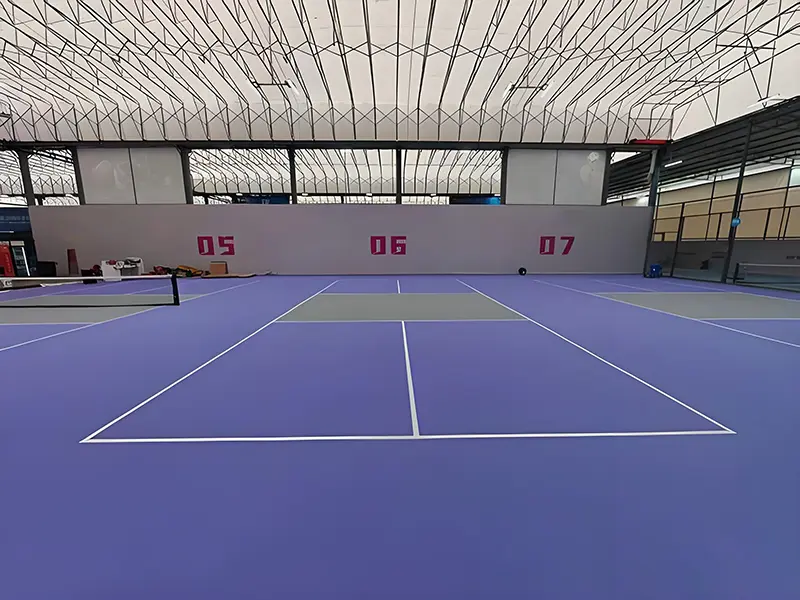
Indoor gymnasiums (especially in schools, YMCAs, and community centers) often face a shortage of court space. They must accommodate multiple sports—such as basketball, volleyball, badminton, and pickleball—simultaneously, making permanent flooring modifications for a single sport impractical.
Portable pickleball flooring allows a basketball court to be quickly converted into a pickleball court without damaging the existing gym floor or requiring permanent line markings. Once the activity concludes, the flooring can be packed away, restoring the space to its original state and perfectly resolving conflicts between different sports.
Temporary Pickleball Courts for Events
Suitable for scenarios such as pickleball tournaments, trade shows, corporate team-building events, festivals, exhibition center rentals, and brand activations. Multiple standard courts can be set up within hours; after the event, everything is packed up and removed, leaving the venue exactly as it was found.
Portable Pickleball Courts for Warehouses
Large, underutilized spaces—such as idle warehouses, industrial plants, or exhibition centers—can be rapidly transformed into professional sports venues using roll-out or interlocking pickleball flooring. This allows for the operation of sports clubs or the hosting of tournaments at a very low conversion cost, significantly boosting the utilization rate and commercial value of the space.
4. How to Choose Portable Pickleball Court Flooring
4.1 Indoor or Outdoor?
For indoor use, Vinyl sports flooring is the preferred choice; it offers a seamless feel underfoot, an excellent athletic experience, and is easy to clean as it attracts less dust.
For outdoor use, PP interlocking tiles are preferred; they are UV-resistant, feature drainage structures, and can withstand exposure to rain.
4.2 How Often Will the Court Be Moved?
If the court needs to be moved weekly or monthly, choose roll flooring or PP tiles that are moderately weighted and compact when stored. If the flooring will remain in place for more than six months, you might opt for a product with greater thickness and superior performance.
For one-off events, consider pickleball flooring that offers extensive custom printing options.
4.3 How Important Is Ball Rebound?
Consistent ball rebound is crucial—especially for outdoor suspended pickleball court tiles—as this is often where quality and performance differences become apparent.
4.4 How Much Storage Space Do You Have?
Rolled flooring forms a cylinder when stored, making it ideal for placement against a wall; interlocking tiles can be stacked, making them suitable for shelf storage.
4.5 How Many Courts Do You Need?
When setting up multiple courts simultaneously, interlocking tiles offer greater flexibility in assembly; for a single large-area court, rolled flooring results in fewer seams and a more seamless, unified appearance.
4.6 How Quickly Does the Court Need to Be Installed?
If installation must be completed within a few hours, rolled flooring requires time to relax and be secured, though it ultimately offers superior surface flatness.
5. How Much Does Portable Pickleball Court Flooring Cost?
Prices vary based on customization, specifications, and order volume, so there is no single standard rate. Costs are typically determined by the following factors:
- flooring material
- court size
number of courts - PP vs. PVC
- thickness
- surface structure
- drainage design
- court markings
- packaging
- shipping
- installation
- storage system
- customization
6. FAQ
Can portable pickleball flooring be used outdoors?
Interlocking tiles are UV-resistant, age-resistant, and feature built-in drainage, making them suitable for long-term outdoor use. PVC rolled flooring with a Acrylic coating and a specialized “Crystal Armor” (or similar) custom-printed wear layer can also be used outdoors.
Are PP interlocking tiles good for pickleball?
Yes, provided they offer the required ball rebound characteristics; this is the key factor in determining the suitability of PP modular sports flooring.
Can portable flooring provide consistent ball rebound?
Yes, professional-grade flooring that meets standards does so; you can request specific pickleball performance test reports and data on actual gameplay results from the supplier.
What is the best material for portable pickleball flooring?
It depends on your specific needs—such as indoor vs. outdoor use and frequency of play. Please contact our factory, and we can provide a solution tailored to your requirements.