
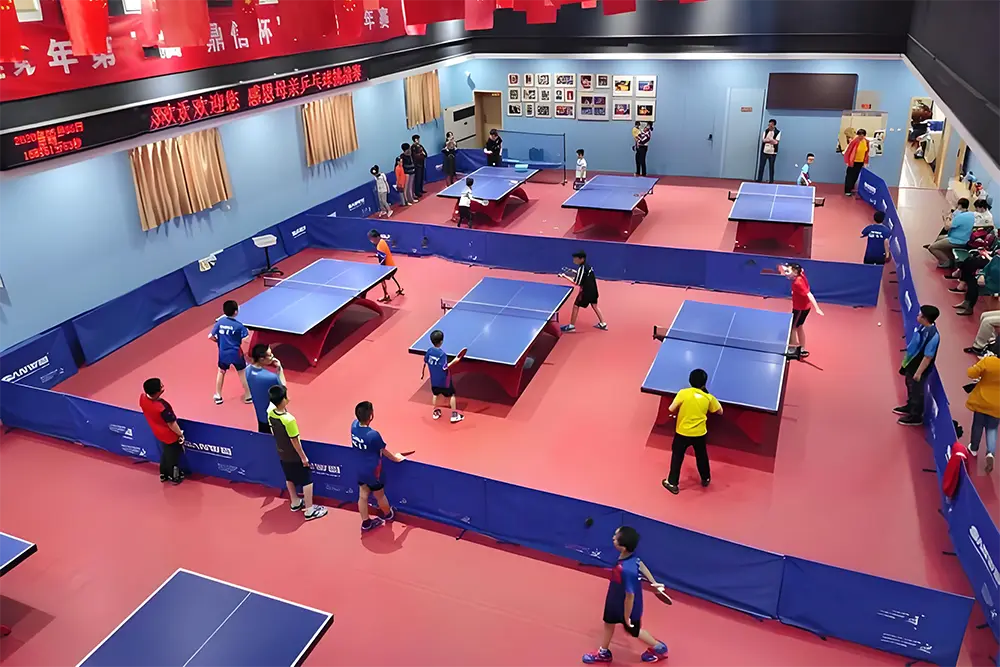
The performance requirements for table tennis flooring differ fundamentally from those of other ball sports like badminton, basketball, and pickleball. However, as a sports flooring supplier, we can confidently state that PVC flooring is the most suitable material. We will explain the differences between PVC flooring used in table tennis and other courts based on actual playing experience and the authoritative ITTF standards, making it easier to assess performance during purchase and ensuring long-term suitability.
1. Table Tennis Requirements for Sports Flooring
A standard table tennis ball dropped from a height of 30cm will bounce 23-26cm on the floor. The bounce height remains relatively consistent across the entire court.
Players make frequent, short-range movements and sudden stops during play. Therefore, the floor surface must have reliable anti-slip and wear-resistant properties, directly affecting the accuracy of players’ serves and returns.
Avoid overly soft cushioning; for example, the thickness of the PVC sports flooring foam layer should be reasonable and not excessively thick.
Double fiberglass layers are the best choice, as they effectively resist ground deformation and bulging caused by thermal expansion and contraction. If your flooring bulges, after ruling out installation issues, it’s likely due to substandard flooring material quality.
2. Do I need ITTF certification?
For most buyers, if your table tennis club hosts events and is a professional venue with long-term value—for example, if a table tennis venue collaborates with well-known media for promotion or is part of the International Olympic Committee (IOC) Young Leaders Program—then choosing ITTF flooring is highly recommended. However, if it’s just a regular club with low-frequency use in daily activities, it’s not necessarily required.
In our table tennis flooring solutions, we provide a detailed explanation of the ITTF standard.
3. Performance Analysis of Different Materials
Solid Wood Flooring:
Solid wood sports flooring (commonly maple, oak, etc.) has good natural elasticity and moderate surface hardness. It has high impact absorption (≥53%), vertical deformation is generally 1–2mm, effectively reducing shock, and good ball rebound consistency (rebound rate ≥90%). The dry friction coefficient can be controlled between 0.4 and 0.7.
Disadvantages include high cost, complex construction (requiring a joist), sensitivity to humidity, and high maintenance costs. It is suitable for international competitions and professional venues.
PU Resilient Flooring:
PU flooring is generally made by applying a polyurethane (silicone PU) surface layer to a concrete or cement base, with a total thickness of approximately 9–11 mm. It has better elasticity than wood flooring, strong impact absorption, and good protection for athletes’ joints, but ball rebound is less than solid wood. The friction coefficient is adjustable (generally ≥0.5), and the surface layer has good wear resistance and weather resistance. Silicone PU can be colored and is aesthetically pleasing, but the coating requires strict waterproofing. Construction is convenient (multi-layer roller coating), but it requires a high degree of dryness of the substrate. It is commonly used in multi-functional gymnasiums, outdoor hard courts (basketball, volleyball, etc.), and fitness centers. Its disadvantages include slightly lower heat resistance and the need for regular topcoat renovation. It is typically lightweight and easy to remove.
PVC Resilient Flooring
100% PVC material, blended with plasticizers, etc., with a wear-resistant coating and anti-slip texture on the surface. Overall thickness 4.5–10mm, including surface UV wear-resistant layer, printed layer, wear-resistant layer, foam layer (for enhanced cushioning), etc.
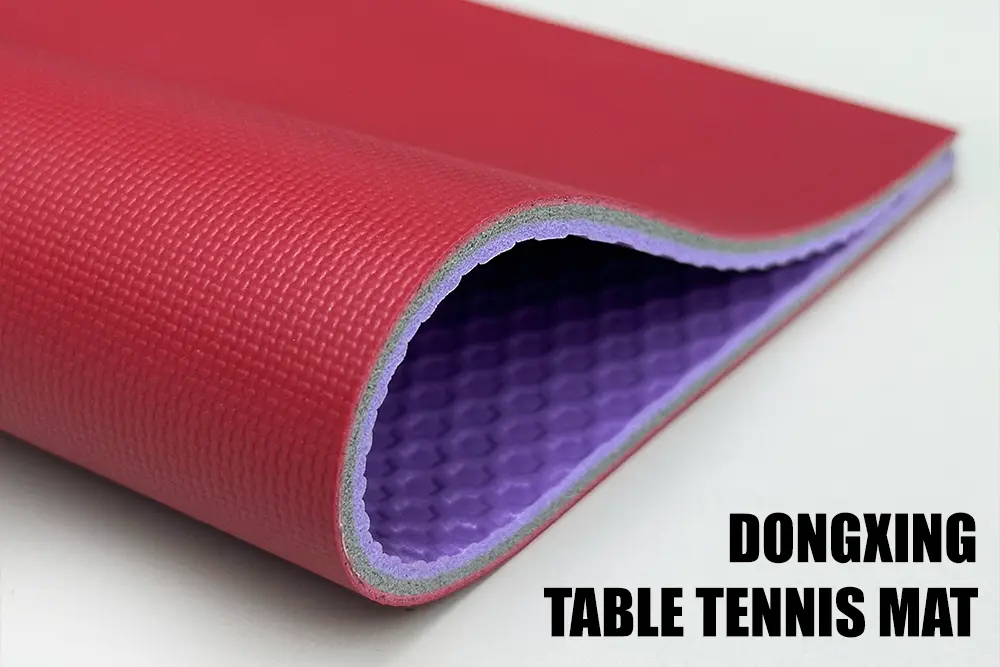
Different formulations and processes affect performance:
More plasticizers result in better elasticity but lower strength;
More fillers result in lower cost but greater rigidity;
Stabilizers and antioxidants ensure aging resistance; UV absorbers improve UV resistance;
Fiberglass mesh reinforcement prevents tensile deformation.
Extrusion, calendering, and other processes can produce rolls or sheets.
Foaming processes are used to form the underlying cushioning foam.
Surface treatments such as frosted texture and logo printing are both aesthetically pleasing and increase slip resistance.
Features:
High comfort, good vibration absorption, wear and stain resistance, excellent weather resistance. Its moderate coefficient of friction prevents balls from rolling for extended periods, which is beneficial for table tennis; and it is environmentally friendly and controllable (meets low VOCs requirements). Compared to wood flooring, PVC flooring boasts superior durability and abrasion resistance.
Rubber Flooring
Rubber (natural rubber or EPDM, SBR granules) flooring is typically 5-10mm thick and has a high density. It exhibits extremely high elasticity and impact absorption, absorbing almost all impact force; its coefficient of friction is also very high (providing excellent anti-slip properties). However, its disadvantage is extremely poor ball rebound; a ping-pong ball landing on a rubber surface does not bounce easily and has a slow reaction time, therefore it is generally not used in formal competition venues. Rubber flooring is abrasion-resistant and has excellent anti-aging properties (suitable for high-frequency use), commonly found in gyms, weightlifting areas, and playgrounds. Installation is done via adhesive tape or interlocking blocks, and maintenance is simple (easy to clean and can be completely renovated).
4. Selection Recommendations
PVC is the best choice. For outdoor recreational areas, PP tiles can be used, which are not only cheaper to purchase and install but also easier to maintain.