
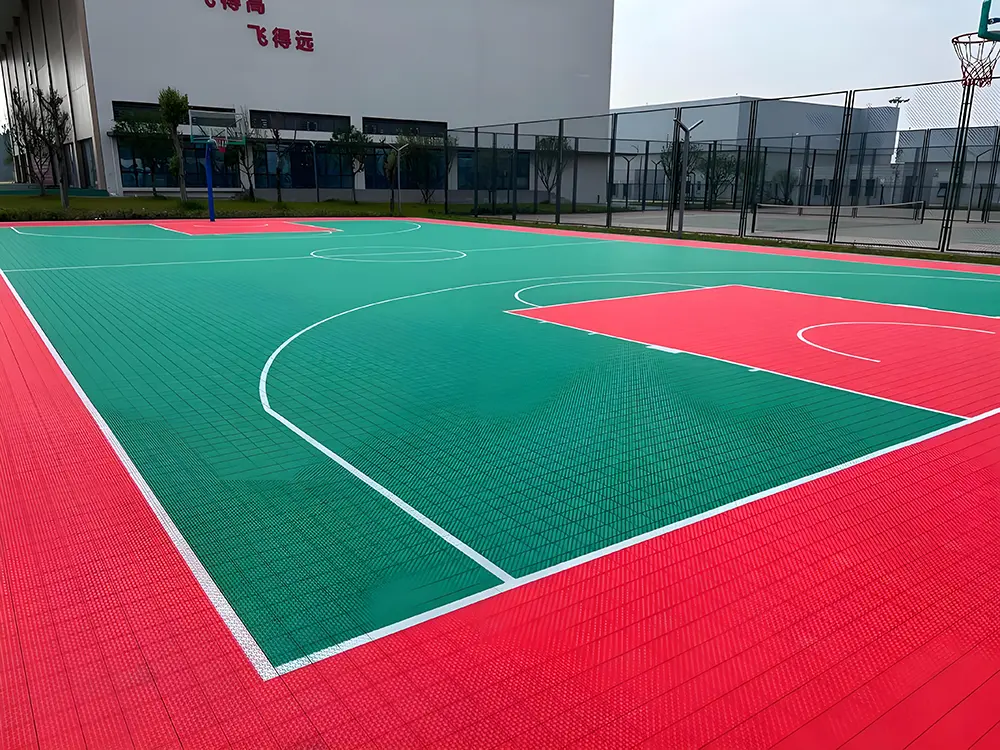
If you’re looking to build a professional outdoor basketball court, where high temperatures and extreme temperatures don’t affect the surface, and you can customize different sizes without worrying about water accumulation, then basketball court modular floor tiles are ideal. Made of durable and wear-resistant PP plastic, they have low requirements for the underlying surface. Therefore, if you’re unsure whether your court’s foundation can support this type of tile installation, this article will be very helpful.
1. Suitable Underlying Surface Types
Concrete, Cement
The most mainstream and suitable subfloor for basketball courts worldwide, both indoors and outdoors. Its high flatness perfectly matches the mechanical properties of the flooring, allowing for the installation of professional sports wood flooring or PVC flooring.
Asphalt, Asphalt Surfaces
For renovations of existing asphalt surfaces in residential areas, parks, and municipal facilities, modular sports flooring can improve shock absorption and cushioning. Before installation, remove damaged or protruding asphalt areas and repair and level them with cold-applied patching material. Install limiting strips around the perimeter of the court, allowing for thermal expansion and contraction.
Gravel and Sand Floors
Gravel needs to be compacted and leveled, followed by the laying of a layer of ≥200g/㎡ two-way geotextile. This prevents sharp gravel from damaging the floor’s support base and avoids soil clogging the floor. For long-term use, our type with a cushioning pad can be selected. PP tiles can also be laid on this type of base.
Natural Lawn and Artificial Turf
Natural lawn needs to be mowed to a height of ≤30mm, thoroughly removing weeds and stones. It should be rolled flat with a lawn compactor, ensuring no obvious pits or water accumulation areas.
Artificial turf is filled with quartz sand and rubber granules, swept and compacted, ensuring a surface without bumps or depressions, no curling or hollow areas, and no cracks at the joints.
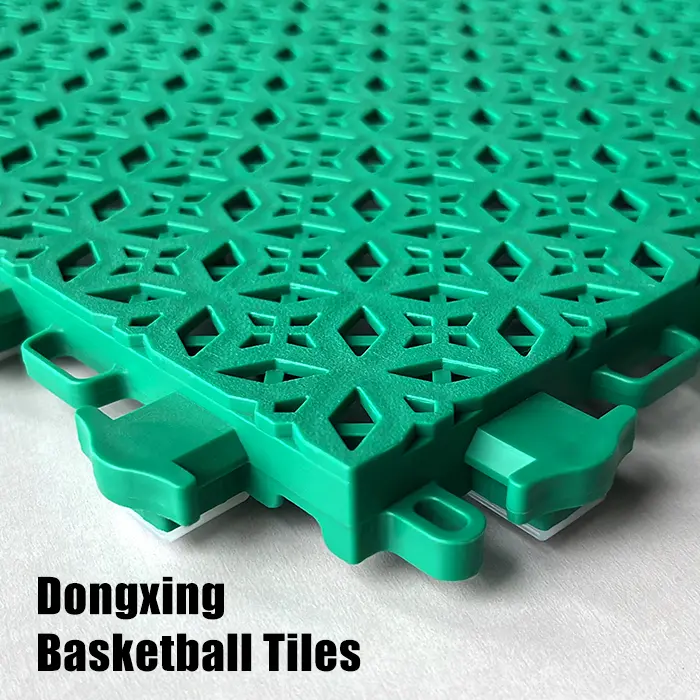
Because basketball court tiles have a suspended design, with a certain height of open space between the bottom support and the upper surface, even with a grass base, as long as it is properly prepared, the grass should not be too high, and a certain degree of flatness is maintained, it can be laid on this base. It’s important to note that natural grass grows over time, so it’s best to treat it with herbicides beforehand to prevent it from growing too tall and compromising the stability of the sports floor.
Tile and marble floors
basketball flooring tiles can be laid directly. In areas with large gaps between tiles, masking tape can be applied to the underside of the flooring to prevent uneven stress on the locking system. This type of base layer is commonly used in underground parking garages, old factories, and office buildings converted into basketball courts.
Epoxy flooring
A highly adaptable base layer for factories, workshops, old stadiums, and parking lot renovations. Existing flooring does not need to be removed or treated; it can be laid directly without affecting subsequent site restoration. It is important to note that PP interlocking flooring has pre-drilled holes for nail fixing. Drilling holes in the floor for anchoring is strictly prohibited to avoid damaging the waterproofing and anti-static properties of the flooring. Only securing it with retaining strips around the perimeter of the court is necessary.
2. Surfaces unsuitable for basketball court tiles
Loose subfloors that have not been compacted are prone to settlement and collapse, leading to broken interlocking mechanisms, surface deformation, and uneven surfaces.
Swamps, low-lying wetlands, and areas with year-round water accumulation will cause the flooring to be constantly submerged, rendering it unusable.
Sloping surfaces with a gradient greater than 1% will cause players to shift their center of gravity, slip, and get injured. The flooring will also continue to slide under gravity, causing interlocking mechanisms to detach and the entire court to deform.
Surfaces containing sharp debris such as rebar, gravel, or glass can puncture the bottom of the flooring, severely affecting the flatness of the court.
Proximity to boilers, high-temperature furnaces, and open flame operations, where the ambient temperature consistently exceeds 80℃, can cause the flooring to deform and melt. Furthermore, PP material is flammable, posing a serious fire hazard.
3. Summary and Recommendations
As a manufacturer of interlocking sports flooring, we offer installation guidance services. When using this flooring material, we can customize products to meet your specific requirements, such as court dimensions and color. While interlocking flooring has lower requirements for the ground surface, it’s still essential to ensure the flatness and slope of the base. Choosing products with interlocking links that are less prone to loosening will improve lifespan and the overall stability of the court surface.