
As the fastest-growing ball sport globally, the demand for pickleball court construction continues to surge in 2026—from private backyards and community public courts to commercial chain stadiums and professional competition bases. The choice of court materials directly determines the player’s experience, joint safety, competitive fairness, and even the construction cost.
1. Why is the choice of pickleball court materials so important?
Unlike established ball sports such as tennis and badminton, pickleball incorporates unique characteristics such as “short-distance high-frequency footwork, rapid lateral changes of direction, low center of gravity volleys, and continuous small jumps.” Furthermore, its core player base spans all age groups, with a very high proportion of middle-aged and elderly enthusiasts, placing higher demands on court safety, ball rebound, and performance stability.
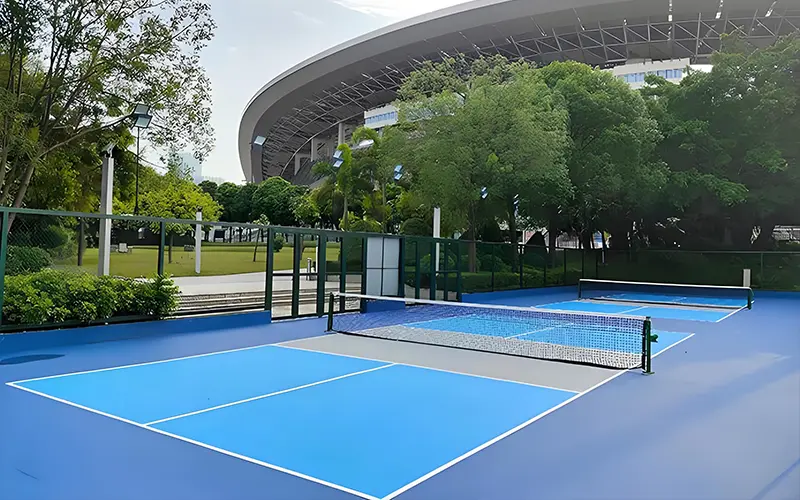
Therefore, choosing the right materials directly impacts:
Player Safety:
Inadequate materials either lack sufficient friction, leading to slips and ankle sprains, or have excessively deep textures that trap shoes and cause falls; Overly hard surfaces lack cushioning, causing players to experience 3-5 times their body weight in impact force upon landing.
Ensuring Fair Play:
Playing with short balls and net shots, often outside the volley zone, demands extremely high consistency in ball bounce height and trajectory.
A bounce error exceeding 10% makes it difficult for players to accurately predict the ball’s trajectory, directly affecting their experience.
Maintenance Costs:
The lifespan of different materials can vary by more than three times. Modular interlocking flooring has virtually zero maintenance costs, while ordinary acrylic coatings require complete recoating every 5-8 years, and repairing cracked concrete bases is extremely costly.
Adaptability to Complex Indoor and Outdoor Scenarios:
Outdoor pickleball court materials should be resistant to UV exposure, rain immersion, and high/low temperature deformation.
Indoor courts need to balance sound insulation, foot comfort, and wear resistance.
Different materials have vastly different suitability for different scenarios, and blindly selecting materials can lead to mismatches in usage requirements.
2. Core Performance Requirements of Pickleball Courts
A common misconception in pickleball court construction is directly applying the performance standards of tennis and badminton courts to pickleballs. While similar to tennis, both require the floor to have ball rebound properties, there are differences.
The 2026 USAPA official manual clearly defines six key performance requirements for professional pickleball courts:
- Ball rebound rate: 85%-95%, overall rebound error ≤3%.
- A pickleball dropped from a height of 1.83 meters will bounce 76.2-83.8 cm on a rigid surface
- Sliding friction coefficient: Dry state 0.60-0.75, wet state ≥0.55
- Impact absorption rate: 15%-30%
- Vertical deformation: 0.5mm-2.5mm
- Rolling load: ≥1500NWeather resistance (outdoor): Color difference ΔE≤1.5 after 1000 hours of UV aging test, temperature range -30℃~70℃.
In addition, professional pickleball court materials must meet basic requirements such as environmental protection, low VOC release, stain resistance, and easy cleaning. For school and public community venues, additional compliance with the corresponding national environmental safety standards for sports fields is required.
3. Mainstream Pickleball Court Materials in 2026
Outdoor Acrylic Pickleball Flooring Material System
This is a new composite structural material solution for 2026, and also the solution recommended by Dongxing Sports Flooring Manufacturer for pickleball. It combines the cushioning and shock absorption of PVC flooring with the outdoor weather resistance of acrylic coating, making it the top choice for outdoor use.
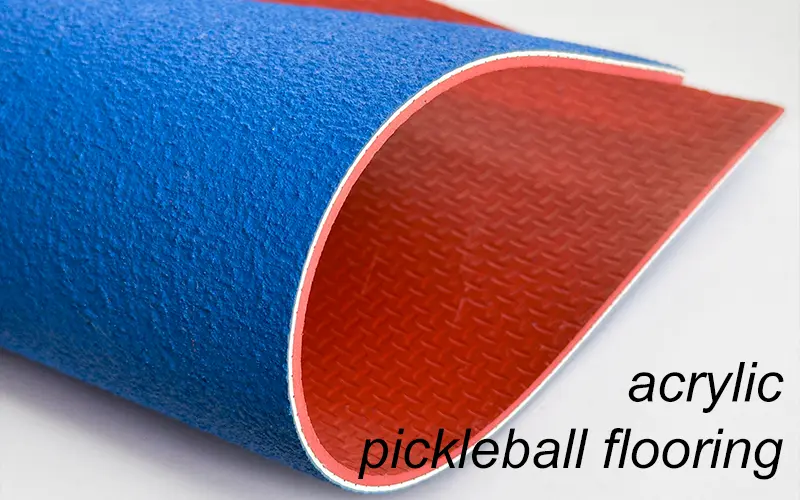
Structurally, it employs a multi-layered composite structure: a 4.5-6.0mm modified PVC dense base layer + a fiberglass stabilizing layer + a 0.5-1.0mm acrylic wear-resistant sealant layer. The acrylic layer incorporates high-concentration anti-UV additives and anti-slip quartz sand, while the PVC base layer undergoes moisture-proof and mildew-resistant modification treatment.
Advantages: Ball rebound rate and coefficient of friction meet sports requirements; its wear and weather resistance are outstanding.
Disadvantages: The cushioning effect is not as good as 100% PVC sports flooring.
Indoor PVC Flooring Material
Indoor PVC pickleball court flooring is currently the dominant material in indoor sports halls and is our core product. Through a multi-layered composite structure, it precisely matches the indoor sports needs of pickleball, allowing for unique court effects tailored to the venue’s décor, with customizable patterns and colors.
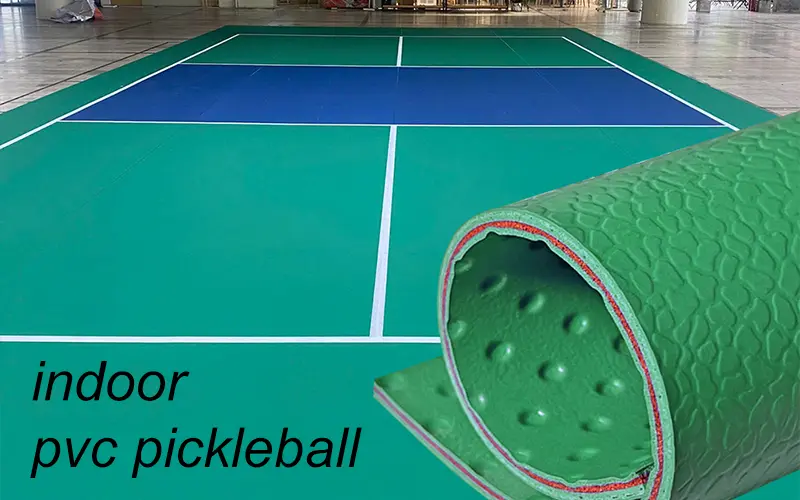
This product utilizes a multi-layer composite roll structure consisting of a 0.8-1.2mm pickleball-specific wear-resistant layer, a fiberglass stabilizing layer, a semi-dense, semi-foamed layer, and an anti-slip adhesive layer. The total thickness is 3.0mm or 3.5mm. The surface features a stone-patterned pickleball-specific anti-slip texture, and the texture depth can be customized.
Advantages: Excellent noise reduction; the foamed cushioning effectively absorbs sports noise; the dense structure balances wear resistance, anti-slip properties, and ball rebound performance. Installation methods include partial application of adhesive, full application, and direct laying.
Disadvantages: Wear resistance and weather resistance are not as good as acrylic, but a PUR layer can be added for outdoor use.
Modular Interlocking Floor Tiles
(Modified PP Interlocking Tiles) is integrally injection molded with an industrial-grade precision interlocking structure. The bottom features a composite design of hollowed-out drainage channels and elastic support columns.
Easy installation without glue; two people can complete the installation of a standard pickleball court in half a day. Excellent outdoor weather resistance, able to withstand extreme temperatures from -30℃ to 70℃, and will not fade or become brittle after 5-8 years of outdoor exposure. The perforated drainage structure forms a comprehensive drainage network, allowing rainwater to quickly infiltrate and flow away. Maintenance and procurement costs are extremely low.
The disadvantage is that the ball’s rebound is not as good as PVC and acrylic, making it suitable for temporary and recreational pickleball courts.
Polyurethane (PU) Sports Flooring
Polyurethane flooring is divided into two main categories: water-based silicone PU and cushioning polyurethane. It is a classic solution for high-end competition venues and professional training bases. In 2026, it was upgraded to an environmentally friendly water-based formula, adapting to more stringent environmental requirements. It is laid in multiple layers on-site, with a structure of “primer sealing layer + elastic rubber cushioning layer + polyurethane wear-resistant surface layer + marking layer,” with a total thickness of 3-8mm. The thickness of the elastic layer can be adjusted according to needs to customize cushioning performance.
The elastic layer thickness is adjustable, and the impact absorption rate and ball rebound rate can be precisely matched to the USAPA top-level competition standards, providing a comfortable feel and excellent cushioning and knee protection, suitable for the high-intensity training of professional players; however, the initial procurement and construction costs are high, making it the most expensive category of all materials; it has extremely high requirements for the flatness and strength of the base layer, and the construction cycle is long; later local damage repair is difficult, color difference is prone to occur, and the entire topcoat needs to be recoated every 5-8 years.
4. Indoor and Outdoor Pickleball Court Flooring Selection Guide
Core requirements for indoor courts: quietness, cushioning and knee protection, accurate ball rebound, wear resistance and durability
The first choice is PVC roll flooring, perfectly suited to the needs of commercial stadiums, school gymnasiums, and professional training bases;
Second choice: High-end cushioned polyurethane flooring, suitable for professional training bases and international competition-level indoor venues;
Supplementary for temporary scenarios: Modular interlocking flooring, suitable for temporary indoor events and quick construction of old venues without modification, not recommended for long-term fixed and high-frequency use.
Outdoor Pickleball Courts:
The preferred choice is outdoor acrylic pickleball flooring, suitable for outdoor commercial stadiums and professional competition venues, offering top-notch performance while maintaining weather resistance and a superior athletic experience.
Secondary choice: Water-based silicone PU polyurethane flooring, suitable for high-end outdoor competition venues and flagship commercial stadiums.
5. FAQ
What is the best material for a pickleball court?
There is no absolutely “best” material, only the most suitable solution for the scenario. For indoor use, PVC sports flooring is preferred. For outdoor use, choose acrylic or PP tiles depending on your budget; acrylic offers better sports performance.
Can interlocking pickleball tiles be used indoors?
Yes, but it’s not the optimal choice for long-term, fixed indoor courts. Interlocking flooring is easy to install, removable, and reusable, suitable for temporary indoor events and quick setup of older venues without modification. However, for indoor venues with long-term, high-frequency use, PVC roll flooring is the preferred choice, offering seamless splicing, better sound insulation, and a more comfortable feel underfoot, better suited to the needs of high-frequency indoor use.
What is the most durable outdoor pickleball court material?
The most durable outdoor materials are acrylic-coated PVC flooring and modified PP modular interlocking flooring. Both have a normal service life of 8-12 years and can withstand UV exposure, rain erosion, and changes in high and low temperatures.