
If you’re looking to create a professional dance studio for commercial dance training or performances, the choice of flooring directly impacts dancer safety, movement, injury risk, overall experience, and even your revenue. Industry statistics show that 68% of chronic dance injuries are related to substandard flooring materials or improper installation. However, 72% of home and casual dance studios prioritize cost and aesthetics over key performance aspects. We provide a comprehensive overview of mainstream dance flooring materials, offering solutions that better meet your needs and a complete selection guide.
1. Focus on Dance Flooring Performance
Shock Absorption (Cushioning): The floor’s ability to absorb the impact of jumps and landings reduces stress on dancers’ joints. Professional dance floors need at least 30% shock absorption, and for high-jump dance styles, 40-55% is ideal. Cushioning and landing feedback are directly transmitted to the dancer’s body, making this crucial for high-frequency use. However, higher cushioning isn’t always better. In professional dance, excessive cushioning can affect movement precision. Therefore, a balance between movement and dancer safety is essential.
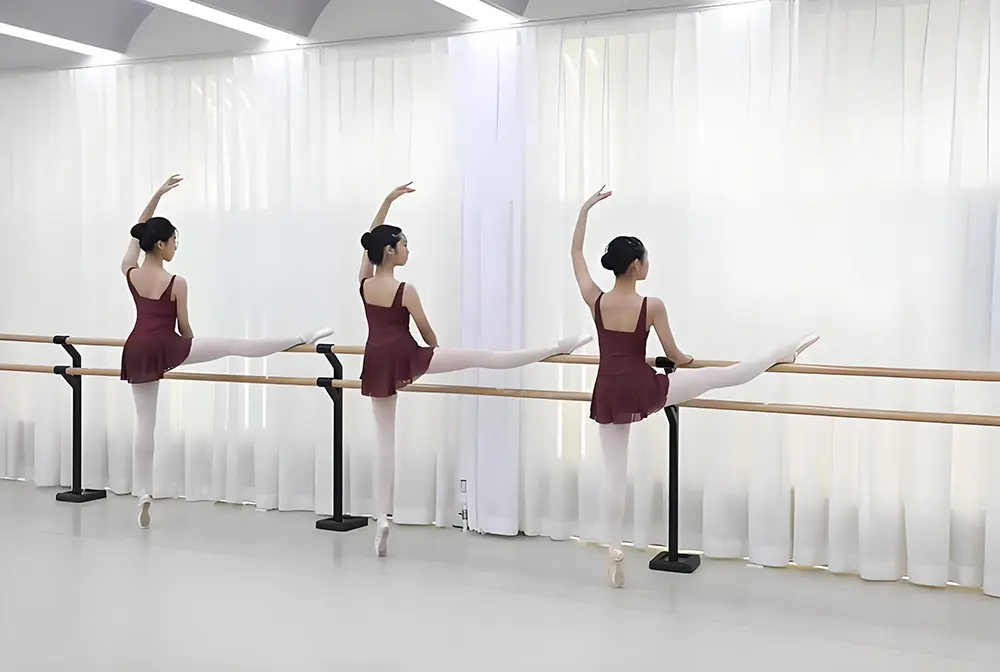
Coefficient of Friction
DIN standards specify an optimal friction absorption range of 0.4-0.6 for dance applications. This provides dancers with good power generation during rotations, jumps, and various movement steps.
Tactile Feedback
The floor returns energy to the dancer after compression, reducing fatigue from long rehearsals. EN 14904 requires professional dance floors to have an energy rebound rate of at least 30% to ensure sensitive feedback for dynamic movements.
Dimensional Stability
The floor resists thermal expansion and contraction caused by temperature and humidity changes, preventing bulging and warping.
Noise Reduction
Dance studios in homes and residential spaces should provide good noise reduction.
Surface Finish
Must be matte or semi-matte (non-reflective) to avoid glare from dance studio lighting. Typically, black, gray, and off-white are the main colors.
2. Mainstream Dance Flooring Materials
2.1 High-Density Vinyl Dance Flooring
Commercial vinyl materials have become the choice of 90% of professional commercial dance studios worldwide. They fully meet the above performance requirements. This composite flooring consists of a PUR wear-resistant layer, a printed layer, a fiberglass layer, and a high-density solid PVC core. This structure allows for high customization, enabling precise matching to different dance scenarios and balancing performance and cost through structural adjustments.
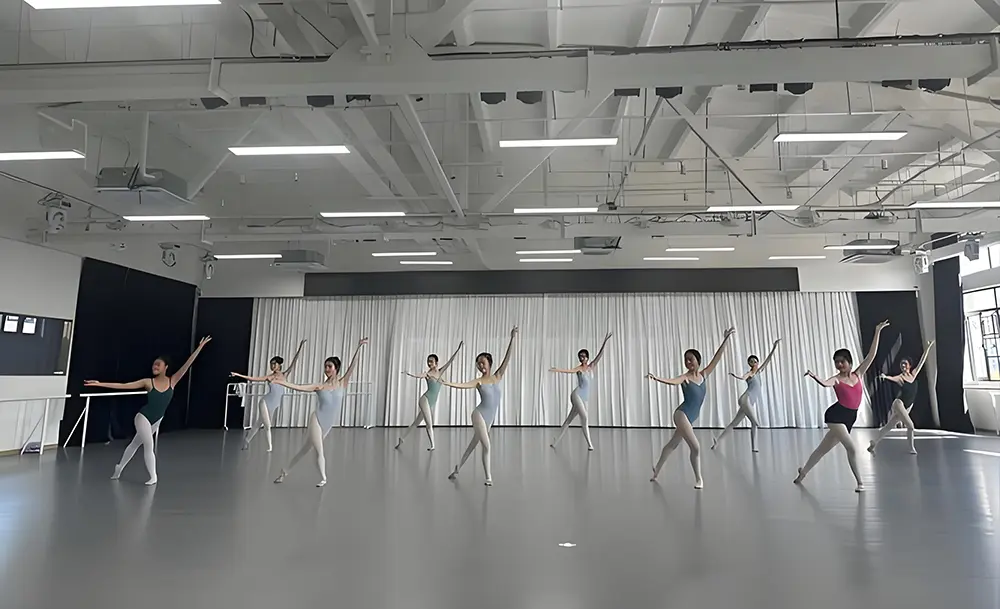
Common thicknesses: 1.5 mm, 2.0 mm, 3.0 mm.
It takes up virtually no floor space. Installation involves applying adhesive and welding the roll seams, making maintenance very simple.
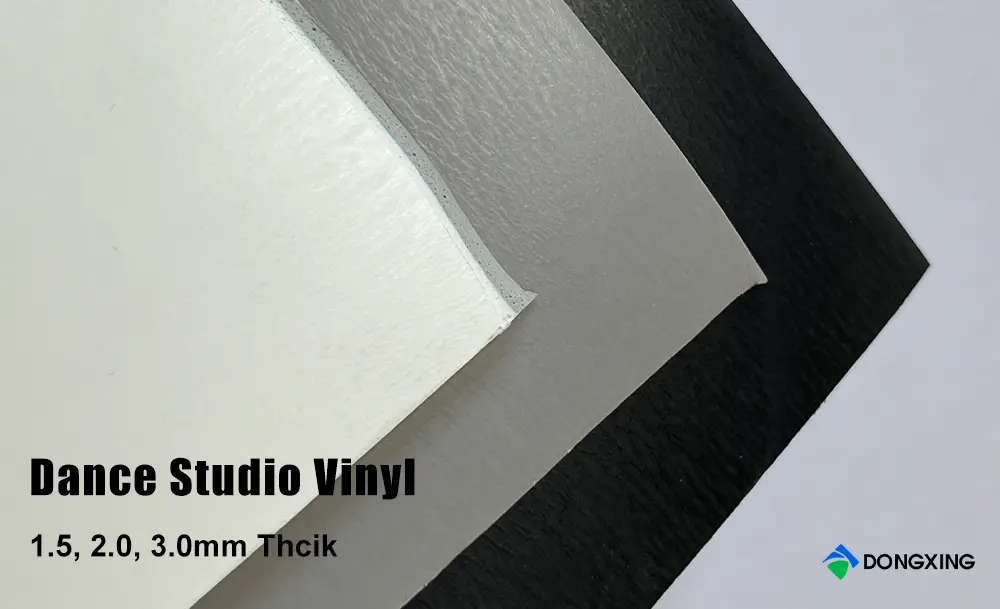
The biggest misconception about choosing vinyl flooring is that “the thicker the better” or “the more foam layers for cushioning, the better.” In reality, each thickness and structure is designed for different dance styles. For more information on this material, please refer to our vinyl dance flooring section.
In terms of price, it is significantly cheaper than solid wood flooring and can meet the needs of all dance studios and types. However, for highly professional and high-end dance performances, solid wood flooring might be more suitable. This is the key to choosing the right material.
2.2 Hardwood Dance Flooring
Wooden dance floors have long been the industry standard for professional ballet, tap, and ballroom dancing because the natural elasticity, stable energy rebound, and timeless beauty of solid wood are irreplaceable by vinyl sheet flooring. However, not all wood flooring is suitable for dance; wood flooring for home decoration is not ideal, while sports wood flooring is a better match.
Solid wood dance flooring refers more to a complete elastic system, using 20-25 mm thick North American hard maple or European beech wood, installed on a matching subfloor. This elastic system consists of treated wooden joists, rubber shock-absorbing pads spaced 300 mm apart, and a plywood subfloor, providing 40-60% shock absorption while maintaining rigid lateral stability.
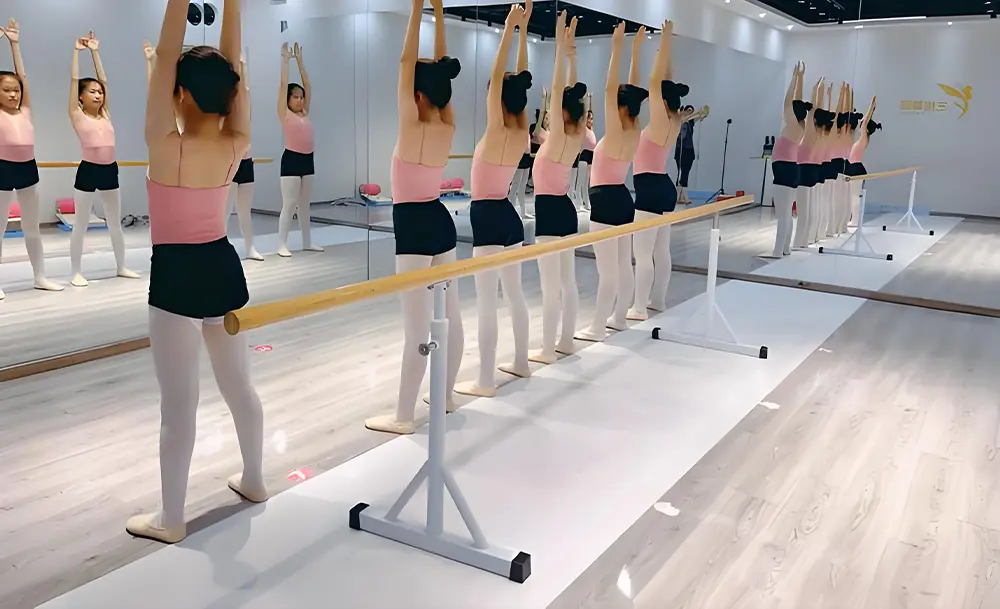
Limitations of Choosing Wood Flooring
High initial investment costs; a complete elastic solid wood flooring system costs 2-4 times more than high-quality high-density PVC vinyl flooring. Therefore, if the budget is limited and it’s not for high-end dance applications, it may not be suitable.
Furthermore, the installation and maintenance requirements are extremely high: wood flooring needs annual waxing and quarterly deep cleaning. Installation requires layer-by-layer laying and is difficult to move, making it less than ideal for short-term rentals of dance studios or temporary performance venues.
Additionally, wood flooring requires stable indoor humidity and temperature control to prevent warping, cracking, or squeaking.
Which dance types are suitable for wood flooring?
Professional ballet and pointe work
Tap, flamenco, and Irish tap dance
Social dance and competitive Latin dance
Professional modern dance and contemporary dance companies
3. Choosing Your Best Dance Floor
- Determine your primary dance style
- Assess your venue and rental period
- Develop a reasonable budget (including installation and maintenance)
- Prioritize safety and dancer experience (performance requirements)
- When choosing colors, focus on functionality rather than aesthetics.
In summary
As a manufacturer of commercial vinyl flooring, we have ample experience and reason to recommend the most suitable dance surface material. We have dozens of application cases in Europe, America, and the Asia-Pacific region. If you have difficulty choosing materials, please feel free to contact us.