
In commercial spaces, whether for medical or public spaces, vinyl flooring is one of the most popular choices, widely used in hospitals, educational institutions, offices, and sports venues. Structurally, it can be divided into two types: heterogeneous and homogeneous. Each type offers different performance characteristics. Choosing the right structural type for your specific application not only provides good strength but also balances procurement costs. An incorrect choice can not only increase the budget but also potentially pose safety hazards.
1. Structural Definitions
1.1 Homogeneous Vinyl Flooring
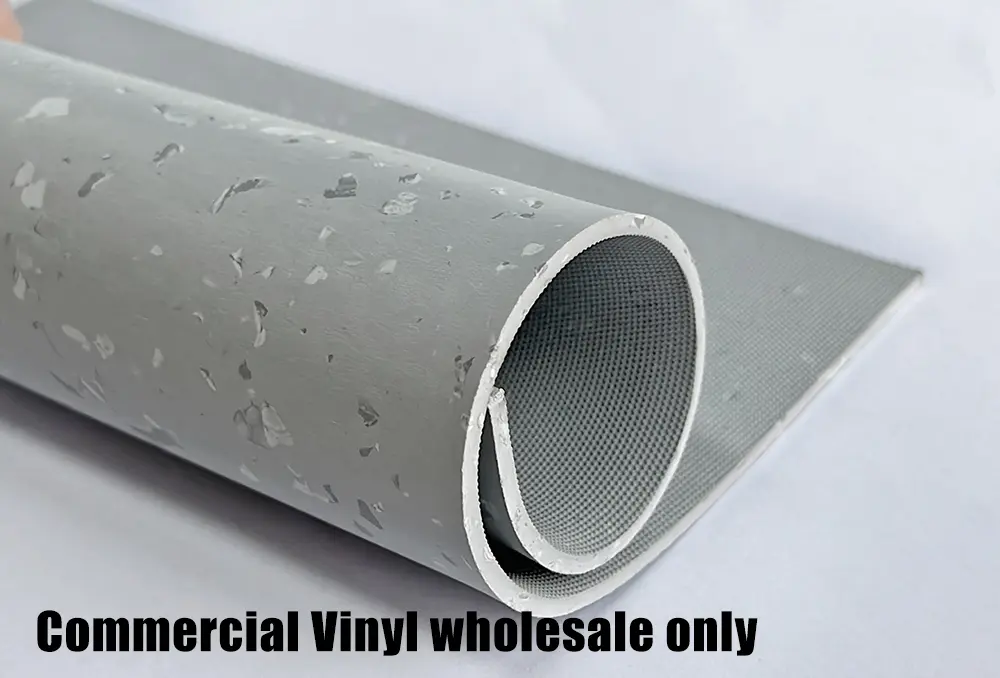
Also known as “homogeneous through-grain,” its characteristic is that the material, color, and texture are completely consistent from the surface to the core. The entire cross-section has the same structure. This means it doesn’t suffer from surface wear affecting its usability, thus possessing strong wear resistance.
1.2 Heterogeneous Vinyl Flooring
A multi-layered composite structure, typically composed of 5-6 layers of materials with different functions, laminated together, resembling a “wafer biscuit.”
The standard structure, from top to bottom, is as follows:
- UV Protective Layer: Stain resistance and abrasion resistance
- Abrasion-resistant Layer: Determines lifespan (0.15-0.8mm)
- Printed Layer: Wood grain, stone grain, and other patterns
- Fiberglass Layer: Prevents floor shrinkage and deformation
- Foamed/Dense Layer: Provides elasticity and a comfortable feel underfoot
- Adhesive Backing Layer: Facilitates installation
2. Performance Comparison
| Dimension | Homogeneous | Heterogeneous |
|---|---|---|
| Abrasion Resistance | Ultra-high abrasion resistance, consistent throughout the full thickness; can be sanded and refinished 1-2 times | Surface wear-resistant, depends on the wear layer thickness; cannot be sanded |
| Scratch Resistance | Moderate, scratches are not obvious | Excellent, but scratches penetrating the wear layer cannot be repaired |
| Chemical Resistance | Excellent, resistant to acid and alkali reagents with pH 3-12 | Good, but strong chemicals may penetrate and damage the base layer |
| Antibacterial Performance | Excellent, dense seamless structure inhibits bacterial growth; can be integrated with silver ion antibacterial technology | Good, with surface antibacterial treatment, but seams are prone to dirt accumulation |
| Installation | Supports hot welding, forming a completely seamless monolithic floor | Supports hot welding, but the welding strength of multi-layer structure is slightly lower |
| Elasticity & Shock Absorption | Moderate, high hardness; shock absorption rate approx. 20-30% | Excellent, shock absorption rate up to 40-50%; more comfortable foot feel |
| Acoustic Performance | Average, noise reduction approx. 8-12dB | Excellent, noise reduction up to 15-20dB; effectively reduces walking and equipment noise |
| Dimensional Stability | Excellent, uniform upper and lower structure, consistent thermal expansion and contraction | Good, but multi-layer structure has different thermal expansion rates, which may cause edge warping |
| Indentation Resistance | Excellent, residual indentation ≤ 0.1mm | Average (with foam layer); residual indentation ≤ 0.3mm |
| Design Versatility | Limited, mainly solid colors or simple speckled textures | Unlimited, can print any pattern; highly realistic wood grain, stone grain, carpet grain |
| Initial Cost | Relatively expensive | Moderate |
| Life Cycle Cost | Long service life | Moderate service life |
3. Practical Cases
3.1 Hospital Sector
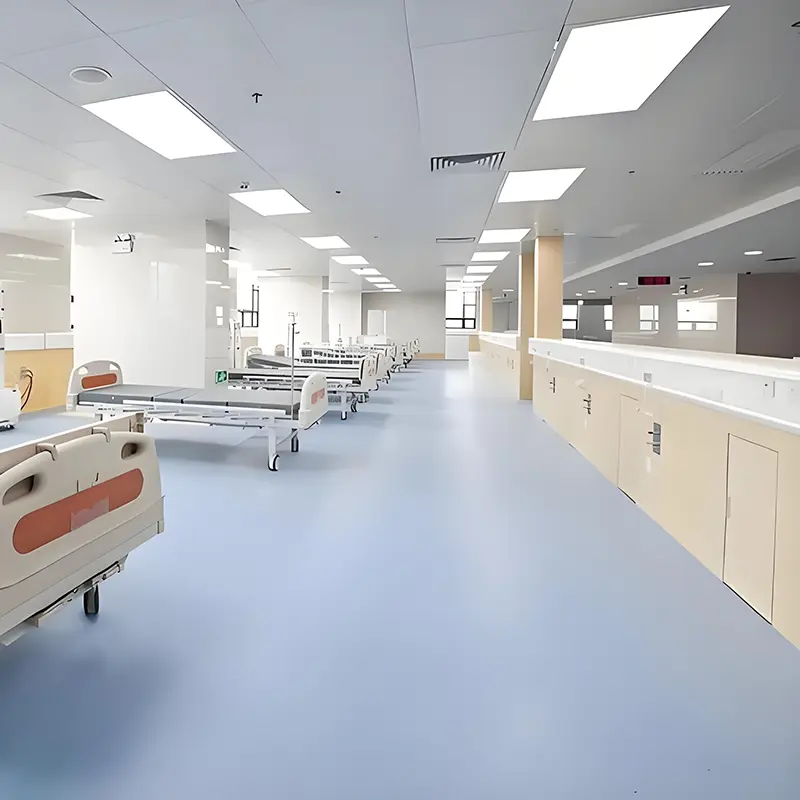
Hospitals require homogeneous vinyl flooring for operating rooms, ICUs, infectious disease wards, laboratories, and pathology departments. It allows for 100% seamless welding and can withstand frequent corrosion from various medical chemicals such as alcohol, iodine, hydrogen peroxide, and chlorine-containing disinfectants.
Conductive fibers can be integrated to meet the anti-static requirements of precision instruments in operating rooms, preventing electrostatic interference with equipment operation. For anti-static applications, our specialized anti-static flooring series is available.
For general wards, rehabilitation centers, nurse stations, and administrative office areas, we recommend heterogeneous commercial flooring. This can reduce walking noise by 40%, providing a quiet environment for patients, alleviating fatigue from prolonged standing for medical staff, and reducing the risk of injury from falls.
3.2 Dance Industry
The choice of dance studio flooring directly affects dancers’ safety and performance. Professional dance flooring uses a closed-cell PVC foam cushioning layer with a shock absorption rate of up to 50%, dispersing over 80% of impact force and effectively protecting dancers’ knees, ankles, and lumbar spine.

The resilience is controlled between 90-95%, providing sufficient support for jumps without causing dancers to lose balance like on a trampoline.
The surface features a special frosted or other patterned texture, with a coefficient of friction controlled between 0.6-0.7. This value is known as the “golden coefficient of friction for dance”—neither too slippery to cause falls, nor too rough to hinder rotations and glides.
Effectively absorbs footsteps and jumping sounds generated during dance, preventing noise disturbance to other classrooms or nearby residents.
DONGXING Recommended Products: 2.0mm, 3.0mm vinyl dance flooring.
3.3 Other Commercial Venues
For example, kindergarten classrooms, libraries, supermarkets, office areas, conference rooms, production workshops, etc., you can choose the appropriate flooring material based on the performance comparison table above. If you have difficulty choosing, or would like to see a detailed product catalog of commercial vinyl flooring, please contact us and obtain free samples!