
Hospital flooring falls under the medical-grade category, and the requirements for flooring materials are far more stringent than ordinary flooring. Hospitals need to provide hygiene and safety protection functions. Vinyl flooring utilizes both homogeneous and heterogeneous structures to meet the specific requirements of different spaces within the medical field.
1. Performance Requirements of Hospital Flooring Materials
It must be non-porous, seamlessly weldable, and provide full-cycle antibacterial and anti-mildew properties, inhibiting the growth of bacteria and pathogens.
It must withstand the high traffic volume in areas such as outpatient clinics, emergency rooms, and ICUs, as well as the pressure from wheelchairs and medical equipment trolleys.
It must withstand the corrosive effects of disinfectants, iodine, alcohol, hydrogen peroxide, medications, and blood stains commonly used in hospitals, without discoloration, loss of gloss, or damage to the surface structure.
It must possess stable anti-slip properties while maintaining appropriate elasticity to reduce secondary injuries from falls.
It must effectively absorb the impact noise generated by walking and trolley use, meeting the quiet environment requirements of hospitals.
It must meet relevant international fire resistance standards.
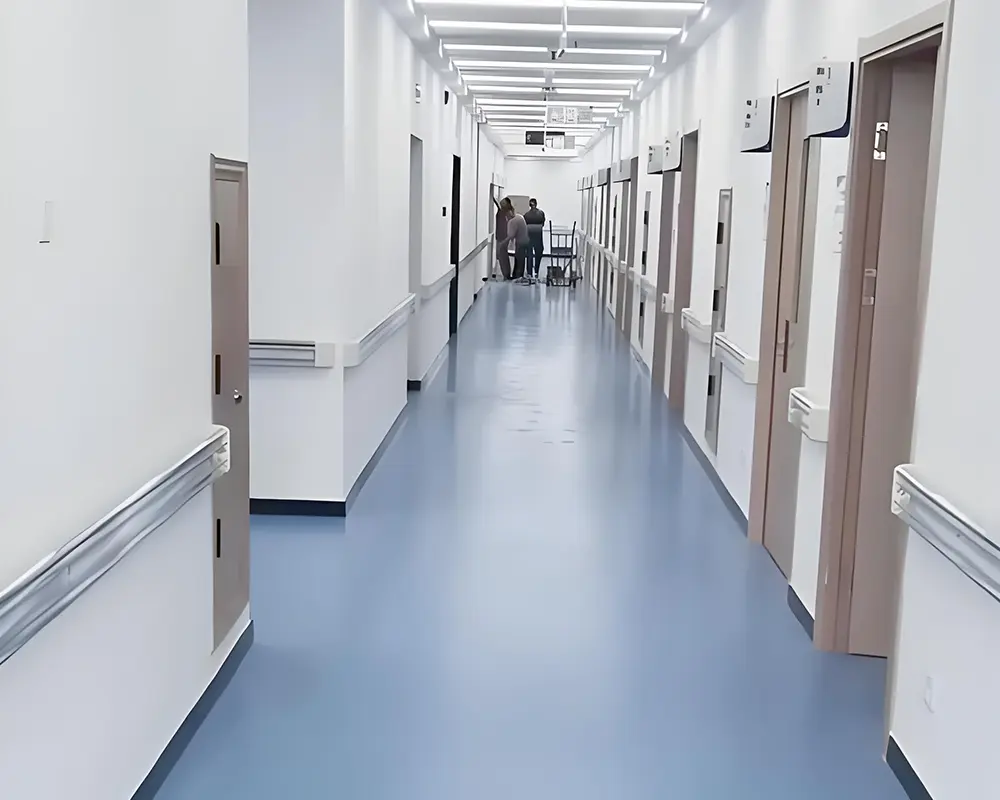
2. Homogeneous Vinyl Flooring
Choosing vinyl materials for hospitals and high-end medical fields is currently the most mainstream choice globally. Unlike home decoration, its core performance meets the requirements mentioned above. Commercial vinyl flooring comes in homogeneous and heterogeneous structures. Homogeneous structures offer better wear resistance and lifespan, making them more suitable for hospital floors.
Homogeneous vinyl flooring has broad-spectrum antibacterial agents added to all cross-sections specifically for medical settings, showing good performance against common drug-resistant bacteria in hospitals such as Escherichia coli, Staphylococcus aureus, MRSA (methicillin-resistant Staphylococcus aureus), and Acinetobacter baumannii. It is a primary consideration for selection in key areas such as operating rooms, ICUs, and infectious disease departments.
Homogeneous vinyl flooring can withstand high loads and has extremely high wear resistance. Even if the surface pattern wears down, it can be completely refinished with professional sanding, and a single refinishing can generally last 8-10 years.
The uniform, dense structure, without delamination or pores, prevents chemical penetration even with minor scratches.
With a low coefficient of thermal expansion, it is suitable for complex temperature and humidity environments such as hospital central air conditioning and underfloor heating, without deformation or warping. Even in irregular spaces like wards, seamless installation can be achieved through flexible cutting.
However, homogeneous vinyl flooring has the following drawbacks: Due to its homogeneous structure, color and pattern selection is relatively limited, mainly consisting of solid colors or simple textures. It cannot achieve complex wood grain, marble, or other personalized custom printing. It lacks a cushioning foam layer, resulting in a relatively hard feel underfoot, and its cushioning performance is slightly inferior to heterogeneous vinyl.
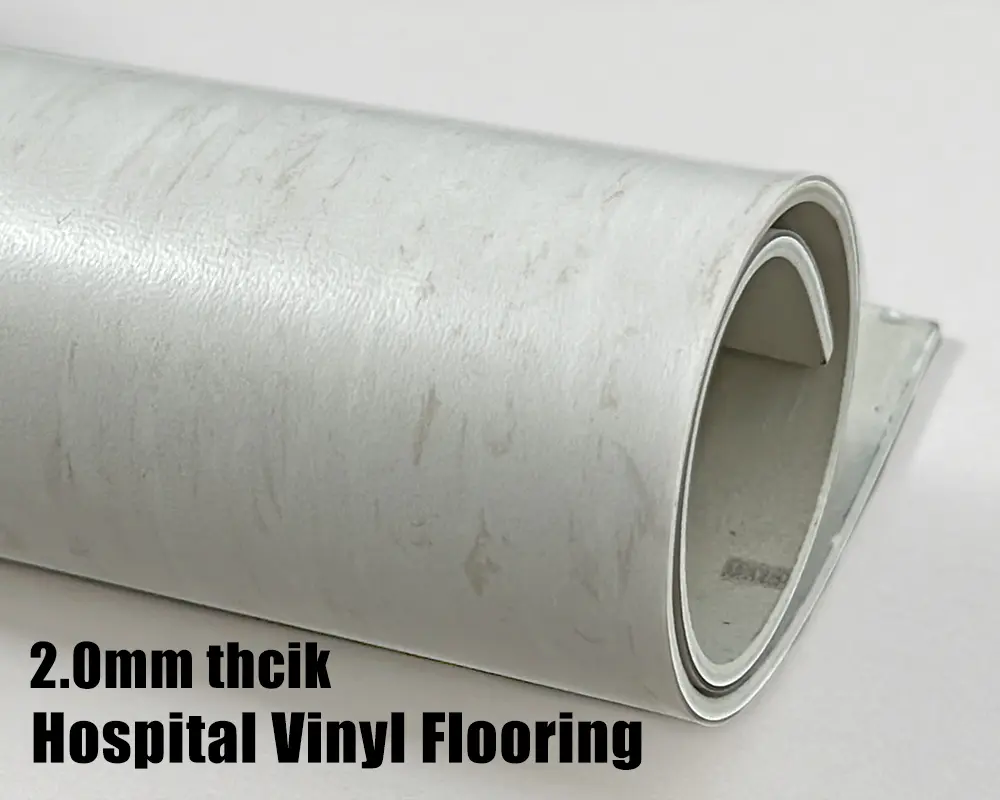
3. Heterogeneous Vinyl Flooring
This type of flooring features a multi-layered composite structure, achieving customized performance through the design of different functional layers. This structure is more suitable for low-load areas in hospitals, such as corridors, outpatient halls, and general wards, while also reducing procurement costs.
Cured UV Layer: Seals surface pores, improving stain resistance and chemical corrosion resistance.
Wear Layer: Determines the flooring’s lifespan and antibacterial properties; a 0.5mm-1.0mm wear layer is recommended.
Printed Layer: Available in various colors and patterns, customizable.
Double-layer fiberglass: Controls the floor’s coefficient of thermal expansion, preventing warping, shrinkage, and deformation.
PVC base layer: Semi-foaming can be added appropriately to balance wear resistance and cushioning.
Disadvantages of heterogeneous vinyl flooring: Antibacterial performance relies entirely on the surface wear layer; wear on the wear layer reduces its antibacterial properties. The surface cannot be sanded and refinished after wear, and the entire layer must be replaced once the wear layer is worn through. Its lifespan is shorter than homogeneous structures.
4. How to choose vinyl flooring for hospitals?
Choose different types for different functional areas. For example, homogeneous flooring is more suitable for high-infection, high-load areas such as operating rooms, ICUs, and infectious disease departments. Heterogeneous flooring offers better cost-effectiveness for general wards and office areas. Hospitals, as long-term public buildings, have high costs for replacing flooring materials, which also disrupts operations and patient care. Therefore, for large-scale professional medical fields, flooring materials must meet relevant standards, pass fire resistance and wear resistance tests, and have core technical parameter data. Choose a reliable vinyl flooring supplier.
5. FAQ
How thick is hospital vinyl flooring?
The common thickness is 2.0mm, but 3.0mm is also available.
How to install vinyl in a hospital?
Installation involves applying adhesive to the entire bottom and welding the seams for a seamless finish. Proper installation prevents floor warping and bulging.
Is vinyl flooring less toxic than carpet?
It meets ISO environmental standards, is low in VOCs, and formaldehyde-free.
What are the negatives of vinyl flooring?
The printed layer is prone to wear over time. Although it is waterproof and seepage-proof, poorly treated seams can allow water to seep down.
Should I choose rolls or sheets?
Rolls are recommended because they have fewer seams. Sheets are smaller than regular ceramic tiles or wood flooring, resulting in more seams that are more prone to cracking.