
Badminton courts are a globally popular sport, and a professional and comfortable court is essential for both court operators and players to achieve mutual benefits. This article will introduce popular materials worldwide to help you choose the right flooring for your needs.
Why is choosing the right badminton court flooring so important?
Every badminton player knows the pain of slipping on a wet court or the lingering knee and ankle pain after a long match on a hard, inflexible surface.
But for court owners, club operators, or construction companies, choosing the wrong flooring material affects much more than just actual playing comfort: it directly impacts injury liability, the court’s commercial reputation and pricing power, and potentially higher ongoing maintenance and operating costs.
Therefore, choosing the best badminton flooring material not only makes your court more popular and increases operator profits, but it also creates the ideal court for badminton enthusiasts.
There is no single best material, only the badminton flooring best suited to your needs.
3 Most Popular Badminton Court Flooring Materials Compared
The global badminton flooring market is dominated by three core materials, each with distinct strengths, ideal use cases, and tradeoffs. Below is a head-to-head breakdown tailored to badminton’s specific performance demands.
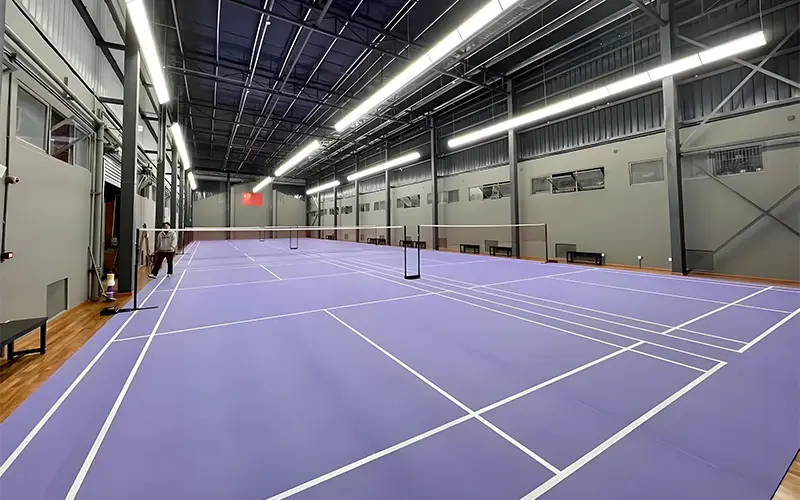
1. PVC Badminton Flooring Mat
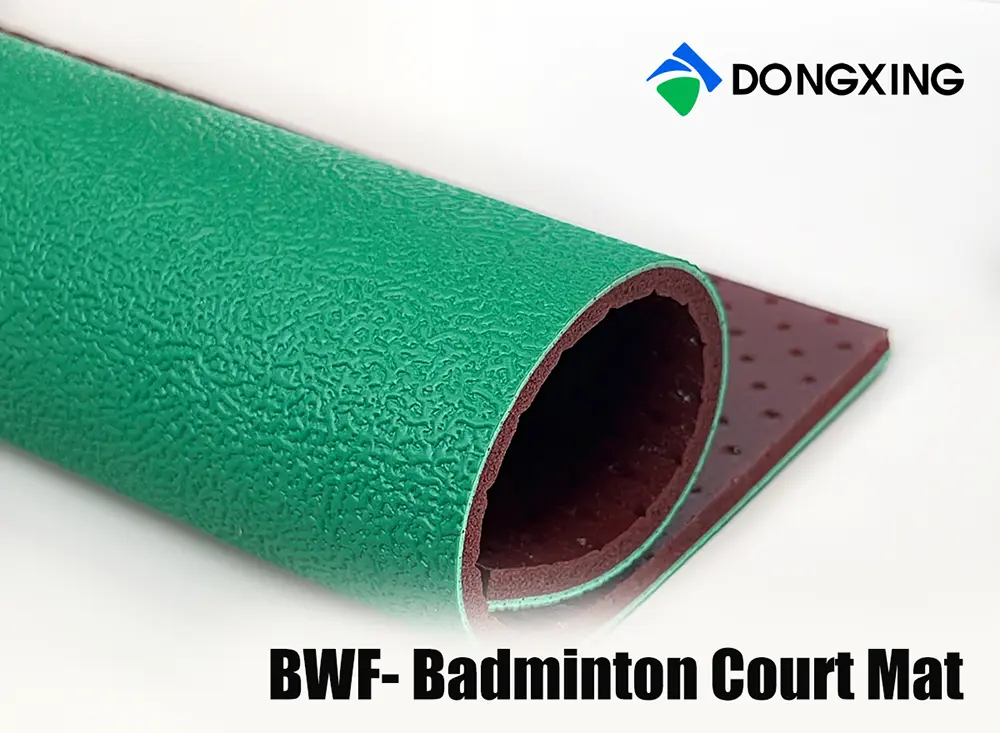
PVC (polyvinyl chloride) vinyl is the most widely used flooring material for badminton courts worldwide, from local community clubs to professional BWF-certified tournament venues. It is a multi-layer synthetic floor, typically constructed with a thick wear layer, fiberglass stabilization layer, and closed-cell foam buffer core for shock absorption.
Core Advantages:
Optimized performance for badminton: Tuned slip resistance, consistent shock absorption, and predictable ball bounce
Flexible installation: Works in most indoor venues, with custom color and line marking options
Mid-range pricing: Balances upfront cost and long lifespan for most use cases
Low daily maintenance: Resists stains, spills, and scuffs with minimal upkeep
Key Limitations:
Requires a perfectly level, dry subfloor to avoid bubbling, warping, or lifting
Low-quality budget options have a very short lifespan under high traffic
Not suitable for outdoor or semi-outdoor venues with moisture or UV exposure
Ideal For: Indoor recreational clubs, competitive training facilities, professional tournament venues, and school gyms with dedicated badminton courts.
2. Solid & Engineered Wood Badminton Flooring
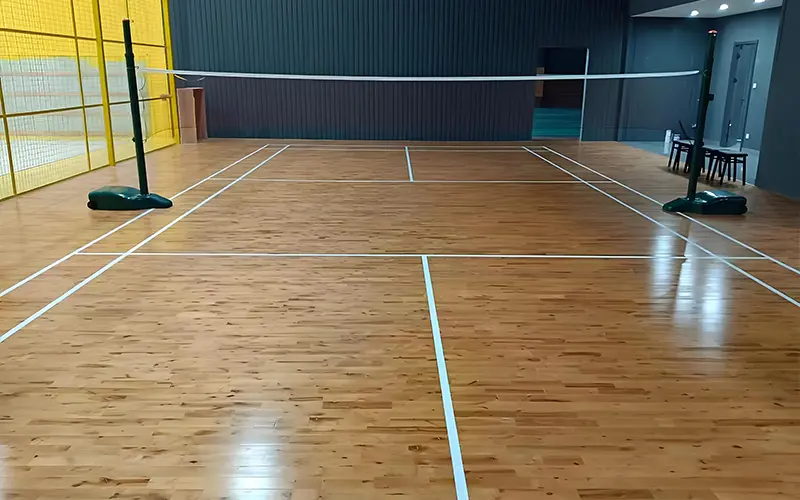
Wooden sports flooring (most commonly solid maple or ash) is the traditional premium choice for high-end badminton venues, prized for its superior shock absorption, natural feel, and premium aesthetic. Professional wood badminton floors use a multi-layer system: a structural wood or metal batten/joist framework, moisture barrier, and solid wood top layer finished with a sports-grade urethane coating.
Core Advantages:
Unmatched long-term durability: Lifespan of 15–25+ years with proper care, with extremely low depreciation
Excellent shock absorption and energy return: Reduces athlete fatigue and injury risk during high-intensity play
Premium brand value: Elevates a venue’s commercial positioning, allowing higher membership and booking rates
Fully refinishable: Can be sanded and re-coated multiple times to restore like-new performance
Key Limitations:
Extremely high upfront cost, with specialized installation required
Highly sensitive to humidity and temperature fluctuations: Prone to warping, swelling, or shrinking in unstable environments
Labor-intensive maintenance: Requires regular cleaning, waxing, and periodic professional refinishing
Not suitable for damp venues, basements, or areas with high moisture risk
Ideal For: Elite professional training centers, premium private member clubs, venues hosting national/international tournaments, and permanent high-end indoor sports complexes.
3. Interlocking PP Tiles
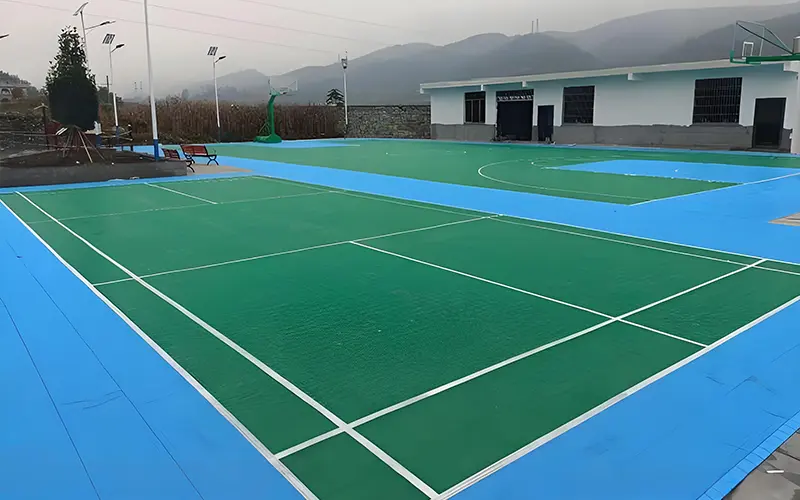
Interlocking sports tiles, typically made from rigid polypropylene, are a modular, snap-together flooring solution for badminton courts. They feature a raised grid structure that creates a built-in air buffer, and require no adhesive or extensive subfloor preparation.
Core Advantages:
Ultra-low installation cost and effort: DIY-friendly, no glue or professional labor required, and can be installed over slightly uneven concrete
Portability: Can be disassembled, moved, and reinstalled for temporary or pop-up courts
Low maintenance: Water-resistant, easy to clean with a pressure washer, and individual tiles can be replaced if damaged
Budget-friendly upfront cost: The lowest initial investment of the three materials
Key Limitations:
Inferior performance for competitive play: Harder surface with less consistent shock absorption, higher noise levels, and less predictable grip during fast movements
Shorter lifespan: Typically 3–8 years under regular high traffic
Visible seams: Can create minor inconsistencies in play, and may cause discomfort during prolonged play
Not recommended for professional or high-intensity regular training use
Ideal For: Temporary pop-up courts, outdoor or covered semi-outdoor venues, low-budget community facilities, home courts, and multi-purpose spaces with occasional badminton use.
Considering later maintenance costs
The cost of badminton flooring materials is only one aspect of your budget: maintenance costs and replacement frequency will determine your long-term budget.
PVC Vinyl Sports Flooring
Annual Maintenance Cost: $0.10 to $0.30 per square foot (daily wet mopping with a neutral pH cleaner, no special treatment required)
Lifespan: Mid-range 1.2mm abrasion layer: 5-8 years; Premium BWF certified 1.5mm or thicker abrasion layer: 8-12+ years
Wooden Sports Flooring
Annual Maintenance Cost: $0.50 to $1.50 per square foot (dry cleaning, regular waxing, and spot repairs)
Major Overhaul: $3 to $5 per square foot, for full sanding and recoating; high-traffic areas require this every 5-8 years.
Lifespan: 15-25+ years, can be refinished multiple times, therefore has the lowest long-term depreciation rate of all materials.
Interlocking PP Floor Tiles
Annual Maintenance Cost: $0.05 to $0.20 per square foot (high-pressure cleaning or sweeping, minimal routine maintenance)
Lifespan: 3-8 years; damaged tiles can be replaced individually.
No Major Overhaul Required: When most tiles show wear or cracks, replacement is usually necessary.
Badminton Court Flooring Selection Criteria
Not all sports floors are suitable for badminton. Badminton demands rapid lateral movement, explosive jumping, and stable grip, meaning these non-negotiable technical standards must be prioritized when evaluating a court.
1. Coefficient of Friction (COF)
The coefficient of friction is the most important safety indicator for badminton courts. It measures the slip resistance between the court surface and the player’s shoes.
BWF and EN 14904 standards: The coefficient of friction for professional badminton matches must be between 0.4 and 0.6.
Importance: A coefficient of friction below 0.4 increases the risk of slipping during lunges and changes of direction; a coefficient of friction above 0.6 leads to “stickiness,” preventing smooth turns and potentially causing ankle, knee, and ACL injuries.
2. Vertical Deformation and Shock Absorption
Badminton players experience impact forces equivalent to 3-5 times their body weight with each jump and landing. Vertical deformation (the amount of floor subsidence under load) and shock absorption directly protect athletes from chronic overuse injuries and acute impact trauma.
BWF and EN 14904 standards: Minimum shock absorption of 40%, vertical deformation between 1.5 mm and 2.3 mm.
Important Note: “More isn’t always better.” Excessive vertical deformation (over 3 mm) leads to energy loss, increased athlete fatigue, and reduced performance; deformation below 1.5 mm fails to provide effective injury protection.
3. Abrasion Layer Thickness (Applicable to PVC Flooring)
The abrasion layer is the outermost solid PVC surface of vinyl flooring, and its thickness is a major factor determining the floor’s lifespan under high-traffic conditions.
Minimum requirement for recreational courts: 1.0 mm solid PVC abrasion layer
Minimum requirement for regular/high-traffic courts: 1.2 mm solid PVC abrasion layer
Professional/training courts: 1.5 mm to 2.0 mm solid PVC abrasion layer
Avoid: Flooring labeled “Abrasion Layer” or with a thickness less than 0.8 mm. Such flooring will exhibit wear, fading, or bubbling after 1-2 years of normal use.
4. BWF Certification
BWF (Badminton World Federation) certification is the global gold standard for badminton court flooring. To obtain certification, the flooring must pass rigorous laboratory tests, including coefficient of friction, shock absorption, vertical deformation, shuttlecock bounce, and dimensional stability, to ensure it meets international competition requirements.
For venues aiming to host professional tournaments, BWF certification is mandatory.
Even in recreational venues, choosing BWF-certified badminton flooring ensures a safe, high-quality sporting experience, reduces injury risk, and improves player retention.
FAQ
Q1: What is the best flooring for a badminton court?
A: PVC sports flooring specifically designed for badminton is currently the best choice. It precisely matches the requirements of badminton for friction coefficient, impact absorption, and shuttlecock rebound rate, balancing safety, athletic performance, durability, and cost-effectiveness. It is the preferred material for over 90% of professional badminton courts worldwide, and BWF-certified PVC flooring is standard equipment for tournament-level courts.
Q2: What are the official dimensions of a badminton court?
A: According to BWF official standards, the inner court dimensions for doubles are 13.4m × 6.1m, and for singles are 13.4m × 5.18m. International tournament-level courts require an additional buffer zone of ≥2.0m outside the baselines and ≥1.5m outside the sidelines, with a total court size ≥17.4m × 9.1m.
Q3: Can PVC badminton mats be used outdoors?
A: Only outdoor-grade modified PVC badminton mats are suitable for outdoor use. These products contain UV stabilizers and weather-resistant agents, protecting them from sun exposure and rain. Ordinary indoor PVC mats are strictly prohibited from outdoor use; otherwise, they will fade quickly, become brittle, crack, and have a significantly shortened lifespan.
Q4: What is the difference between BWF certified and non-certified badminton flooring?
A: BWF certified flooring has passed the Badminton World Federation’s stringent performance tests. Its core indicators, such as shuttlecock rebound rate, impact absorption, and coefficient of friction, fully meet the professional standards for badminton, ensuring sports safety and fair competition, and are suitable for hosting official tournaments. Non-certified flooring lacks standardized parameters, making it prone to slipping, insufficient cushioning, and uneven rebound, resulting in a higher risk of sports injuries, a shorter lifespan, and unsuitability for hosting official tournaments.
Q5: How thick should a badminton court PVC floor be?
A: 3.5mm is recommended for home entertainment areas; 4.5mm (mainstream, cost-effective) for community clubs and school gymnasiums; 5.5mm or 6.0mm for professional training and provincial competition venues; and 6.0mm or 7.0mm (top-of-the-line) for international competition venues. The core consideration is the thickness of the wear layer; for daily use, the wear layer should not be less than 0.7mm.
Q6: How long does PVC badminton flooring last?
A: High-quality BWF-certified PVC badminton flooring can last 8-15 years with frequent daily use; inferior recycled flooring only lasts 1-2 years. Proper installation and regular cleaning and maintenance can further extend the floor’s lifespan.