
Most car shops, car washes, vehicle repair shops, and residential and commercial garages require suitable flooring materials that can solve the problems of traditional concrete floors, such as water accumulation, slipperiness, and difficulty in cleaning. Interlocking PP garage floor tiles have significant advantages over coating materials such as epoxy flooring. Imagine: your garage, after prolonged use, becomes damp, water accumulates uncontrollably, the floor cracks easily, and even the coating peels off – this is truly frustrating.
1. Why Choose Modular Interlocking Flooring?
Low Requirements for Subsurface Surface
If your garage floor is uneven or poorly ventilated, other materials require sanding and leveling before installation, otherwise it will be difficult to install. Interlocking flooring, however, can be installed even on a subsurface that looks unsatisfactory or is overgrown with weeds; simple preparation is all that’s needed before installation.
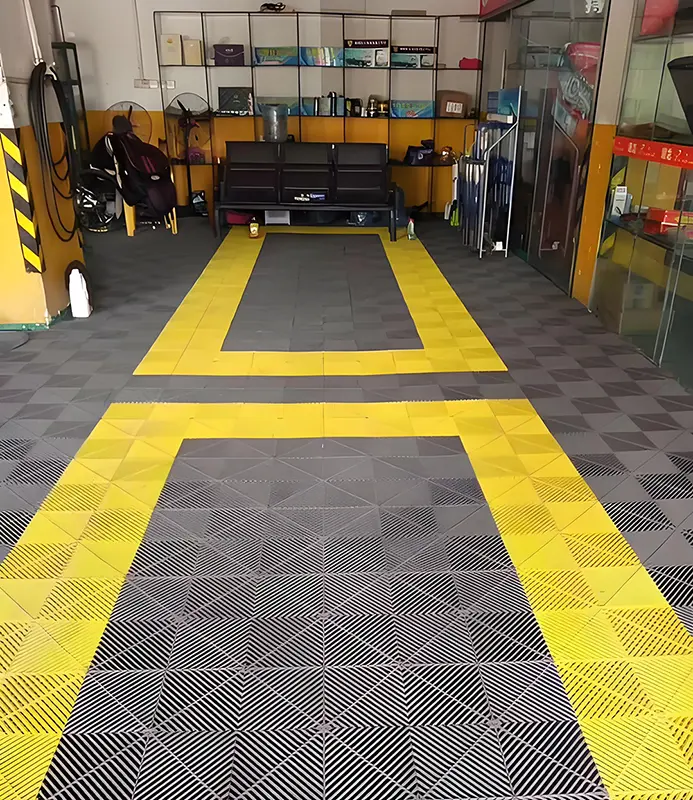
Easy to Clean
In car washes or repair shops, or even your own garage, there’s no need to move vehicles, and you don’t have to worry about water accumulation or oil stains on the floor. Because of the perforated structure of PP interlocking garage floor tiles, moisture can be quickly drained. Even if they get dirty, they can be easily rinsed with a water gun during a car wash.
Low cost and easy maintenance
If a section of the floor is damaged, you only need to replace one garage floor tile, not the entire floor material.
Moisture and mold resistant
Garages, except for open-air areas, rarely have good ventilation, so moisture and mold resistance is crucial; otherwise, maintenance and replacement costs are high. PP environmentally friendly materials are perfectly suited for this environment.
2. Choosing Type and Design
Modular garage flooring also comes in different qualities and usage grades. For example, in car washes, vehicles are typically parked for less time than in garages and are frequently exposed to cleaning agents and water guns.
In garages, the primary purpose is long-term parking, requiring good load-bearing capacity and compatibility with different vehicle types, as well as wear resistance and a long service life.
Therefore, our interlocking garage floor tiles come in two types: one suitable for garages and one for car washes, and are available for both indoor and outdoor use. The difference lies in their function. Different colors can be flexibly selected, allowing for the design of parking spaces and various patterns.
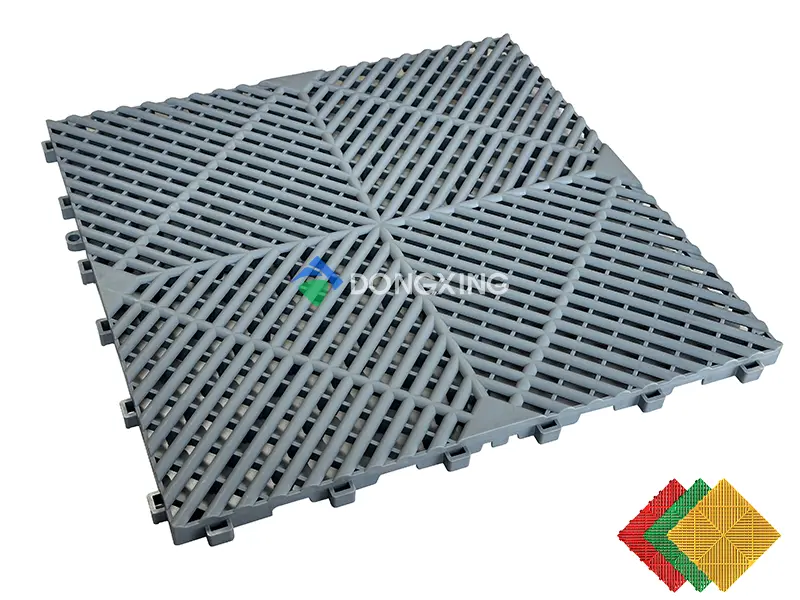
Core Performance:
- Modified PP: Contains UV stabilizers and anti-aging agents. Service life 8-10 years.
- High-density support structure, grid design, providing stable load-bearing capacity for cars, SUVs, and MPVs.
- Completely waterproof and impermeable, with tight, seamless interlocking connections.
- UV resistant, wear-resistant, and provides some sound insulation and anti-static properties.
It is important to note that when choosing a garage floor supplier, ensure the material is not recycled. Request samples to verify its quality and strength to avoid inferior products.
3. Installation and Maintenance
Choosing the right garage floor material is not enough; proper installation is also crucial to prevent problems and extend service life. Although it is as simple as interlocking sports flooring and requires no professional tools, proper installation methods can prevent issues such as warping, widening gaps, unevenness, and displacement.
3.1 Ground Requirements
No absolute flatness is required; bumps or pits greater than 2cm are acceptable. It can be laid directly on concrete, old tiles, or epoxy flooring without leveling.
The ground must be dry and free of standing water. For soil surfaces, curing is recommended; otherwise, rainwater may soften the ground, affecting flatness and causing subsidence.
A 5-10mm expansion joint must be left along the walls of the garage floor to prevent thermal expansion and contraction.
3.2 Fixing Requirements
For residential and full-coverage spaces, no glue is needed. The interlocking system will prevent shifting under vehicle pressure.
However, at doorways, corners, and areas not fully covered, edge trim must be used for fixation to prevent tripping and secure the floor edges.
In special scenarios, such as car washes or outdoor areas, ensure a 1% drainage slope before laying to prevent water accumulation under the garage floor. Use specialized edge trim to cover trenches and corners to prevent mud and sand from entering.
3.3 Daily Cleaning
Use a high-pressure water gun to rinse once a month. For stubborn oil stains, use a regular neutral detergent to wipe them off; avoid strong acids and alkalis.
If localized damage occurs, use a flathead screwdriver to pry open the latches and replace the entire tile.
If your garage needs to be moved, this interlocking flooring can be completely removed and installed in another location.
4. FAQ
Based on our user surveys of garage flooring products and frequently asked questions on the well-known Reddit forum, we provide the following answers:
Can jacks be used on interlocking garage flooring in auto repair shops?
Jacks apply localized force. If necessary, we recommend placing a thicker layer of plywood or other material on the floor. While jacks won’t damage the garage tiles, they may leave indentations. Of course, with high-quality PP material, you may not need to worry about this.
What does it feel like to walk on?
Interlocking garage flooring tiles feel solid underfoot, without any hollow noise, almost similar to the modular materials used in sports courts.
Will this PP garage floor leave tire marks?
Absolutely not. It uses UV stabilizers and abrasion-resistant coatings, making it difficult for rubber tires to leave marks even after long-term parking and driving. Unless it’s a low-quality material.
Is it waterproof, rainproof, and ice-proof?
The grid-like, interlocking structural design and arched supports mean that unless there’s extremely heavy rainfall or significant snow accumulation, there’s no need to worry about these issues.