
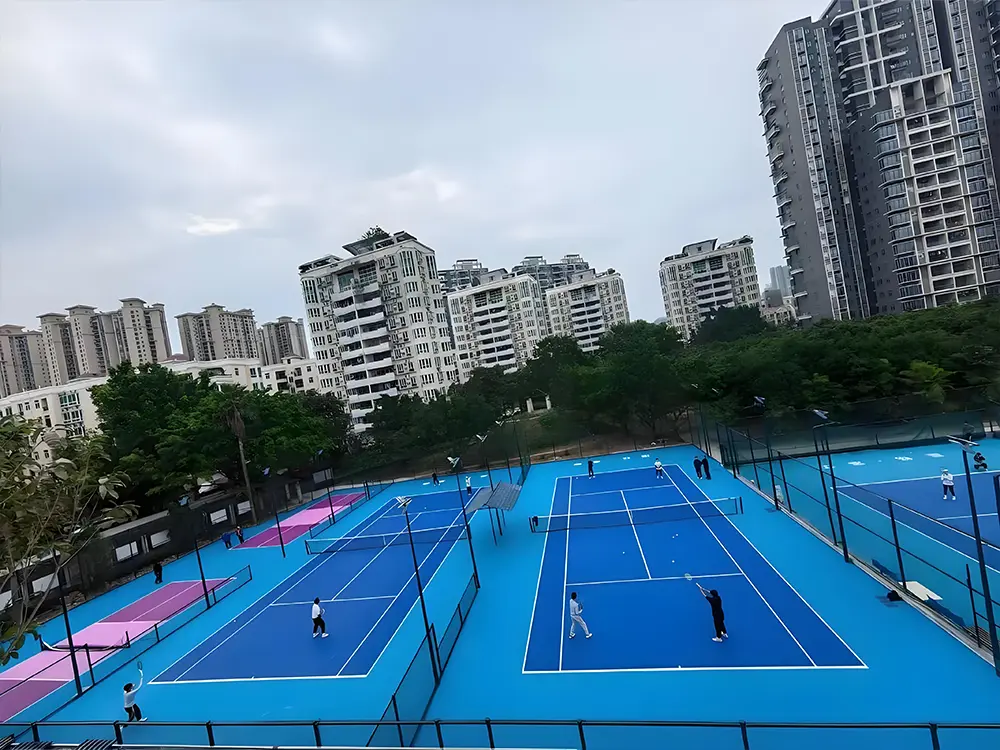
A standard tennis court can accommodate a maximum of four pickleballs. We’ve noticed some users have mentioned their needs when purchasing pickleball court mats. They want a multi-functional, reusable court, but the problem is that tennis courts and pickleball courts use completely different PVC flooring materials, making it impossible to accommodate both types of balls simultaneously. Therefore, if you want both, you can only choose interlocking tiles for easy installation and removal.
Only by fully understanding the differences between tennis and pickleball court materials can you make the most of your court and maximize your sporting experience.
1. Performance Differences
The most crucial difference between pickleball and tennis court surface lies in their mandatory performance specifications:
Pickleballs are made of lightweight plastic and require more stable rebound. Tennis courts have a higher tolerance for rebound and can adapt to different court speeds, thus not affecting the shot.
Playing pickleball requires smaller and more frequent footwork, while the hitting and receiving motions in tennis are larger, so the requirements for the friction of the surface material are different.
Pickleball is still beneficial for middle-aged and elderly people, so there are certain requirements for cushioning and protection. Tennis prioritizes stable bounce to ensure powerful serves and baseline shots, rather than cushioning.
2. Differences in Sports Flooring Materials
2.1 Vinyl Sports Flooring
While both Peak courts and tennis courts can use PVC flooring rolls, their structures and performance are completely different.
PVC Tennis Court Flooring: Indoor courts typically have a thickness of 4.5-8.0 mm, with a wear layer at least 1.2 mm thick. It features a cushioning foam layer; this structure can withstand high-intensity, repeated foot traffic, and its denser, more robust structure ensures stable ball bounce.
PVC Pickleball Court Flooring: Whether indoors or outdoors, it’s 3.0 mm thick, with high-end requirements reaching up to 3.5 mm. The wear layer is at least 0.8 mm thick. It lacks a cushioning foam layer, or often uses a semi-dense, semi-foamed structure to ensure ball rebound and ground feedback.
2.2. Interlocking Floor Tiles
Modular PP interlocking tiles offer little difference for both tennis and pickleball courts; the two are almost identical in terms of outdoor sports flooring material. However, when using this material for pickleball, it’s crucial to ensure the ball’s rebound meets requirements. This presents a technical challenge for PP tiles.
2.3 Clay, Grass, and Artificial Turf
These sports flooring materials are iconic for professional tennis courts, but are completely unsuitable for pickleball. Therefore, there are many options for tennis courts, while for pickleball courts, PVC mats and acrylic materials are the most recommended.
3. Structural Differences
80% of the wear and tear on a tennis court occurs in the baseline area (the area where players stand when serving and hitting) and the service court.
70% of the wear and tear on a pickleball court is concentrated in the non-volley zone (kitchen line) and the area within 7 feet (approximately 2.1 meters) on both sides of the net, where players perform volleys and taps.
A common mistake when converting a tennis court to a pickleball court is failing to reinforce the area in front of the net, leading to premature surface wear and cracks.
4. Subgrade Requirements
Tennis courts require a robust, high-compactment subgrade (concrete compressive strength ≥30MPa, asphalt ≥25MPa) to withstand the repeated impacts and frequent foot traffic from tennis balls.
Pickleball courts have slightly lower requirements for subgrade compaction, but stricter requirements for flatness (3-meter straightedge measurement error ≤2mm, while tennis courts require ≤3mm). Due to the smaller court area and shorter rallies, even minor flatness defects will be more noticeable during matches.
5. How to Build a Court Suitable for Both Pickleball and Tennis?
The first option is to choose an acrylic coating or modular interlocking tiles, which can accommodate the needs of these two or even more ball sports, but the differences between them must be considered.
The second option is well-known and is preferred by users who want convenient and easy-to-roll sports flooring, allowing for quick and easy replacement of different flooring materials for multi-functional use.