
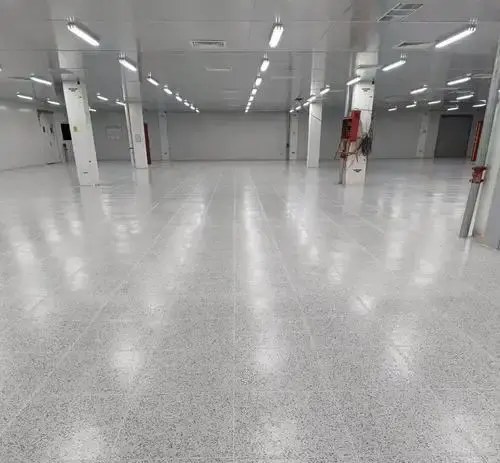
In environments sensitive to static electricity—such as electronics manufacturing facilities, data centers, and cleanrooms—ESD (electrostatic dissipative) vinyl flooring serves as a core component of the electrostatic protection system. If the flooring quality is not durable, issues such as degraded anti-static performance, resistance levels exceeding limits, or even total system failure can easily arise after just one or two years of use. Consequently, the initial selection and installation directly impact long-term performance and maintenance costs. As a vinyl flooring manufacturer, we are actively expanding our production capacity and refining our manufacturing processes for industrial vinyl flooring. To assist you, we have provided the following procurement guide.
1. Distinguishing Between ESD Flooring Types
| Type | Resistance Range | Discharge Speed | Application Scenarios | Safety Risk |
|---|---|---|---|---|
| Static Dissipative (ESD/DIF) | 1×10⁶ ~ 1×10⁹ Ω | Slow & Controllable | General electronic workshops, computer rooms, laboratories | Low, no electric‑shock risk |
| Conductive (ECF) | 2.5×10⁴ ~ 1×10⁶ Ω | Very Fast | Semiconductors, flammable & explosive environments, Class‑1 EPA | Requires personnel safety design |
For 90% of industrial electronics workshops, electrostatic dissipative flooring is sufficient. Blindly opting for “conductive” flooring—which offers lower resistance—not only entails higher costs but also introduces potential electric shock hazards for personnel, particularly in the event of equipment current leakage.
2. Key Testing Metrics
High-quality ESD flooring must meet three specific electrical performance criteria; surface resistance alone is not a sufficient indicator:
- Point-to-point resistance: Measures surface conductivity uniformity.
- System resistance to ground: Measures overall static dissipation capability (the most critical metric).
- Static voltage decay time: Time required to drop from 1000V to 100V (should be ≤0.5 seconds).
- Triboelectric voltage: Voltage generated by human walking (should be < 100V).
3. Why do some ESD vinyl floor fail after just two years?
This is the most common issue reported by users in the industrial anti-static flooring sector. A significant reason for the loss or degradation of anti-static functionality is incorrect product selection.
3.1 Three methods for achieving anti-static properties in Vinyl flooring:
Surface-coated type (short-term)
Principle: Spraying an anti-static coating onto the surface of standard PVC.
Characteristics: Initial resistance meets standards; low cost.
Lifespan: 6 months to 2 years; performance degrades rapidly with wear.
Identification: Wipe the surface with alcohol and re-test; a significant rise in resistance indicates a coated type.
Carbon black-filled type (long-term)
Principle: Uniformly mixing conductive carbon black particles into the PVC substrate.
Characteristics: Conductive throughout the material; performance is unaffected by wear.
Lifespan: Over 10–15 years.
Note: Uneven carbon black dispersion can cause resistance “hotspots”; high-quality products utilize nano-scale dispersion processes.
Graphene / Carbon nanotube type (high-end)
Principle: Adding graphene nanotubes to form a three-dimensional conductive network.
Characteristics: Low dosage required; does not affect color; more uniform resistance.
Lifespan: Over 20 years; degradation rate < 5% per 10 years.
Representative examples: High-end product lines from leading industry brands utilize this technology.
Purchasing Tips:
Ask the vendor whether the conductive component is a surface coating or an additive within the material itself to distinguish between short-term coated types and long-term types.
Get our ESD vinyl flooring catalog
3.2 Anti-static failure during use
Use of standard floor wax, oil-based cleaners, or silicone-based cleaners creates an insulating film on the surface, causing resistance to spike above 10¹² Ω and completely eliminating anti-static functionality.
In high-traffic areas (aisles, around workstations), if the wear layer wears through, the underlying non-conductive substrate is exposed, causing local resistance to exceed limits. The wear layer thickness should be ≥0.5mm; ≥0.7mm is recommended for heavy-duty workshops.
Breakage of the copper foil grid, loose grounding terminals, or poor contact between the copper foil and conductive adhesive prevents static electricity from dissipating into the ground.
Excessive floor moisture content allows water vapor to penetrate the adhesive layer and disrupt the conductive path; this is common in ground-floor or basement projects lacking proper moisture-proofing.
Installation using standard non-conductive adhesive or incorrect conductive adhesive mixing ratios creates an insulating layer between the flooring and the grounding system.
4. How do you select a high-quality anti-static flooring supplier?
Drawing on our experience with vinyl flooring in industrial anti-static applications and industry data, we address the questions most frequently asked by purchasers.
4.1 Service Life
High-quality homogeneous ESD vinyl flooring offers an electrical performance lifespan of 15–20 years.
Electronics workshops with light-to-moderate traffic: Partial refurbishment required after 12–15 years.
High-traffic corridors with forklift use: Replacement should be considered after 8–10 years.
Cleanroom environments: Stable performance maintained for over 15 years.
Lifespan is determined by the wear layer and maintenance habits—much like sports or commercial vinyl flooring.
4.2 Vinyl Rolls vs. Tiles
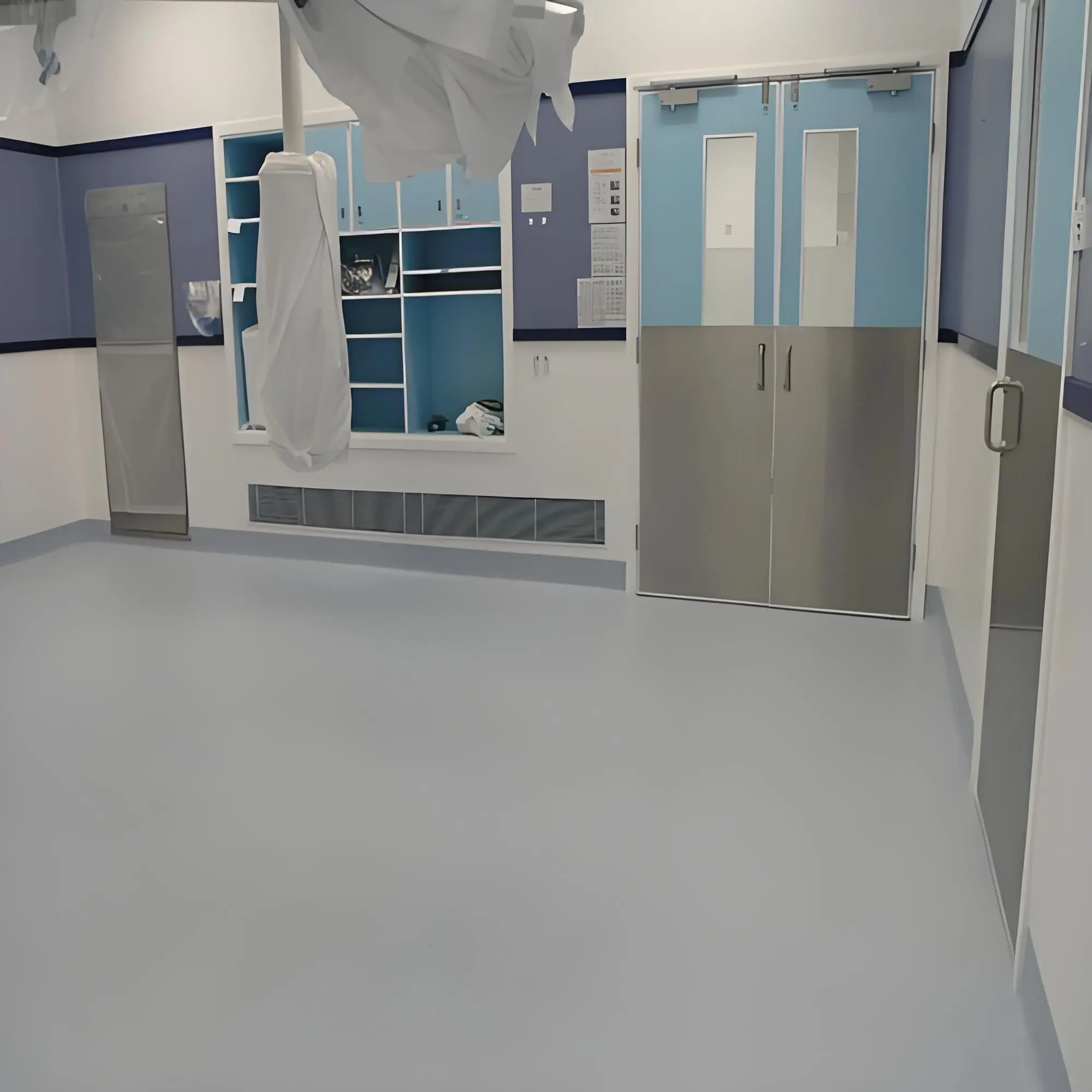
Choose rolls for cleanrooms and operating rooms;
Choose 600×600mm tiles for general workshops and server rooms.
The key difference is that rolls offer fewer seams and greater structural integrity, whereas tiles have more seams but are easier and cheaper to install.
4.3 Price Variations in Anti-Static Flooring
Quotes for the same type of product vary significantly across suppliers due to:
Conductive technology: Coating-based < Carbon black-based < Graphene-based
Wear layer thickness: 0.3mm vs. 0.7mm
Raw material grade: Recycled vs. virgin material
Homogeneous vs. heterogeneous structure
Third-party certification (e.g., SGS, ESD Association)
Brand premium and technical services
4.4 Do darker colors provide better anti-static performance?
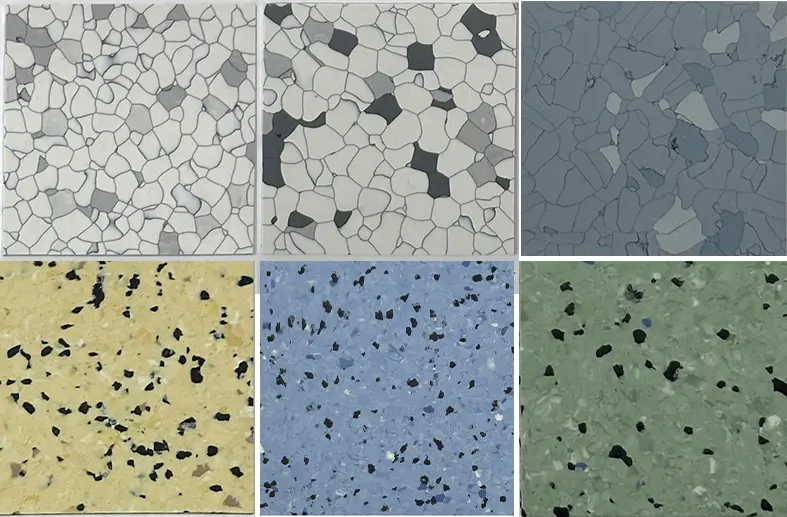
Black or dark gray flooring does not necessarily offer superior conductivity; light colors (light gray, sky blue, light green) can also achieve stable anti-static performance using graphene technology. Color depth depends solely on the amount of carbon black added and has no direct correlation with performance stability.
4.5 How often should resistance be tested?
Comprehensive testing upon acceptance of a new project: at least 3 test points per 100m².
Quarterly spot checks; monthly checks for critical areas.
Annual comprehensive system test with records retained.
Additional testing required after changes in cleaning methods, floor repairs, or significant fluctuations in environmental humidity.
4.6 Can existing flooring be directly refurbished?
Prerequisites:
Existing ceramic tiles/terrazzo: Must be level, free of hollow spots, and free of surface crumbling; self-leveling compound application is recommended.
Existing standard PVC: Direct overlay is not recommended, as it interferes with grounding continuity.
Epoxy flooring: Must be abraded to create a rough surface to ensure proper adhesion of the conductive adhesive.
Regardless of the substrate type, a copper foil grounding grid must be installed; one cannot rely on the conductivity of the existing floor.
4.7 Is it suitable for humid environments?
ESD vinyl flooring is inherently water-resistant, but high humidity can compromise the reliability of the grounding system. In high-humidity environments:
Substrate moisture content must be ≤3%.
A moisture-proof primer must be applied as a barrier.
Grounding terminals must be treated for rust prevention.
If relative humidity consistently exceeds 75%, static generation naturally decreases, but floor resistance may drop; verify that it remains within safe limits.
5. Procurement Checklist
Confirm ESD rating: Dissipative (10⁶–10⁹ Ω) or Conductive (10⁴–10⁶ Ω).
Confirm conductive technology: Bulk-conductive (additive mixed into the material), not a surface coating.
Wear layer thickness: ≥0.5mm (≥0.7mm for heavy-duty applications).
Review third-party test reports: Must include system resistance, decay time, and triboelectric voltage.
Confirm fire rating: At least Class B1 (flame-retardant).
Confirm ancillary materials: Specialized conductive adhesive, ESD welding rods, and copper foil specifications.
Confirm installation team: Must have specific ESD flooring experience (not a standard PVC installation crew).
Confirm warranty: Electrical performance warranty of at least 3 years.
ESD Anti Static flooring constitutes a comprehensive static discharge system. Errors at any stage—from material selection and installation to operation and maintenance—can cause the entire system to fail. As a manufacturer specializing in commercial and industrial flooring, we are deeply committed to the ESD sector, continuously expanding our capabilities to provide tailored solutions for a wide range of projects. Please feel free to request detailed product catalogs and samples from us.