
To create a professional and comfortable badminton court, sports facility builders and operators should always pay attention to the real feedback from players and enthusiasts. We’ve collected many opinions from actual badminton players about their court experience, and as a badminton floor manufacturer, they’ve provided valuable suggestions for optimizing and upgrading our products. This not only concerns the playing experience but also directly impacts the choice of badminton court flooring materials, the design of the venue’s decor, and profitability.
1. Court Dimensions and Space Reservation
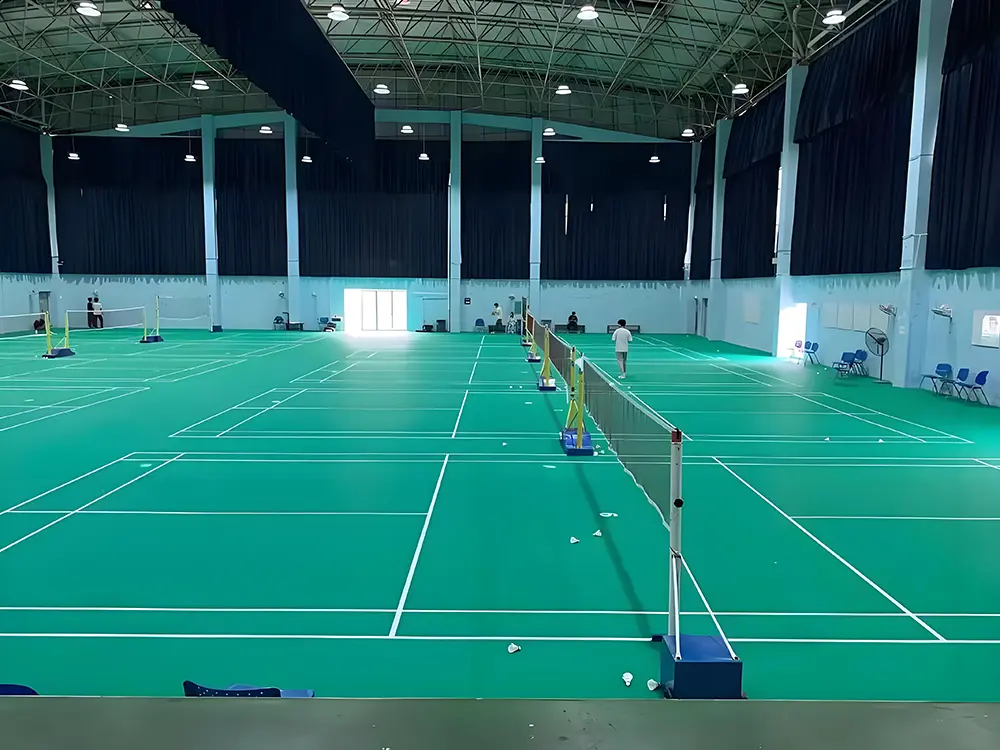
Lines and Buffer Zones: Many venues, in order to build more badminton courts, compress the dimensions outside the standard badminton court lines and the reserved space between adjacent courts. Imagine how much safety is reduced, how little room for error is allowed, and how cramped it feels. Even if your badminton court meets the standard BWF badminton court dimensions, insufficient space outside the lines will still result in a poor experience. A qualified badminton court should ideally have a buffer zone of ≥2m for the baselines (front and back of the court) and ≥1.5m for the sidelines (left and right of the court). Professional-grade courts should achieve even higher standards. 1. Sufficiently High Ceiling: High clears and lobs are fundamental badminton techniques. A low ceiling directly disrupts the shuttlecock’s trajectory, preventing players from hitting high shots freely and creating a strong sense of oppression.
BWF requires a minimum ceiling height of ≥9m for professional venues, and at least 12m for international tournament venues.
Even in recreational spaces, the ceiling height should never be less than 7m.
2. Sufficient Floor Cushioning
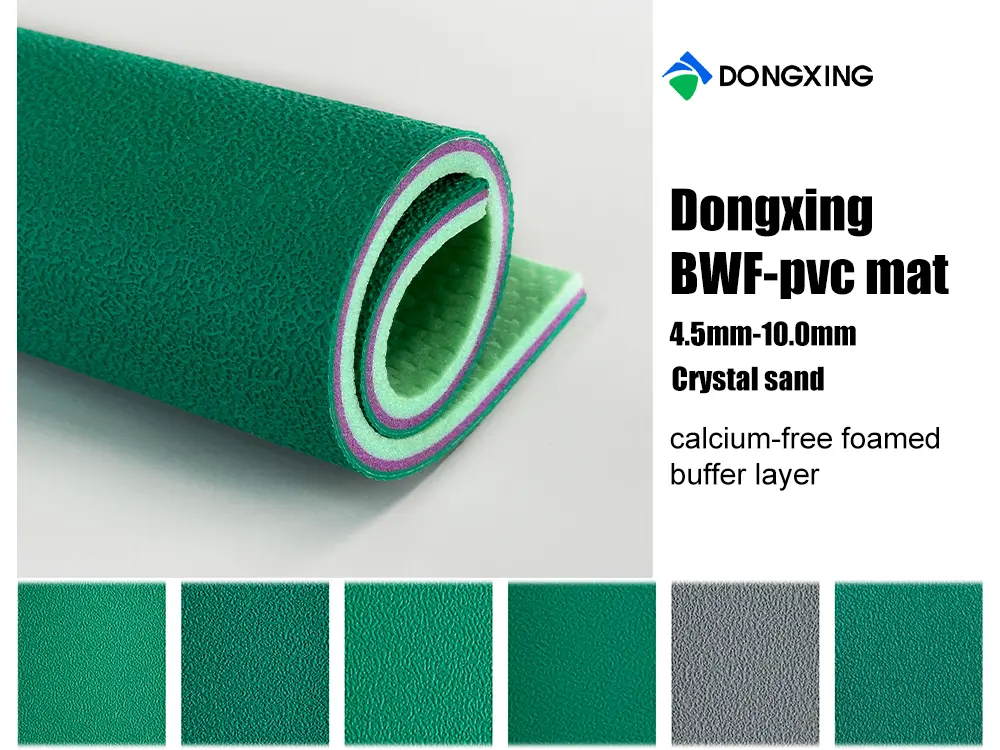
BWF badminton flooring is at least 4.5mm thick, with professional-grade options using 7.0mm or 8.0mm. Its PVC foam cushioning layer absorbs 30% or more of the impact, allowing the floor to absorb most of the impact when players jump and land, instead of forcing their knees and ankles to withstand the ground’s recoil.
Even during two hours of high-intensity doubles play, the knees won’t feel sore or painful, and the floor can withstand sudden stops and turns smoothly.
3. Dark Background and Net
Using dark colors for the walls, floor, and net in badminton court decoration can reduce eye strain for players and make it easier to judge the trajectory of the shuttlecock.
Otherwise, light-colored decorations and lighting systems can easily cause glare and blinding effects, affecting the playing experience, even if the lighting system’s brightness meets requirements.
4. Moisture and Slip Resistance
Badminton involves a lot of sweating, and the floor can easily drip sweat or spill drinking water. Therefore, the choice of badminton court flooring should use darker patterns with more intricate textures. For example, Dongxing offers crystal sand surfaces, and you can also choose Big Sand for enhanced slip resistance and wear resistance. This ensures a good coefficient of friction in both dry and wet conditions. Our flooring materials meet the required parameters in BWF and Labosports tests, and their performance can be verified by you.
5. Net System
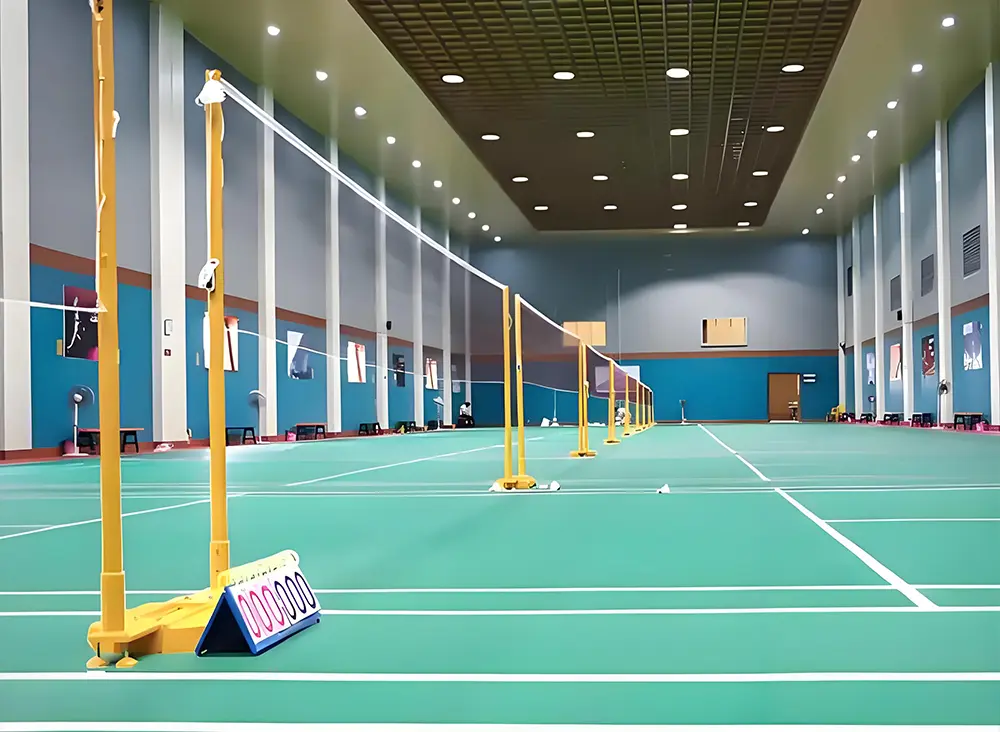
The basic parameters of the net must be perfect: net height at the net posts is 1.55m, net height in the middle of the court is 1.524m, and net length is 6.1m, perfectly covering the full width of the doubles court. The mesh size should be controlled between 15-20mm to prevent shuttlecocks from getting stuck. The net posts must be placed outside the doubles sidelines, absolutely not encroaching on the court space and not hindering players’ side-spin shots.
Net sagging in the middle is a common problem in most venues and a detail that most significantly impacts the experience. The net cord must be made of high-strength plastic-coated steel wire, especially the top cord, with a diameter of at least 6mm to withstand sufficient tension and prevent stretching and deformation over time. The net posts must have weighted cast iron bases or pre-embedded fixed net posts to prevent them from being pulled or shifted by the net tension. An adjustable locking mechanism allows for fine-tuning of the net cord tension at any time, ensuring the net surface remains flat and preventing sagging even after long-term use.
Why choose a composite net?
- A good court will invariably use a full-width dark brown/coffee-colored polyester mesh. This isn’t just an aesthetic preference, but a genuinely professional choice.
- The brown mesh provides excellent contrast against the white shuttlecocks and white net edging, allowing players to clearly judge the distance between the shuttlecock and the net. Calls for net-grabbing and over-the-net shots are immediately clear, eliminating visual misjudgments.
- The brown mesh is non-reflective and won’t create glare when combined with lighting, making it more eye-friendly than white or black mesh.
6. Lighting Requirements
Good lighting needs to be both bright and uniform. Amateur courts must have an average illuminance of at least 750 lux, while professional tournament-level courts must reach at least 1200 lux. Simultaneously, the illuminance uniformity must exceed 0.8, ensuring the entire court, from the net to the baseline, is evenly lit, without any uneven lighting or difficulty seeing the shuttlecock in one half of the court.
All light fixtures must be equipped with anti-glare grilles or diffusers to further filter harsh direct light, preventing eye strain and fatigue even during extended play. 7. Small Window Design and Ventilation.
A good badminton court should not have large windows. Even if there are, blackout curtains or blinds should be installed. The strong difference in brightness between natural light and indoor lighting makes it difficult for players to see upwards when hitting or receiving the shuttlecock, and the light from the window becomes a problem.
Avoid Direct Fan Blows: Badminton shuttlecocks are lightweight, and even a slight breeze can alter the flight trajectory of high clears, drop shots, and net shots, causing a deviation of several centimeters in landing point, making it impossible to play normally. The optimal solution is a ceiling-mounted, draftless central air conditioning system combined with a whole-house fresh air system. Especially in the hot and humid summer, maintaining a stable temperature of 22-26℃ and relative humidity of 50%-60% is the most comfortable. The fresh air system should exchange air 6-8 times per hour to quickly remove sweat and stale air from the court and bring in fresh air, while avoiding turbulence within the court, thus not affecting the flight of the shuttlecock.
In summary
A truly good badminton court is never just about “meeting BWF standards.” It’s about perfecting every detail, starting from the player’s actual experience. Sufficient buffer zones allow you to smash with confidence; cushioned flooring protects your joints from injury; angled lighting ensures clear, glare-free visibility throughout; a flat, non-sagging net ensures fair play; comfortable temperature control allows you to focus on the game; and clean, tidy facilities give you peace of mind.
While this might mean changes in budget for operators, imagine the difference: who wouldn’t love such a perfect and comfortable badminton court? It will undoubtedly be widely welcomed and praised, potentially generating even greater returns.