
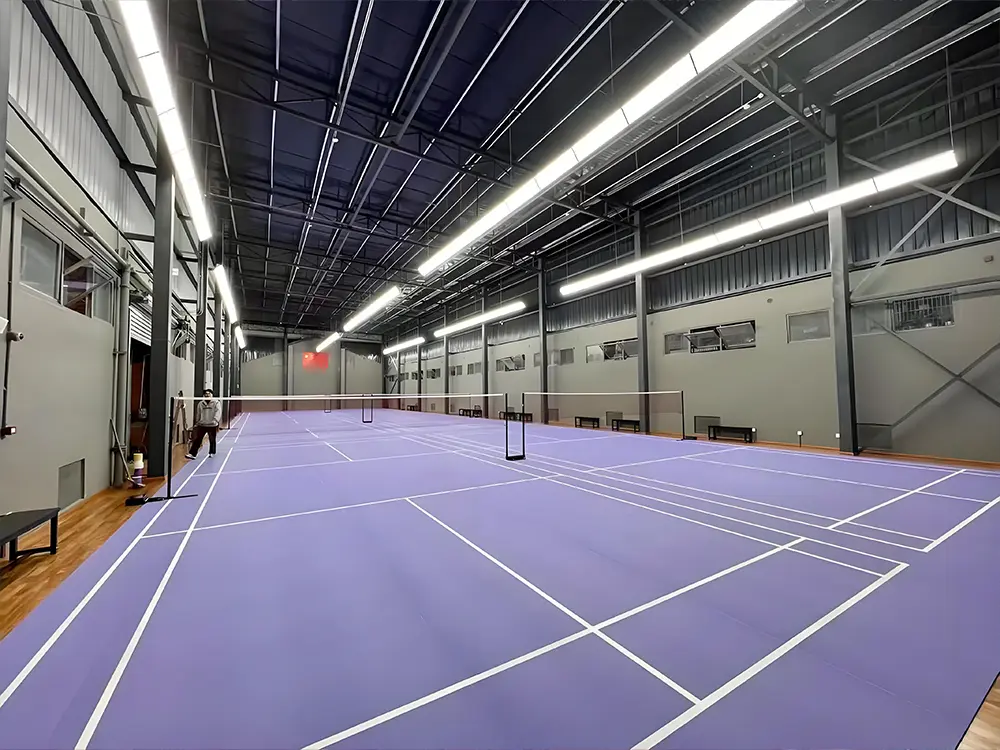
When planning to build a badminton court, the thickness of the PVC sports flooring is one of the most easily misunderstood yet crucial decision-making factors. Many court builders only focus on surface texture and overall price, ignoring the impact of thickness on the sports experience, athlete safety, court lifespan, and long-term operating costs.
As a sports flooring manufacturer, Dongxing has found that 60% of badminton court problems stem from incorrect thickness selection, a mismatch with needs. Floors that are too thin result in insufficient shock absorption and frequent athlete injuries; floors that are too thick cause unnecessary cost waste and may even affect the bounce performance of the shuttlecock.
1. Understanding Badminton Court Mat Thickness
Total Thickness:
Refers to the overall thickness of the flooring from the bottom layer to the surface, determining the flooring’s shock absorption, rebound, and sound insulation performance.
Abrasion Layer Thickness:
Refers to the thickness of the transparent PVC layer on the flooring surface, directly determining the flooring’s lifespan and is a more important indicator than the total thickness.
2. Commonly Used PVC Badminton Flooring Thicknesses
| Total Thickness | Common Wear Layer Thickness |
|---|---|
| 4.5mm | 0.45mm-0.5mm |
| 5.0mm | 0.5mm-0.6mm |
| 6.0mm | 0.6mm-0.7mm |
| 7.0mm | 0.7mm-0.8mm |
| 8.0mm | 0.8mm-1.0mm |
3. Relationship Between Thickness and Vinyl Flooring Structure
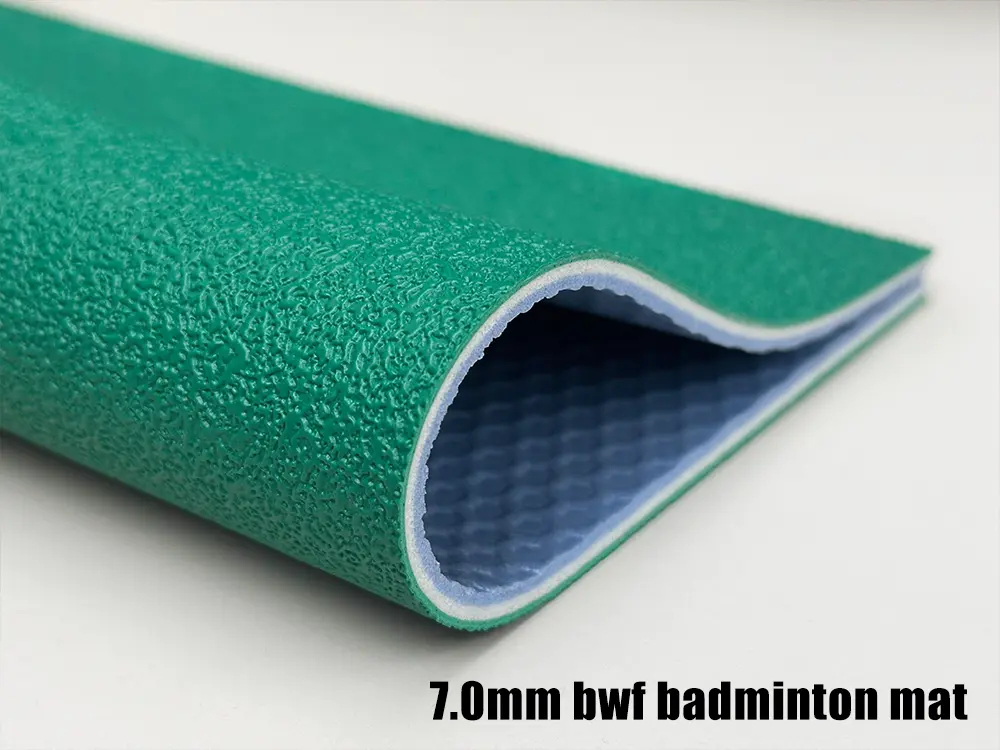
Dense Base Structure: High hardness, fast rebound, but poor shock absorption. This structure is commonly used in pickleball court flooring materials.
Foamed Base Structure: Good shock absorption, comfortable feel, but slightly slower rebound; currently the mainstream structure.
Multi-layer Composite Structure: A combination of dense and foamed layers, offering the most balanced performance, but slightly more expensive than the above two.
4. The Impact of Thickness on Performance
4.1 Shock Absorption and Impact Resistance
Shock absorption performance is the most important indicator of badminton flooring, directly related to the joint health of athletes. The Badminton World Federation (IBF) requires professional competition courts to have an energy absorption value ≥20%.
4.5mm Flooring: Energy absorption value approximately 12%-15%, insufficient shock absorption, long-term use can easily lead to knee, ankle, and lower back injuries.
6.0mm Flooring: Energy absorption value approximately 22%-25%, meets international standards, effectively absorbs the impact of sports.
7.0mm Flooring: Energy absorption value approximately 28%-32%, optimal shock absorption, meets BWF tournament certification, suitable for high-intensity professional training and competition.
It is important to note that many people believe the thicker the shock absorption, the better. However, for badminton, energy absorption exceeding 35% can actually affect the athlete’s starting speed and increase energy consumption. This is why international competition courts typically choose 7.0mm flooring instead of the thicker 8.0mm, and it is also the optimal thickness choice for BWF certification.
4.2 Ball Rebound Consistency
The bounce height and consistency of the shuttlecock are key criteria for judging the quality of a badminton court. A standard badminton shuttlecock dropped freely from a height of 1.8 meters should bounce between 1.15 and 1.35 meters, with a bounce height difference of ≤5cm between different locations on the same court.
Too thin (<4.5mm): Uneven ground surfaces will be directly reflected on the floor surface, resulting in uneven shuttlecock bounces.
Medium thickness (6.0-7.0mm): Effectively masks minor unevenness on the ground, ensuring consistent shuttlecock bounce.
Too thick (>8.0mm): An overly soft floor will reduce the shuttlecock bounce height, affecting the fairness of the game.
4.3 Sports Safety and Slip Resistance
Thin flooring has low deformation and a high surface friction coefficient, but excessive hardness can lead to serious injuries upon fall.
Medium-thickness flooring has moderate deformation, providing sufficient grip while offering cushioning upon fall.
Thick flooring has high deformation, slightly reducing the surface friction coefficient, but minimizing injury upon fall.
4.4 Durability
4.5mm: Lifespan approximately 3-5 years with 4 hours of daily use.
6.0mm: Lifespan approximately 6-8 years.
7.0mm: Lifespan up to 10-12 years.
5. Recommended Optimal Badminton Floor Thickness
International Professional Competition-Grade Courts
Recommended Thickness: 7.0mm (BWF Standard, Abrasion Layer ≥ 0.7mm)
Energy Absorption: 25%-30%, Ball Rebound Height: 1.2-1.3 meters
Suitable for international and national competitions
Representative Products: BWF-PVC Badminton Flooring with Crystal Sand
Club/Commercial Courts
Recommended Thickness: 6.0mm (Abrasion Layer ≥ 0.6mm)
This is currently the most cost-effective option on the market.
Lifespan: 6-8 years with 8-12 hours of daily use.
Performance close to professional competition-grade, but at approximately 30% lower cost.
Suitable for most commercially operated badminton courts.
Other Recreational Courts
Recommended Thickness: 4.5-5.0mm (Abrasion Layer ≥ 0.45mm)
Low usage frequency, approximately 3-5 times per week. Limited space; thicker flooring is not required.
6. The Impact of Thickness on Cost
Thicker flooring is heavier, making it more difficult to move and install; thicker flooring requires more glue and seam tape, leading to fluctuating material costs; for older, uneven floors, choosing slightly thicker flooring can save on surface preparation costs; however, blindly pursuing thickness is not advisable, as it increases the material cost of the flooring itself. The choice should be based on the intended frequency of use. Although the initial investment for 7.0mm badminton flooring is higher than that for 4.5mm, the total cost over its lifespan is actually lower! The thickness of the wear layer, not the overall thickness, is the key factor determining the lifespan of the flooring.