
Pickleball has evolved from a niche sport into one of the fastest-growing sports globally. This is no accident, as consulting on materials and solutions for this sport has recently become a larger proportion of our business at Dongxing Sports Flooring. We carefully listen to the diverse needs of our clients building pickleball courts, as it’s not simply a matter of indoor versus outdoor use. We consider the age of the players, their aesthetic preferences, whether the court can accommodate other sports, and how to enhance its convenience.
The same applies to other sport courts. Clients expect more than just a surface material; they seek a complete court construction plan, considering our pricing and budget. Based on user feedback, we continuously refine our pickleball flooring products to meet a wider range of needs. If you’d like to learn more about choosing pickleball court materials, we recommend reading: 2026 Best Pickleball Court Materials
Or visit our product section for more information.
To help clients successfully complete their pickleball court construction, we’ve prepared a detailed plan for your reference, based on our production and practical construction experience.
1. Pre-Construction Planning
1.1 Site Selection
A good site should have the following characteristics:
- Proximity to residential areas or communities
- Convenient parking
- Lack of similar businesses nearby.
Note: If your goal is commercial profitability, site selection is even more important than construction itself. We understand that many users build pickleball courts through leasing, and they often prioritize budget costs from the outset. Therefore, profitability becomes crucial to ensure a high return on investment.
1.2 Consider Indoor vs. Outdoor
Indoor courts can operate 24/7, offering more stable revenue, but initial investment costs are higher.
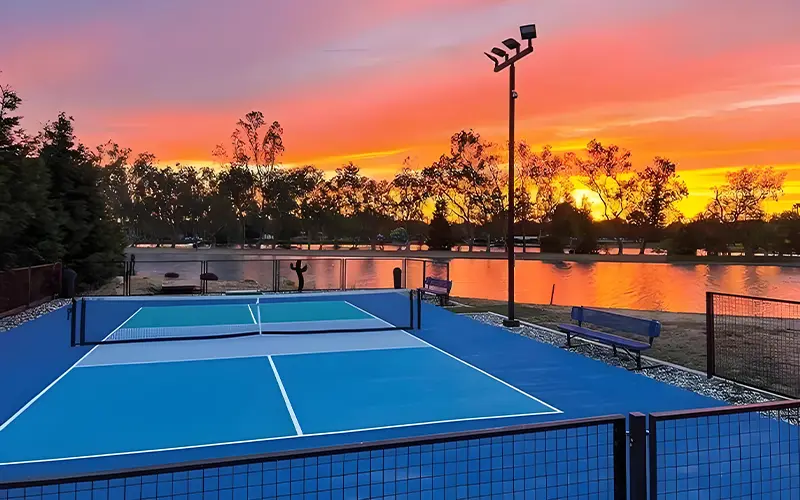
Outdoor courts have lower initial investment but are more susceptible to weather conditions. If your country is in a rainy region, indoor courts are more suitable, and vice versa.
1.3 Budget and Return on Investment
The main budgets for building a complete pickleball court include:
- Surface materials and construction/installation costs.
- Fencing and lighting (indoor).
- Labor costs.
- Court purchase/leasing costs.
- Other ancillary facilities.
Therefore, overall, surface materials are critical, as they directly affect the playing experience and budget.
2. Standard Pickleball Court Dimensions
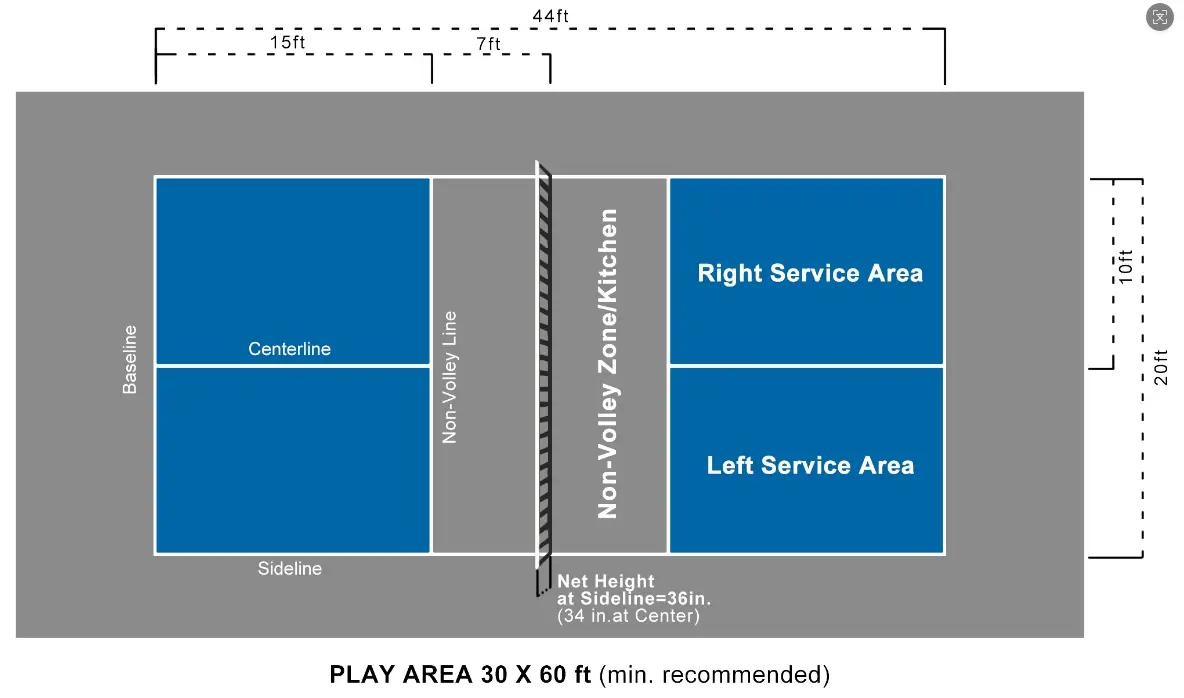
The standard pickleball court, for both doubles and singles, has a universal core frame size of 13.41m (44 feet) long and 6.10m (20 feet) wide, identical to the frame size of a doubles badminton court, allowing for compatible modifications.
(This is important because we’ve encountered users who needed a pickleball court that could also be used as other courts; understanding the relationship with badminton court dimensions, in addition to using convenient flooring materials, can help you make better decisions.)
The effective width of the singles court is reduced to 5.49m, while the length remains unchanged at 13.41m.
Dimensional tolerance requirements:
For line segments shorter than 5m within the court, the dimensional error ≤ ±5mm; for other longer line segments, the error is controlled within 0.1% of the specified value; the diagonal length difference of the court ≤ 10mm, ensuring the court is square and free from deformation.
2.1 Safety Buffer Zone Dimension Requirements
Recreational level: ≥ 1.5m outside the sidelines, ≥ 1.8m outside the baselines. Overall pickleball court dimensions: 17.01m × 9.10m
Tournament level: ≥3.05m outside the sidelines, ≥3.05m outside the baselines.
Overall pickleball court dimensions: 19.51m × 12.19m
Wheelchair access: Dedicated widened buffer zone, 22.56m × 13.41m.
2.2 Functional area marking standards
Non-volley zone (kitchen area): A rectangular area extending 2.13m (7 feet) from the net to each side of the court; this is the core functional area of the pickleball court.
Service Area: Located behind the non-volley zone, the court is divided into two equal service areas by the center line. Each service area measures 3.05m (length) x 2.44m (width), and all four service areas must be identical in size.
The functional areas, i.e., the lines on the pickleball court floor, are provided directly by us as the manufacturer. We guarantee that the lines are standardized and neat, the custom-printed pickleball flooring has clear patterns, and the court lines are standard.
2.3 Court Clearance and Orientation Requirements
The indoor clearance height must be ≥6.10m, and the lowest point of international competition-grade lighting fixtures must be ≥7.62m from the ground.
The court sidelines must run north-south to minimize direct sunlight interference with the players’ vision. The core inspection standard for indoor lighting is glare-free illumination.
3. Pickleball Court Construction Material Standards
3.1 Foundation
The concrete foundation standard requires a strength grade ≥ C25, flexural strength ≥ 3.5 MPa, thickness ≥ 120 mm, reinforcement using ≥ Φ8@150 bidirectional steel bars, and a protective layer thickness ≥ 40 mm. The surface flatness error within 3 meters should be less than 2-3 mm.
3.2 Pickleball Court Flooring Materials
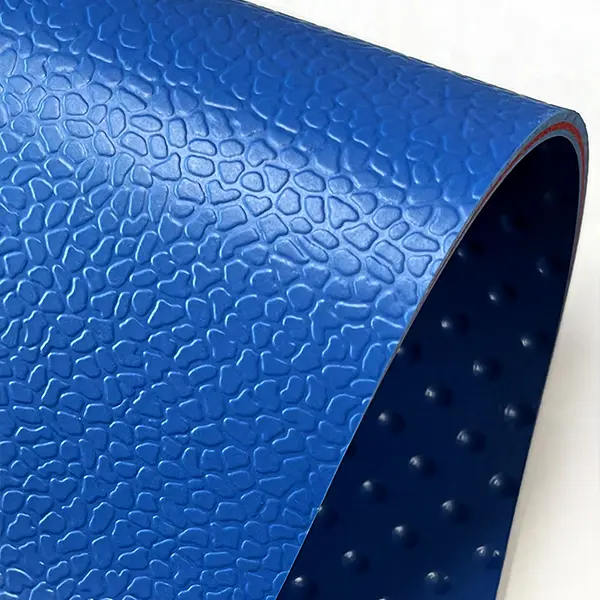
Based on our production experience at Dongxing Plastics, we highly recommend PVC roll flooring. For outdoor use, materials with an acrylic coating can be used. This is commonly used in many international pickleball courts. You can also compare materials with well-known pickleball clubs and other venues in your area to help you make a decision.
The flooring material should meet the following performance requirements:
- Ball rebound rate: ≥75%
- Shock absorption: 20%-40%
- Vertical deformation: 0.6-3.0mm
If you ignore these performance characteristics when purchasing pickleball court materials, ball rebound issues are likely to occur after the court is laid, directly affecting the experience. Rework will mean higher costs. Therefore, you cannot only consider the price and ignore the quality, otherwise it will be a losing proposition.
Recommended Products:
3.3 Indoor Pickleball Lighting Standards
| Venue Usage Scenario | Average Horizontal Illuminance | Average Vertical Illuminance | Illuminance Uniformity | Applicable Scenarios |
|---|---|---|---|---|
| Recreational Fitness Level | ≥300 lux | ≥200 lux | ≥0.6 | Community, campus recreational venues, daily training |
| Club Training Level | ≥500 lux | ≥300 lux | ≥0.7 | Commercial clubs, professional training venues |
| International Competition Level | ≥1000 lux | ≥750 lux | ≥0.8 | IFP/USAPA certified international competitions, TV broadcast events |
3.4 Net and Net Posts
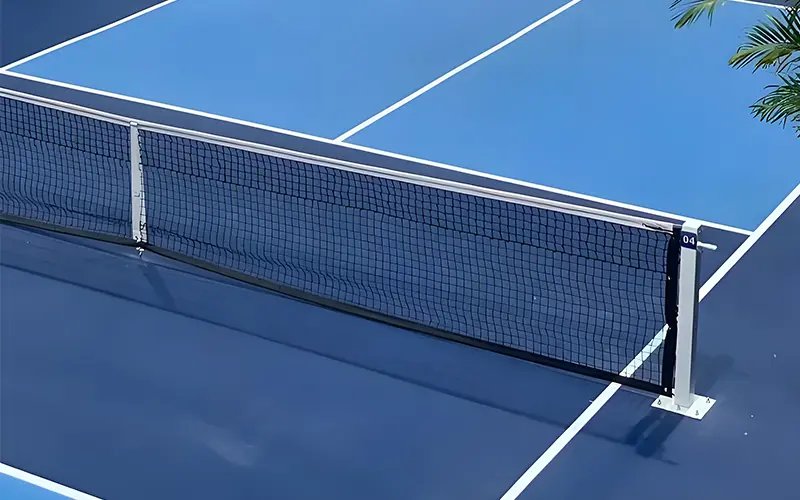
Net Specifications: High-strength nylon/polyester synthetic fiber, anti-aging, UV resistant, mesh size ≤50mm×50mm, 19mm×19mm professional tournament mesh is commonly used.
Net length between net posts ≥6.63m, net height ≥0.762m.
Reinforcement Requirements:
The top edge of the net is equipped with a 50.8mm wide white folded net strap with an internal steel wire rope for adjustable tension; the bottom edge is reinforced with thickened fabric tape or vinyl strips to ensure a flat net surface, uniform tension, and no significant sagging.
Net Post Specifications:
The center-to-center distance between two net posts is 6.71m. The maximum net post diameter is 76.2mm. Thickened steel pipes are used, with hot-dip galvanized and powder-coated anti-corrosion treatment. For outdoor courts, the net posts are buried at a depth of ≥60cm and fixed with C25 concrete. For indoor courts, in-ground or portable nets can be used, equipped with a net tensioning mechanism to ensure stable net tension at 300-400N. The net post surface is free of sharp corners and burrs; all edges are rounded to prevent player injuries from collisions. For informal recreational courts, portable net systems that meet the size requirements can be used.
3.5 Fencing System
Fences are essential for both outdoor and indoor continuous playing fields. Their core functions are to isolate the playing area, intercept balls, and ensure safety.
Fence height ≥ 3.05m, with intermediate fencing height ≥ 2.5m for continuous playing fields; wire diameter ≥ 3mm, using PE-coated chain link mesh, 50mm×50mm mesh size.
Posts are made of 60×60mm square tubing, wall thickness ≥ 2.5mm, hot-dip galvanized + powder-coated finish, post spacing ≤ 3m, burial depth ≥ 50cm, fixed with C25 concrete.
3.6 Rest Area Facilities
A rest area is crucial for sports centers with multiple pickleball fields. Seating, benches, referee chairs, scoreboards, drinking fountains, etc., must be adequately provided.
4. Pickleball Field Construction Acceptance Standards
Inspect the strength, flatness, and slope of the base concrete.
Testing includes: pickleball court floor thickness, ball rebound rate, impact absorption, marking accuracy, weld strength, and acrylic coating adhesion; full court dimension verification, net and net post installation inspection, lighting system illuminance and glare testing, safety inspection of fencing and supporting facilities, and drainage system water flow testing.
Standardized pickleball court construction provides the best playing experience, is favored and recommended by enthusiasts, and reduces maintenance costs and operational risks. This article incorporates our considerations as a manufacturer regarding user needs, helping you build sports courts faster and better, and enabling our sports flooring products to better serve you. We are committed to the production and R&D of indoor and outdoor sports court flooring materials, continuously improving to meet user needs. We welcome you to request our free samples for testing!