
For basketball enthusiasts worldwide, owning their own backyard basketball court is a fantastic idea. It allows them to dedicate more free time to basketball without the hassle of searching for a court. It’s a great way to improve skills or simply enjoy playing. Choosing the right materials and installation method is the best way to save costs when laying backyard basketball court flooring.
1. Why PP Interlocking Tiles?
Modular interlocking sports flooring is undoubtedly the best flooring material for your backyard basketball court. It offers a low price, easy installation, waterproof and UV resistant properties, reusability, and the ability to replace only individual tiles. It also boasts a wide range of colors and customizable patterns. These features are unmatched by any other sports flooring material.
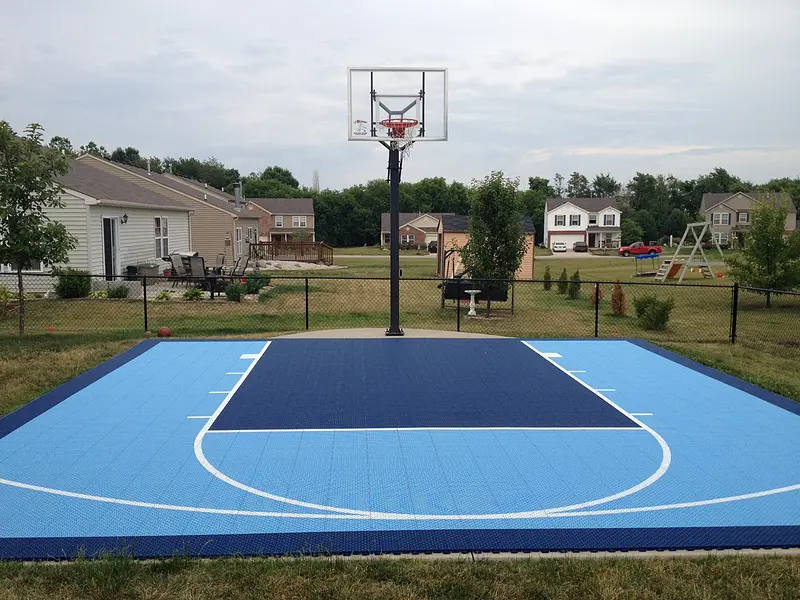
The modular design and interlocking mechanism require no professional installation tools; one person can easily install the backyard basketball court.
It has low surface requirements, requiring only a flat surface, and can even be installed on gravel surfaces.
It’s easy to install and disassemble; if you no longer want to use your backyard as a basketball court, you can easily disassemble and reuse it.
Rubber or acrylic coatings are fixed and permanent surfaces, but their installation and purchase costs are high, requiring professional installation teams. Furthermore, their performance for outdoor use isn’t necessarily better than PP tiles.
Recommended products: Outdoor Basketball Court Tiles DX25
2. Standard Half-Court Basketball Flooring Cost
Backyards typically feature 3×3 half-court basketball courts, with the most common standard half-court being 15m x 14m = 210 square meters.
Therefore, the total cost includes: flooring material cost + subfloor preparation cost + accessory cost + transportation/tax cost.
If your subfloor requires no additional treatment and can remain level after basic cleaning and repairs, this cost is almost zero.
Therefore, the key factor is the price of PP sports flooring tiles, along with transportation and taxes. Different modular sports flooring options have different prices and structural patterns; the final cost can be determined based on the quoted price or retail price. Generally, backyard basketball courts are not professional venues; meeting daily training and leisure requirements is sufficient, so durable and moderately priced products are suitable.
If you are a distributor and have a certain purchasing volume with the manufacturer, we can provide the matching edge trim free of charge, which is more cost-effective for bulk orders.
3. DIY Basketball Court Installation Steps
Installation is extremely simple and can be completed in one day by 1-2 people.
Substrate Preparation (1-2 hours): Clean the substrate of debris, pebbles, and weeds, ensuring the ground is flat, dry, and free of oil stains;
If there are small pits in the substrate, repair them with cement mortar; cracks can be sealed with tape and will not affect installation.
Floor Installation (3-4 hours): Start from one corner of the court and assemble the floorboards in sequence, aligning the male and female interlocking threads, and gently tap with a rubber mallet to ensure the interlocking is complete;
Check the flatness after every 5-10 tiles to ensure there are no warped edges or loose tiles;
Leave a 5-8mm expansion joint around the perimeter of the court to prevent arching due to thermal expansion in summer.
Edge Finishing and Marking (1-2 hours): Wrap the perimeter of the court with edge finishing strips and secure them to the ground with expansion bolts to prevent tripping. Use masking tape to mark the three-point line, free throw line, and center line. Apply polyurethane marking paint and remove the masking tape after the paint dries.
Installation Tips: Keep the grain direction of the flooring consistent during installation to avoid color differences. If cutting the flooring is necessary, it can be easily done with a utility knife or electric saw.
4. FAQ
How long do interlocking basketball tiles last?
100% virgin PP interlocking floor tiles can last 3-5 years or more under normal use. High-quality tiles last even longer.
Do interlocking basketball courts drain well?
No water accumulation after rain; stable anti-slip properties.
Can interlocking basketball court tiles be laid directly on concrete?
Yes, as long as the concrete surface is flat, without a significant slope, cracks, or gravel, the tiles can be laid directly without any additional treatment.