
If you’ve ever sourced sports flooring for a court project, you’ve likely run into these three costly pitfalls:
ordering too little because you only measured the in-bounds playing area, miscalculating rolls vs. tiles, or over-ordering to “be safe” and wasting budget.
Therefore, accurate measurement and estimation of procurement quantities are crucial; as a sports flooring manufacturer, we provide relevant guidelines.
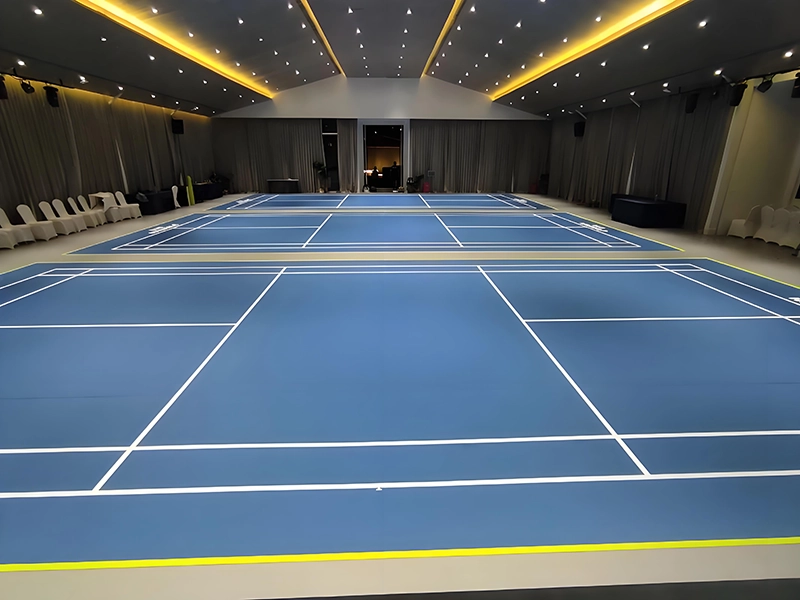
Step 1 — Measure the Total Flooring Area
Accurate quantity calculation starts with measuring the right area—not just the lines on the court. Skipping this step is the #1 reason projects run short of material mid-installation.
Measure the Actual Installation Area
For standard rectangular courts, calculate the base area with the basic formula:
Area= Length × Width
For projects with multiple rectangular zones (such as separate courts, warm-up areas, or walkways), calculate each zone individually and sum the totals. For irregularly shaped courts or facilities with curved edges, divide the space into simple geometric shapes (rectangles, triangles, half-circles), calculate each segment, and add them together. For multi-court facilities, distinguish between individual court areas and the full continuous paved zone—shared divider strips and perimeter walkways all require flooring and must be included.
Playing Area vs. Total Installation Area
This is the most common source of under-ordering. The playing area is the zone inside the official boundary lines, while the total installation area includes safety run-off zones, border buffers, and walkways outside the lines. For example, a standard pickleball playing area is only 20 × 44 ft, but the minimum recommended full playing surface with run-off is 30 × 60 ft, and tournament-standard facilities extend even further to 34 × 64 ft. Always use the full installed footprint, not just the in-bounds lines, for your quantity calculation.
Step 2 — Calculate the Flooring Quantity Based on Material Type
Total area alone does not equal order quantity. Your calculation method must match the material format, as roll goods and modular tiles follow completely different sizing and layout logic.
PVC Sports Flooring Rolls
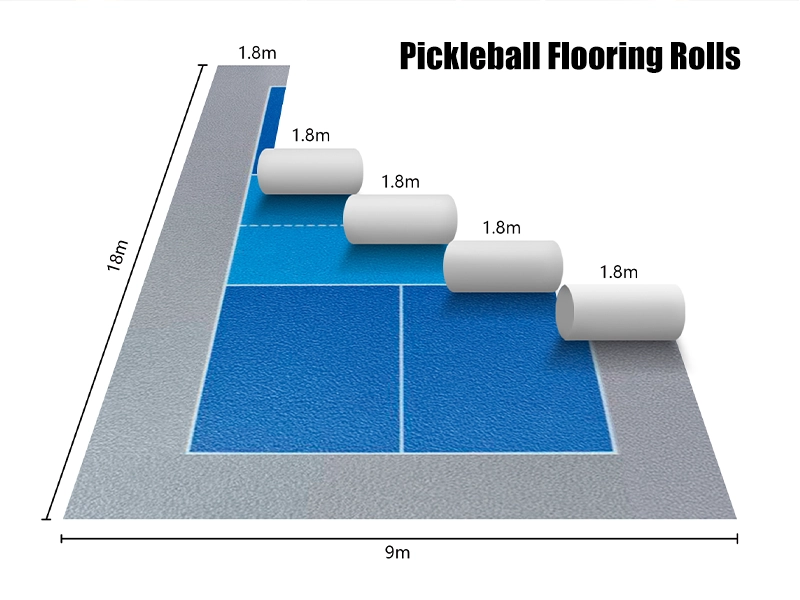
Never calculate roll quantity by dividing total area by the area of one roll—this will almost always give you an incorrect low number. PVC sports flooring rolls have fixed widths, and layout orientation, seam placement, and edge trimming all impact total usage. Follow this workflow:
- Confirm the actual usable roll width (accounting for weld/overlap allowance) and standard roll length (common sizes include 2m × 20m and 1.8m × 15m)
- Choose your laying direction, then divide the court width by the roll width to find the number of strips required. Round up to the next whole number—partial strips are not usable.
- Calculate the length of each strip: court length plus cutting allowance on both ends (typically 5–10cm per end for trimming).
- Multiply strip count by strip length to get total linear meters required.
- Compare total linear meters to standard roll lengths to determine how many full rolls are needed. Mixing different roll widths usually increases offcuts, so stick to one width where possible.
PP Interlocking Sports Floor Tiles
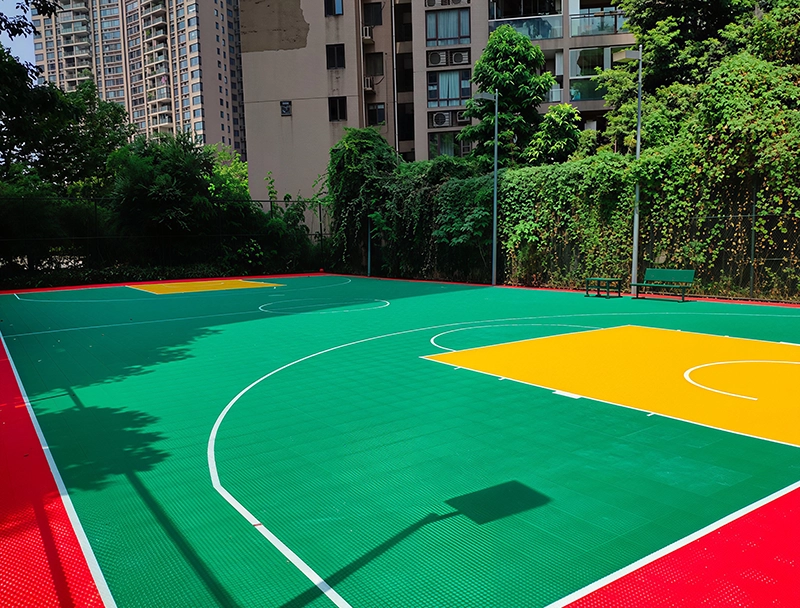
For square modular tiles, the basic area-based formula gives a starting estimate:
Tiles Required= Floor Area / Tiles Area
For maximum accuracy on rectangular courts, calculate using rows and columns instead:
Rows = Court Length / Tiles Length
Columns = Court Width / Tile Width
Total Tiles = Rows × Columns
This method accounts for partial tiles along edges that simple area division misses. Always cross-check against packaging units (tiles per carton) and round up to full boxes.
Step 3 — Add a Waste Allowance
Even with perfect layout calculations, you need extra material for cutting, mistakes, and on-site adjustments. The right waste rate depends entirely on your project specifics.
What Affects Sports Flooring Waste?
Several factors determine how much extra material you’ll need:
- Court shape: Perfect rectangles have the lowest waste; irregular, angled, or rounded courts have much higher offcut rates.
- Material fit: When roll width or tile size divides evenly into court dimensions, waste is minimal. Mismatched sizes mean more trimming.
- Laying direction: Changing orientation to optimize seams or match patterns can increase cutting waste.
- Obstacles: Columns, recessed corners, equipment mounts, and floor penetrations all require custom cutting and increase waste.
- Custom designs: Multi-color layouts, logos, and patterned inlays require extra material and generate more offcuts.
How to Calculate the Extra Quantity
Use this formula to add waste to your net installation area:
Order Area= Net Area × (1 + Waste Rate)
For example, if your net installation area is 167.2 m² and you apply an 8% waste allowance:
167.2× 1.08=180.576m²
Important note: 8% is for illustrative purposes only—it is not a universal standard. Simple rectangular courts with PVC rolls typically need only 3–5% waste, while PP tiles on regular grids may need only 2–4%. Irregular sites with obstacles or custom graphics can require 8–12% or more. Always base your waste rate on a detailed layout plan, not a rule of thumb. Also remember: waste-adjusted area is a reference value, not your final order quantity. You must still round up to full rolls, full cartons, or minimum order quantities.
Step 4 — Calculate the Quantity for a Real Court Project
The following hypothetical examples walk through the full calculation process for two common court build scenarios.
Example 1 — A 30 × 60 ft Court with PVC Roll Flooring
Hypothetical project for illustration only
- Calculate gross court area: 30 ft × 60 ft = 1,800 ft²
- Convert to square meters: 1,800 ÷ 10.7639 ≈ 167.2 m²
- Specify material: 2m wide PVC sports flooring roll, 20m standard length, laid lengthwise along the 60ft side.
- Calculate strip count: Court width ≈ 9.144m. 9.144 ÷ 2 = 4.572, so 5 strips are required (4 strips would leave an uncovered gap).
- Calculate strip length: Court length ≈ 18.288m, plus 0.1m trimming allowance on each end = 18.488m per strip.
- Total linear meters: 5 × 18.488 = 92.44 m
- Add 8% waste: 92.44 × 1.08 ≈ 99.84 linear meters
- Convert to rolls: 99.84 ÷ 20 = 4.99, so 5 full rolls (100 linear meters) are required.
Note: If you had simply divided total area by roll area (40m² per roll), you would have calculated only 4.2 rolls and severely under-ordered.
Example 2 — A Rectangular Court with PP Tiles
Hypothetical project for illustration only Assume the same 167.2 m² net installation area, using 0.3048m × 0.3048m (1ft × 1ft) PP interlocking sports floor tiles.
- Calculate single tile area: 0.3048 × 0.3048 ≈ 0.0929 m²
- Area-based estimate: 167.2 ÷ 0.0929 ≈ 1,800 tiles
- Verify with row/column method (court: 9.144m × 18.288m):
- Rows: 18.288 ÷ 0.3048 = 60 (exact fit)
- Columns: 9.144 ÷ 0.3048 = 30 (exact fit)
- Total tiles: 60 × 30 = 1,800 tiles
- Add 5% waste for breakage and future repairs: 1,800 × 1.05 = 1,890 tiles
- Adjust for packaging: 24 tiles per carton. 1,890 ÷ 24 = 78.75, so round up to 79 cartons (1,896 tiles).
On courts where dimensions do not divide evenly by tile size, the row/column method will produce a higher (and more accurate) count than pure area division.
Step 5 — Don’t Forget These Items Before Ordering
Flooring material is only part of your procurement list. These items are often overlooked but critical to a complete installation.
Court Lines and Multi-Sport Markings
Court lines do not add extra floor area, but they impact your material order. Pre-printed line systems require color-separated material zones and custom cutting plans. Field-painted lines may not change material quantity but will affect installation scheduling. For multi-color or multi-sport courts, calculate each color zone separately and apply waste rates per zone.
Packaging and Minimum Order Quantities
Confirm packaging units before finalizing your order: rolls come in fixed lengths, tiles come in full cartons, and custom colors often have minimum order quantities. Ordering partial rolls or split cartons is usually not possible, so always round up to the next full unit. Also verify batch consistency—ordering all material from one production run avoids color mismatch.
Installation Accessories
Adhesives, welding rods, edge trims, ramp profiles, fasteners, and underlayments are often sold separately and must be calculated independently. For PVC rolls, you’ll need adhesive for full-bond installation and welding rod for seams. For PP tiles, count edge pieces and corner pieces separately from main field tiles.
Spare Material for Future Repairs
Set aside a small quantity of material for future damage repairs, but don’t overstock. Reserve 1–2 cartons of tiles or 3–5 linear meters of roll material for standard projects. Increase spares for custom colors or discontinued products where replacement material will be hard to source later.
Common Mistakes When Estimating Sports Flooring Quantity
Avoid these frequent errors that lead to shortages, waste, or budget overruns:
❌ Only calculating the in-bounds playing area and ignoring safety run-off zones
✅ Always measure the full actual installation footprint
❌ Dividing total area by roll area to get PVC roll quantity
✅ Calculate strip count, strip length, and round up to full rolls
❌ Using only area division for PP tiles without checking rows/columns
✅ Verify with row × column count, then round to full cartons
❌ Double-counting court lines as additional floor area
✅ Lines are part of the playing surface, not extra area
❌ Estimating using nominal sizes instead of actual installed dimensions
✅ Use manufacturer’s actual dimensions including seams and interlock allowances
❌ Treating waste allowance as the final order quantity
✅ Always round up to full rolls, cartons, or MOQs after adding waste
Frequently Asked Questions
How do you calculate sports flooring quantity?
Start by measuring the full actual installation area (not just the playing lines). Then calculate rolls, tiles, or planks based on the material’s actual dimensions and installation layout. Finally, add site-appropriate waste, and round up to match packaging specs and minimum order quantities.
How much extra sports flooring should I order?
There is no universal percentage. Waste rates depend on site layout, cutting requirements, material dimensions, and installation complexity. Regular rectangular courts typically need 2–5% extra, while irregular sites with obstacles or custom patterns may require 8–12%. Always confirm with a detailed layout plan.
How many PP tiles are needed for one square meter?
Divide 1 m² by the actual installed area of one tile. For a standard 0.3048×0.3048 m tile, that equals roughly 10.76 tiles per m². For true accuracy, calculate based on exact rows and columns across the full court dimensions, then adjust for packaging quantities.
How do you calculate PVC sports flooring rolls?
First confirm court dimensions and roll specifications (width, standard length). Choose your laying direction, then calculate how many strips are needed to cover the court width. Multiply strip count by strip length (plus cutting allowances), add waste, then round up to the nearest full roll.
Should I calculate the playing area or the full court area?
Always calculate the total area that will actually receive flooring, which almost always extends beyond the in-bounds playing lines to include safety run-offs, border zones, and walkways. Using only the official playing area will almost always result in under-ordering and mid-project delays.
Can a sports flooring supplier calculate the exact quantity?
Yes, a professional sports flooring supplier can review your court dimensions, material selection, and layout drawings to provide a precise quantity breakdown. The final order list should confirm cutting plans, packaging units, and any installation-specific requirements for your project.
Conclusion — Get an Accurate Sports Flooring Quantity Estimate
If you’re planning a court project and want a precise, customized quantity calculation, share these details with our team:
– Exact court length and width
– Number of courts in the project
– Preferred flooring material and model
– Indoor or outdoor application
– Preferred tile or roll dimensions
Contact Dongxing Sports Flooring today for professional quantity takeoff services and competitive pricing for your sports court project.