
When comparing 2mm and 3mm homogeneous vinyl flooring, a greater thickness is not necessarily better. As long as requirements regarding wear resistance, indentation resistance, fire ratings, and installation standards are met, 2mm homogeneous flooring is generally sufficient for many commercial and healthcare applications. Due to its increased thickness, 3mm homogeneous flooring is better suited for projects where long-term durability, high-frequency continuous foot traffic, or an exceptionally long service life are core requirements.
Moreover, the durability of homogeneous vinyl is not determined solely by thickness. Its actual performance and lifespan depend on a combination of factors, including wear resistance, wear rating/abrasion performance, residual indentation, product classification, rolling load capacity, chemical resistance, surface treatment, installation quality, and routine maintenance.
1. What Does Thickness Mean in Homogeneous Vinyl Flooring?
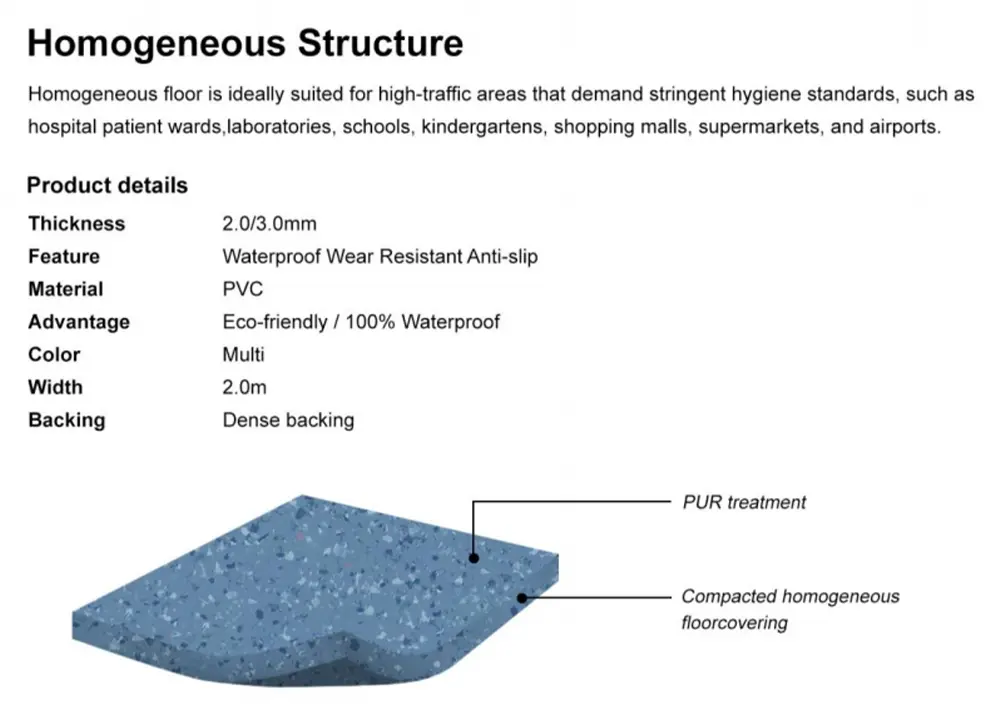
Homogeneous vinyl flooring is defined by its single-layer, uniform construction: the same PVC-based material composition runs consistently through the full thickness of the sheet or plank. Unlike heterogeneous vinyl flooring, which features a separate decorative film and transparent wear layer laminated on top of a structural backing layer, homogeneous vinyl has no distinct layered structure.
This means that as the surface abrades over time, the same material, color and pattern remain exposed underneath. For this reason, total thickness directly correlates with the total volume of wear material available — but it is only one variable that governs how well the floor holds up under real-world conditions.
2. 2mm vs 3mm Homogeneous Vinyl Flooring at a Glance
| Specification | 2mm Homogeneous Vinyl | 3mm Homogeneous Vinyl |
|---|---|---|
| Total thickness | 2.0 mm | 3.0 mm |
| Material construction | Homogeneous | Homogeneous |
| Wear performance | High | High |
| Material volume | Lower | Higher |
| Initial material cost | Usually lower | Usually higher |
| Weight per m² | Lower | Higher |
| Handling | Easier | Heavier |
| Cutting/installation | Easier | Slightly more demanding |
| Traffic resistance | Suitable for heavy commercial use | Suitable for demanding heavy-use environments |
| Service-life potential | High when properly specified | Higher material reserve |
| Typical applications | Hospitals, schools, offices, commercial areas | High-traffic hospitals, public facilities, demanding commercial areas |
| Best selection criterion | Project specification + performance | Project specification + lifecycle requirement |
3. 2mm Homogeneous Vinyl Flooring: When Is It Enough?
A thickness of 2mm is the standard recommendation for most hospital areas—such as patient rooms, outpatient clinics, nurse stations, corridors with low-to-moderate foot traffic, and general treatment areas.
Classrooms, lecture halls, staff offices, corridors, and public areas in schools and higher education institutions. Homogeneous flooring with a 2mm thickness is capable of withstanding daily foot traffic, the movement of furniture, and routine cleaning procedures.
Includes open-plan offices, retail stores, boutiques, public lobbies, and various administrative office buildings.
Hotel guest room floors, airport boarding gate areas, library reading rooms, and various municipal buildings.
Quality cannot be judged solely by thickness. Unlike heterogeneous flooring—where thickness is largely determined by the wear layer—homogeneous flooring is inherently highly wear-resistant. Provided it meets the relevant standards for commercial/industrial ratings, abrasion resistance, residual indentation limits, and rolling load capacity, a 2mm thickness offers a practical and cost-effective solution.
4. 3mm Homogeneous Vinyl Flooring: When Is It Worth Choosing?
3mm homogeneous vinyl represents a step up in total material volume, and is typically chosen for projects where performance certainty and long service life outweigh upfront budget savings. There are two core scenarios where 3mm is usually the stronger specification choice.
4.1 High-traffic and heavy-use environments
For spaces with near-continuous foot traffic, frequent wheeled equipment, or heavy daily use, the extra material reserve of 3mm flooring adds a margin of safety against wear through. Typical examples include busy hospital main corridors, public transportation terminals, airport concourses, large school main hallways, and high-footfall public government buildings. These spaces experience consistent abrasion, rolling loads and impact that can accelerate wear on thinner flooring over time.
4.2 Long-term lifecycle requirements
For capital projects designed for 10–15+ years of uninterrupted service, 3mm homogeneous vinyl is best evaluated on total lifecycle cost rather than upfront purchase price.
It is critical to distinguish initial purchase cost from full lifecycle cost:
Lifecycle Cost = Initial Flooring Cost + Installation Cost + Ongoing Maintenance + Repair / Replacement Costs
A thicker floor may cost more at purchase, but can deliver a longer service window, reduce the frequency of replacement, and lower downtime and disruption costs over the life of the facility. For building owners with a long-term hold strategy, this often makes 3mm the lower-net-cost option over a 15+ year horizon.
5. Does 3mm Homogeneous Vinyl Flooring Last Longer Than 2mm?
Not necessarily.
Because homogeneous vinyl is made of the same material through its entire thickness, a thicker product does contain a larger reserve of wear material. In theory, all else being equal (same manufacturer, same formulation, same installation, same traffic), 3mm flooring will have a longer usable life than an equivalent 2mm product.
However, all else is rarely equal in real-world installations. Actual service life is heavily influenced by factors beyond thickness:
- Traffic intensity and type (foot traffic vs. wheeled equipment)
- Abrasion from tracked-in dirt, grit and footwear
- Rolling load frequency, weight and wheel type
- Subfloor flatness, smoothness and structural condition
- Installation workmanship, adhesive selection and seam weld quality
- Cleaning frequency, chemical products used and disinfection protocols
- Regular maintenance and prompt repair of localized damage
- Overall product manufacturing quality and PVC formulation
A high-quality, properly installed 2mm homogeneous floor can easily outperform a poorly manufactured, badly installed 3mm product. Thickness is an input variable, not a guaranteed outcome for durability.
6. Is 3mm Better for Hospital Vinyl Flooring?
Hospital flooring is one of the most common use cases for homogeneous vinyl, but there is no universal rule that all hospital areas require 3mm flooring. 2mm homogeneous vinyl typically meets performance requirements for many general hospital areas, provided it matches the project’s formal specification.
Hospital corridors and circulation areas
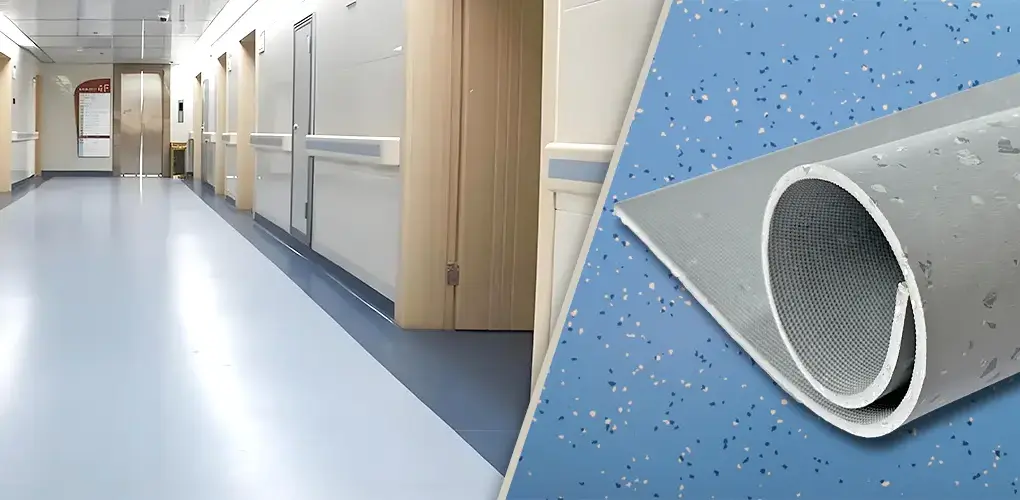
Busy hospital corridors handle constant foot traffic, patient beds, wheelchairs, medical carts and rolling equipment on a 24/7 basis. For these spaces, the critical performance metrics are rolling load capacity, residual indentation resistance and abrasion resistance — not just thickness. A 2mm floor with a high wear group rating and strong indentation performance may perform better than a lower-grade 3mm floor in the same setting.
Operating rooms and sterile areas
It is not mandatory for operating room flooring to be 3 mm thick. Specification for surgical suites is driven by functional requirements: rolling load capacity for surgical tables and equipment, resistance to disinfectants and surgical chemicals, seamless welded installation, coved skirting for hygiene, and compatibility with daily terminal cleaning protocols.
Many premium 2mm homogeneous vinyl products meet all of these requirements and are fully suitable for operating room use. 3mm may be preferred in facilities with extremely heavy equipment rotation or a very long planned service life, but it is not a mandatory requirement by default.
7. 2mm vs 3mm: Which One Has Better Cost Performance?
Cost performance depends entirely on the project’s traffic profile, expected service life and performance requirements. There is no universally “better” option — only the better match for your specific project constraints.
Initial material cost
- 3mm homogeneous vinyl: Uses more raw material per square meter, has higher sheet weight, and may carry slightly higher shipping costs due to increased density. Material cost is typically 15–30% higher than an equivalent-quality 2mm product from the same manufacturer.
- 2mm homogeneous vinyl: Requires less raw material, is lighter per roll, and generally has lower freight costs. This makes it the more budget-friendly option at the point of purchase.
Installation cost
Installation cost is driven far more by subfloor preparation, adhesive system, seam welding requirements, coving work and project logistics than by thickness alone. A 2mm floor that requires full subfloor leveling and fully welded seams may cost more to install than a 3mm floor laid on a well-prepared existing substrate. In most standard installations, the thickness difference between 2mm and 3mm creates only a minimal difference in labor cost.
Lifecycle cost performance
- For projects with moderate traffic, a planned 7–10 year replacement cycle, and tighter upfront budgets, 2mm homogeneous vinyl typically delivers the best cost performance. It provides sufficient durability for the service window without paying for unnecessary material thickness.
- For high-demand facilities where long service life, minimal disruption and reduced replacement risk are top priorities, 3mm homogeneous vinyl usually justifies its higher initial cost. The extended service life and lower long-term maintenance and replacement costs often result in a lower total cost of ownership over 10–15+ years.
Always verify product specifications against your project’s requirements, and prioritize tested, certified performance ratings over thickness alone.