
This is especially true for acrylic-coated PVC flooring, which is fundamentally different from traditional site-applied acrylic coating systems. In factory-produced acrylic PVC flooring, the surface coating is bonded to a PVC substrate under controlled manufacturing conditions, forming a composite sports flooring system. Buyers cannot test only the acrylic surface layer in isolation, nor can they evaluate only the PVC base material. A reliable evaluation must examine three levels:
- Surface coating performance
- PVC substrate performance
- Overall flooring system performance
The following eight quality checks help buyers identify material risks before placing an order, ensuring that the acrylic pickleball court flooring they purchase delivers consistent performance and durability in real outdoor environments.
Part 1. Understand What You Are Testing Before Buying
Why Acrylic-Coated PVC Pickleball Flooring Requires a Different Testing Approach
Traditional acrylic pickleball courts are constructed by applying multiple layers of acrylic coating directly onto a concrete or asphalt base on site. Each layer cures in place, forming a monolithic surface bonded to the substrate. Testing for these systems focuses primarily on coating hardness, texture, and adhesion to the rigid base beneath.
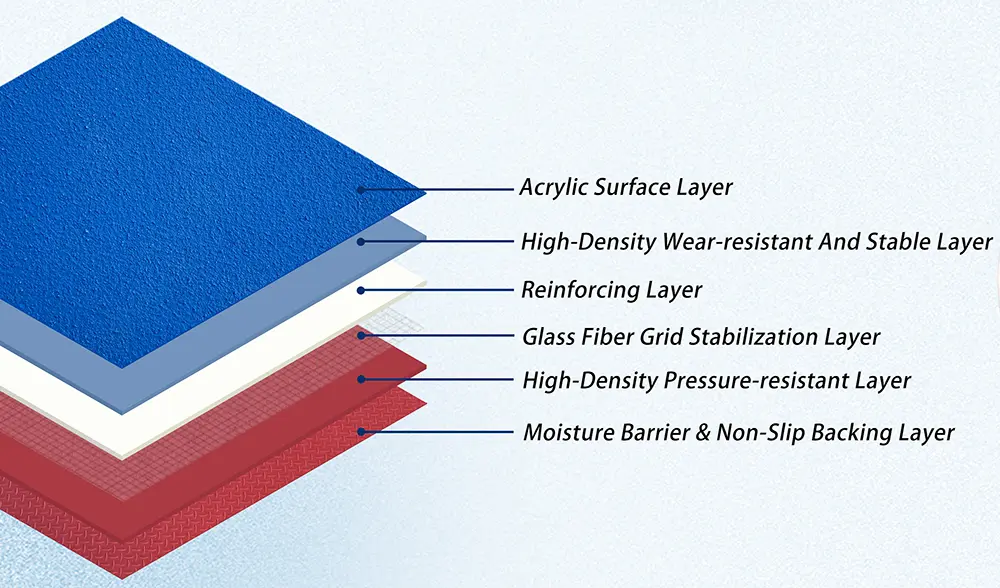
Acrylic-coated PVC flooring follows an entirely different structure. It is a prefabricated composite material consisting of a wear-resistant acrylic top layer, a flexible PVC core, and sometimes a backing layer. The entire product is manufactured in a factory, delivered in rolls, and installed over a prepared subfloor using adhesive and heat-welded seams.
This structural difference changes everything. Instead of evaluating a coating applied to a rigid base, buyers are evaluating a complete flexible flooring system. Temperature changes cause the PVC substrate to expand and contract, which puts stress on the acrylic surface bond. Foot impact compresses the PVC core, affecting both ball rebound and surface feel. Seams between rolls create potential failure points that do not exist in monolithic site-applied systems.
For these reasons, testing acrylic-coated PVC pickleball flooring requires evaluating the material as a complete system, not just individual components in isolation.
Three Layers of Quality That Buyers Should Evaluate
A thorough quality assessment examines performance at three distinct levels:
Level 1 – Acrylic Surface Coating This level evaluates the top wear layer that players directly interact with. Key properties include adhesion to the substrate, abrasion resistance under repeated foot traffic, UV resistance for outdoor color and performance retention, and slip resistance under both dry and wet conditions.
Level 2 – PVC Flooring Base This level assesses the structural substrate beneath the acrylic coating. Critical factors include overall thickness and layer uniformity, flexibility and resistance to cracking under repeated bending, dimensional stability across temperature ranges, and general mechanical properties such as tensile strength and tear resistance.
Level 3 – Finished Flooring System This level evaluates the complete installed court as a functional sports surface. It includes ball rebound consistency across the playing area, shock absorption and vertical deformation for player comfort and safety, seam integrity after welding, and overall compatibility with standard installation methods and subfloor conditions.
Part 2. 8 Essential Quality Checks Before Purchasing
1. Acrylic Coating Adhesion Test – Will the Surface Layer Stay Bonded?
What does the test measure? The test measures the bond strength between the acrylic surface coating and the PVC substrate beneath it. It determines how effectively the two dissimilar materials remain joined under stress.
Why does it matter for outdoor pickleball courts? Outdoor environments subject the flooring to repeated temperature cycling, heavy foot traffic, and constant flexing as players move across the surface. If adhesion is inadequate, the acrylic layer may peel, flake, blister, or develop localized delamination. Once the surface layer begins separating from the PVC base, the court deteriorates rapidly, affecting play quality and creating safety hazards.
How should buyers evaluate it? Two test methods are commonly used, but must be selected based on the flexible nature of PVC flooring. The cross-cut adhesion test involves scoring the surface in a grid pattern, applying adhesive tape, and rapidly removing it to assess coating removal. The pull-off adhesion test measures the force required to pull a dolly bonded to the surface. Importantly, standard test methods developed for rigid substrates cannot be directly applied to flexible PVC flooring without adaptation. Buyers should confirm that the testing protocol accounts for substrate flexibility.
What evidence should suppliers provide? Buyers should request a formal adhesion test report that clearly states the testing method used, sample preparation details, and failure mode photographs. Pay special attention to where failure occurs: adhesive failure between coating and substrate indicates a bonding problem, while cohesive failure within the coating itself indicates different quality issues.
What warning signs should buyers watch for? Be cautious if a supplier only provides a pass/fail result without specifying the test method or showing failure mode images. Reports that reference test standards intended for rigid substrates should also raise concerns.
2. Surface Abrasion Resistance Test – Can the Acrylic Layer Handle Repeated Play?
What does the test measure? This test evaluates how well the acrylic surface withstands repeated friction and wear over time. It quantifies material loss and surface degradation under controlled abrasive conditions.
Why does it matter for outdoor pickleball courts? Pickleball courts experience constant foot movement, quick lateral shifts, repeated turning and stopping, athletic shoe friction, and regular cleaning maintenance. Surface wear gradually alters the court’s color, texture, uniformity, and playing characteristics. Poor abrasion resistance leads to premature aging, visible wear patterns in high-traffic zones, and inconsistent ball response across the playing surface.
How should buyers evaluate it? The Taber Abrasion Test is the most widely recognized method for evaluating flooring wear resistance. A weighted abrasive wheel rotates on the sample surface for a specified number of cycles, and results are measured by weight loss and visual surface appearance. Key variables include abrasion cycles, abrasive wheel type, applied load, weight loss in milligrams, and surface condition after testing.
What evidence should suppliers provide? Request complete test reports specifying all test parameters and before-and-after surface photographs.
What warning signs should buyers watch for? Never compare weight loss numbers across different products without verifying that test conditions were identical. Different wheel types, loads, and cycle counts produce dramatically different results, making direct comparison meaningless. A supplier who quotes only a wear number without context may be selectively presenting data.
3. UV Aging Resistance Test – Will the Flooring Maintain Its Outdoor Performance?
What does the test measure? This test exposes the acrylic surface and the complete flooring system to accelerated ultraviolet radiation and controlled environmental conditions to simulate long-term outdoor weathering. It measures changes in color, surface condition, and material properties.
Why does it matter for outdoor pickleball courts? Outdoor pickleball courts are continuously exposed to direct sunlight, UV radiation, high surface temperatures, temperature fluctuations, and rain moisture. Over time, these factors can cause color fading, surface embrittlement, cracking, chalking, and degradation of coating performance properties. A flooring that looks great on delivery may deteriorate rapidly under real sun exposure.
How should buyers evaluate it? Accelerated UV exposure testing using fluorescent UV devices follows methods such as ASTM G154. Evaluation includes color change measurement using delta E values, visual surface condition inspection, adhesion retesting after aging, and flexibility assessment after exposure. Test cycles typically alternate between UV exposure and condensation periods to simulate day-night and wet-dry cycling.
What evidence should suppliers provide? Buyers should request a full UV aging test report including exposure duration, lamp type and test cycle parameters, color difference values before and after exposure, and post-exposure surface inspection results.
What warning signs should buyers watch for? UV resistance is about more than just color retention. Even if fading appears minimal, the coating may have become brittle, developed micro-cracks, or lost adhesion strength. Additionally, accelerated aging hours cannot be directly converted to real-world years of outdoor service life, as actual climate conditions vary significantly by location.
4. Dimensional Stability and Heat Resistance Test – Will the PVC Sports Flooring Stay Stable Outdoors?
What does the test measure? This test measures dimensional changes in the PVC flooring when exposed to temperature variations. It quantifies expansion, contraction, shrinkage, and warping across specified temperature ranges.
Why does it matter for outdoor pickleball courts? Outdoor courts can experience extreme temperature swings between day and night, and across seasons. If the PVC substrate lacks dimensional stability, it may exhibit edge curling, shrinkage, expansion, joint displacement, and surface distortion. These issues not only affect aesthetics but also create tripping hazards, compromise seam integrity, and alter playing characteristics.
How should buyers evaluate it? Testing involves measuring length, width, and thickness before and after controlled thermal exposure, along with visual inspection for curling, warping, and flatness changes. Test methods such as ASTM F2199 provide a framework for dimensional stability and warpage assessment, but buyers should verify that the standard applies to flexible PVC sports flooring specifically.
What evidence should suppliers provide? Request a dimensional stability report documenting test temperature, exposure duration, before-and-after measurements with percentage changes, and warping inspection results.
What warning signs should buyers watch for? Acrylic coating and PVC substrate respond differently to temperature changes. Be wary if a supplier provides only PVC raw material data rather than test results for the finished composite flooring. The interaction between layers affects overall dimensional behavior, and raw material data alone does not predict finished product performance.
5. Slip Resistance Test – Is the Surface Safe for Pickleball Movement?
What does the test measure? This test measures the frictional characteristics between athletic footwear and the court surface under both dry and wet conditions. It quantifies how slip-resistant the playing surface is during athletic movement.
Why does it matter for outdoor pickleball courts? Pickleball involves rapid acceleration, sudden stops, lateral movement, and directional changes. Inappropriate friction levels can increase slip-and-fall injury risk or, conversely, create excessive traction that impedes movement and stresses joints. Outdoor courts add the complexity of rain, dew, and wet surface conditions that dramatically change friction properties.
How should buyers evaluate it? The pendulum test is a widely accepted method for measuring slip resistance on sports surfaces. Testing should be conducted under both dry and wet conditions, with attention to surface texture consistency and appropriate footwear-contact simulation. Buyers should understand the specific test device, rubber slider type, and environmental conditions used.
What evidence should suppliers provide? Request a slip resistance test report specifying the test method, dry and wet condition results, test surface preparation details, and sample location information.
What warning signs should buyers watch for? There is no universal friction coefficient threshold that applies to all pickleball flooring across all test methods. Different testing devices and protocols produce different values that cannot be directly converted or compared. Most importantly, outdoor court evaluation must include wet-condition results, not just dry-state measurements that do not reflect real-world rainy-day play.
6. Ball Rebound Consistency Test – Does the Surface Provide Predictable Ball Response?
What does the test measure? This test measures how consistently a pickleball rebounds off the flooring surface across different locations. It evaluates both average rebound height and uniformity across the playing area.
Why does it matter for outdoor pickleball courts? If ball rebound varies significantly across different areas of the court, players cannot accurately predict ball trajectory and speed. This inconsistency fundamentally compromises fair play and skill development. Unlike general commercial flooring, pickleball sports flooring must deliver predictable, uniform ball response as a core functional requirement.
How should buyers evaluate it? Testing requires using a standardized ball type dropped from a consistent height under controlled environmental conditions. Measurements should be taken at multiple locations across representative samples, with repeated drops at each point. It is essential to test across a sufficiently large area rather than relying on a single measurement from a small sample piece.
What evidence should suppliers provide? Buyers should request a ball rebound test report documenting ball specifications, drop height, testing surface configuration, test locations, and repeated measurement results with statistical analysis.
What warning signs should buyers watch for? While ASTM F2117 provides a reference method for sports surface ball rebound using acoustic measurement, it is not a pickleball-specific certification standard. Rebound results are highly sensitive to ball type, temperature, surface structure, and test methodology. Always compare products tested under identical conditions, and be skeptical of single-point rebound claims without location variance data.
7. Shock Absorption and Vertical Deformation Test – How Does the PVC Base Affect Playing Comfort?
What does the test measure? This test evaluates the flooring’s impact absorption properties, force reduction characteristics, vertical deformation under load, and overall energy response during foot strike.
Why does it matter for outdoor pickleball courts? The PVC substrate’s structure and elastic properties directly influence court feel, impact response, and player stability. Appropriate shock absorption reduces fatigue and lowers injury risk during prolonged play. However, excessive cushioning can destabilize players and degrade ball response predictability. The right balance is critical for pickleball-specific movement patterns.
How should buyers evaluate it? Specialized sports flooring test equipment measures shock absorption and vertical deformation. Standards such as EN 14808 (shock absorption) and EN 14809 (vertical deformation) provide reference methodologies, as do ASTM F355 and ASTM F2569 for impact attenuation and force reduction. However, these standards do not automatically guarantee suitability for outdoor pickleball specifically. Notably, ASTM F2772-24 applies to indoor sports flooring systems and should not be used as direct proof of outdoor pickleball product compliance.
What evidence should suppliers provide? Request separate shock absorption and vertical deformation reports, including test equipment specifications, test conditions, and results for the complete flooring construction as installed.
What warning signs should buyers watch for? A softer surface is not automatically a better pickleball surface. The performance goal is balanced player comfort, lateral stability, and predictable ball response. Suppliers who market solely on “maximum cushioning” without addressing stability and ball behavior may not understand pickleball-specific requirements.
8. Seam Integrity and Installation Compatibility Test – Will the Flooring Perform as a Complete Court Surface?
What does the test measure? This test evaluates seam welding strength, joint integrity, bonding compatibility between rolls, adhesive compatibility, and edge stability after installation. It assesses how well individual flooring rolls function as a unified court surface.
Why does it matter for outdoor pickleball courts? Roll-type PVC flooring relies on properly welded seams to create a continuous playing surface. Poor welding or adhesive compatibility can lead to seam opening, edge lifting, joint separation, localized movement, and moisture ingress at joints. These issues are particularly problematic outdoors, where temperature cycling and moisture exposure continuously stress seams. Unlike monolithic site-applied acrylic systems, prefabricated roll flooring has inherent seams that are potential failure points.
How should buyers evaluate it? The most reliable evaluation uses actual installed sample panels. This involves installing PVC flooring with the recommended adhesive, completing seam welding according to the manufacturer’s specified procedure, inspecting weld continuity and surface flatness, performing appropriate seam peel or tensile testing, and checking for edge lifting and joint displacement.
What evidence should suppliers provide? Buyers should request the installation manual, recommended adhesive specifications, welding rod specifications, seam welding demonstration documentation, and sample installation photographs.
What warning signs should buyers watch for? The waterproof nature of the acrylic surface coating does not mean the entire court system, seams, and subfloor interface are waterproof. Buyers must distinguish between surface material water resistance, seam treatment quality, and overall court drainage design. Suppliers who claim “waterproof” without addressing seam performance and subfloor considerations are oversimplifying the issue.
Part 3. How to Read a Sports Flooring Test Report
What Information Should a Reliable Test Report Include?
A professional test report provides far more than a simple pass or fail designation. It contains comprehensive documentation that allows buyers to verify the testing was conducted properly and applies to the product they are actually purchasing.
A reliable report should include the following information:
| Check Item | Information to Verify |
|---|---|
| Product identification | Exact product model and material structure description |
| Sample description | Total thickness, color, surface texture, and layer composition |
| Test method | Specific standard name, number, and version year |
| Testing conditions | Temperature, humidity, load parameters, and equipment settings |
| Testing results | Actual measured numerical data, not just qualitative ratings |
| Laboratory information | Testing facility name, accreditation, and contact information |
| Test date | Date testing was performed |
| Sample photographs | Clear images of samples before and after testing |
Buyers should watch for three common procurement pitfalls. First, verify that the test report corresponds to the exact product model you intend to purchase, not a similar or older version. Second, determine whether the report tests PVC raw material, acrylic coating separately, or the complete composite flooring—raw material testing does not predict finished product performance. Third, ensure the report contains actual measured data rather than only “Pass” or “Qualified” designations that provide no comparative information.
For example, if a supplier provides a dimensional stability report for PVC raw material and uses it to prove the dimensional stability of complete acrylic-coated PVC flooring, the evidence is insufficient. The composite behavior of bonded layers differs from raw material properties alone.
Which Tests Should Be Performed by Third-Party Laboratories?
Not every test requires third-party laboratory certification. Basic dimensional checks, visual inspections, and preliminary sample evaluations can be conducted by the manufacturer or the buyer. However, critical performance tests that determine long-term outdoor durability and sports performance should be independently verified.
Third-party testing is particularly important for UV aging resistance, abrasion resistance, slip resistance, shock absorption, and ball rebound. These tests require specialized calibrated equipment, controlled environmental conditions, and standardized procedures that most manufacturers cannot accurately replicate in-house.
When reviewing third-party reports, confirm that the laboratory holds relevant accreditations and that the test standards cited are appropriate for acrylic-coated PVC sports flooring specifically. Independent testing adds credibility but only when the right methods are applied correctly to the right product type.
Part 4. Practical Sample Inspection Before Placing a Bulk Order
5 Simple Checks Buyers Can Perform on Flooring Samples
Laboratory testing provides the most reliable performance data, but many overseas buyers do not have access to professional testing facilities before placing an order. These five simple checks can be performed on supplier-provided samples to conduct initial screening and identify obvious quality issues.
1. Visual Surface Inspection Examine the acrylic surface closely under good lighting. Look for uneven coating application, pinholes, bubbles, scratches, and color inconsistency across the sample. A high-quality product should have a uniform, defect-free surface with consistent texture and color.
2. Thickness Measurement Use a thickness gauge to measure the total finished product thickness. If the product has a multilayer structure, clarify what each measurement represents. Never assume total thickness equals acrylic coating thickness—ask the supplier to specify the acrylic wear layer thickness separately from the PVC base thickness.
3. Flexibility Inspection Gently bend the sample according to the manufacturer’s recommended radius. Observe whether cracking, coating delamination, or permanent deformation occurs. This is a preliminary screening check only and does not replace formal flexibility testing under standardized conditions.
4. Surface Texture Inspection Run your hand across the surface to feel whether texture is uniform throughout. Check for noticeable roughness differences between areas. Inconsistent texture indicates manufacturing quality control issues and will lead to variable slip resistance and ball response.
5. Sample Seam Inspection Ask the supplier to provide an actual welded seam sample. Inspect whether the weld is smooth and continuous, with no visible gaps, excessive flash, or signs of separation at the joint. A properly welded seam should be nearly invisible and maintain surface continuity.
Sample inspection is useful for identifying visible defects, but laboratory testing is still necessary to verify the material’s actual performance characteristics.
Part 5. Special Considerations for Outdoor Pickleball Court Flooring
Why Outdoor Testing Conditions Matter for Acrylic-Coated PVC Flooring
Laboratory testing provides controlled, consistent conditions for comparing materials, but real outdoor environments introduce complex variables that no single lab test can fully replicate. For acrylic-coated PVC pickleball flooring, four outdoor factors significantly influence long-term performance.
First, direct sunlight and UV exposure affect more than just color. Ultraviolet radiation gradually degrades the acrylic coating’s polymer structure, potentially causing surface embrittlement, reduced abrasion resistance, and diminished adhesion to the PVC substrate. Color stability alone does not indicate complete UV performance retention.
Second, temperature fluctuations challenge dimensional stability in ways steady-state heat testing does not capture. Outdoor courts cycle through hot daytime surfaces and cool nighttime temperatures daily, creating repeated expansion and contraction that stresses seams, adhesive bonds, and the coating-substrate interface. Over time, this cycling can cause cumulative damage that constant-temperature testing misses.
Third, rainfall and moisture affect multiple system components simultaneously. While the acrylic surface itself may be water-resistant, wet conditions change slip resistance properties. Moisture can also penetrate seams, affect adhesive bonds, and interact with the subfloor. Outdoor installations must account for drainage slope and subfloor moisture levels.
Fourth, outdoor installation conditions vary widely. Subfloor flatness, existing cracks, drainage slope, and ambient installation temperature all influence final performance. A material that performs perfectly in ideal laboratory installation may develop issues on a less-than-perfect outdoor concrete slab.
A material passing a laboratory test does not automatically guarantee successful outdoor installation. Laboratory results demonstrate material performance under specific conditions, but real project outcomes depend on subfloor quality, installation workmanship, local climate, and ongoing maintenance practices.
Can Indoor Sports Flooring Test Results Be Used for Outdoor Pickleball Projects?
Buyers frequently encounter test reports referencing standards such as ASTM F2772 or EN 14904. While these are legitimate sports flooring standards, they were developed for indoor applications and cannot be directly applied to outdoor pickleball courts without additional verification.
ASTM F2772, for example, specifies performance requirements for indoor sports flooring systems. It addresses shock absorption, vertical deformation, and ball rebound—but under indoor temperature conditions and without accounting for UV exposure, weathering, or outdoor thermal cycling.
When evaluating test reports for outdoor use, always check the intended application scope of each referenced standard, verify whether the test method is appropriate for flexible PVC flooring, request outdoor-specific weathering and durability evidence separately, and insist on system-level testing rather than component-only data.
Ready to Evaluate Your Acrylic Pickleball Flooring Options?
If you are sourcing acrylic-coated PVC pickleball flooring and need assistance evaluating product specifications, verifying test reports, or requesting customized samples, we can help. Our technical team can walk you through performance data, explain test methodologies, and provide the documentation you need to make a confident purchasing decision.
Contact us today to discuss your project requirements and receive detailed product specifications with verified test data.