
Basketball courts are highly sought after in professional sports venues, commercial basketball arenas, and school gymnasiums, and are popular in Europe, America, and Asia. Whether indoors or outdoors, for both recreational and professional sporting events, basketball is one of the most influential types of ball sports. Therefore, if you want to build a professional court that meets your specific requirements, the flooring material almost entirely determines the basketball experience and the popularity of the venue.
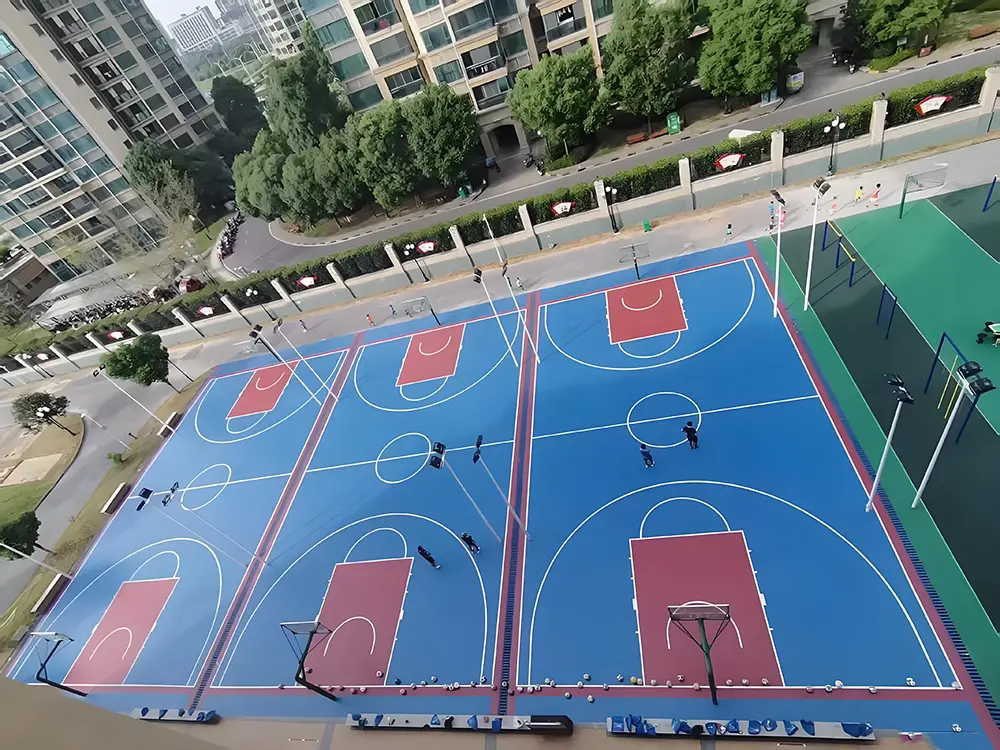
1. Core Standards for Optimal Basketball Court Flooring
FIBA and the European EN 14904 sports flooring standard clearly define the core indicators that professional basketball court floors must meet. If you want to create a highly professional venue, these performance characteristics must be met. For regular courts, these standards can also serve as a reference to help identify what performance standards are needed to avoid a poor experience.
- Ball rebound rate: ≥90%, with a full-court rebound error ≤3%. A basketball dropped freely from a height of 1.8m on a rigid surface must rebound at least 1.62m, ensuring a consistent rebound trajectory across the entire court.
- Shock absorption rate: Solid wood flooring ≥53%, resilient PVC flooring ≥25%;
- Coefficient of sliding friction: 0.60-0.70 (dry state);
- Vertical deformation: 2.0mm-6.0mm;
- Rolling load: ≥1500N;
Note: FIBA explicitly stipulates that Level 1 international top-level competitions must use FIBA-certified solid wood/glass LED flooring, while Level 2 and below competitions may use standard-compliant synthetic flooring, such as PVC sports flooring materials.
2. Global Mainstream Basketball Court Flooring Material Types
2.1 Solid Maple Wooden Sports Flooring
Solid wood sports flooring is globally recognized as the top-of-the-line solution for basketball court flooring and is the only designated material for top-level competitions such as the NBA, FIBA World Cup, and NCAA. Currently, over 90% of professional basketball arenas worldwide use hard maple solid wood flooring.
Structural Description: Utilizing North American hard maple (density ≥0.63g/cm³, moisture content strictly controlled between 8%-12%), with a thickness of 22mm (FIBA mandatory standard), it features a suspended keel structure (single keel/double keel/main and secondary keel), and rubber shock-absorbing pads at the bottom, forming a multi-layered cushioning system of “panel + subfloor + keel + shock-absorbing pads”.
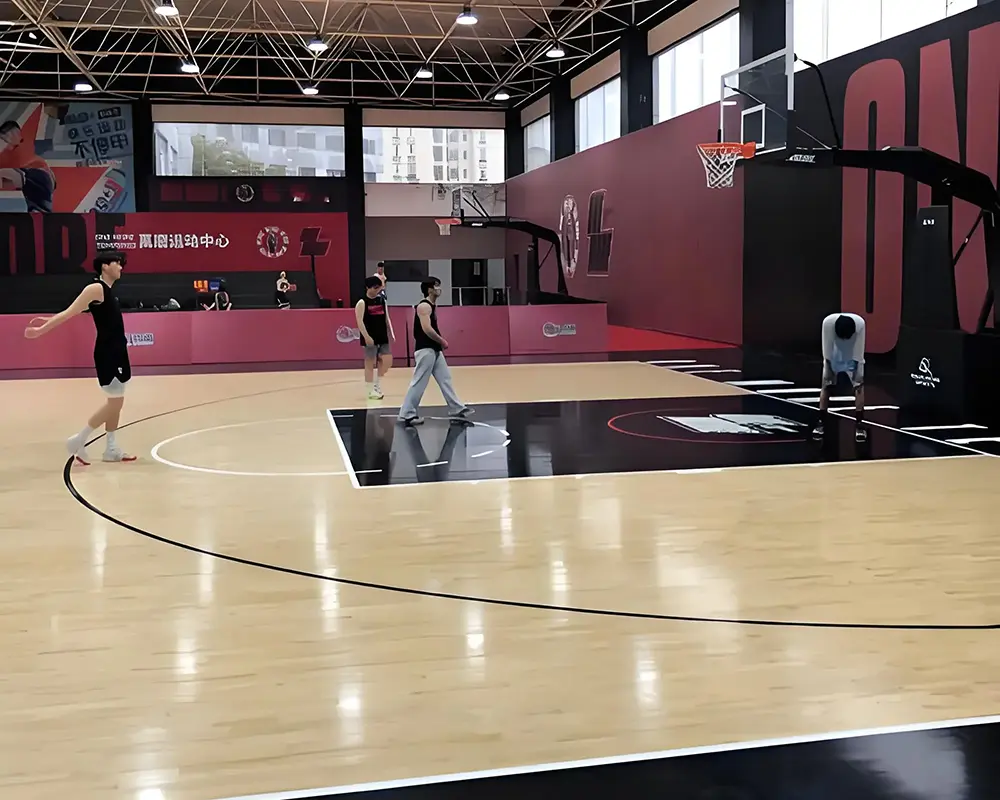
Key Features: Exceeds the performance ceiling, meeting FIBA Tier 1 standards; uniform and stable ball rebound; impact absorption rate ≥53%, maximizing joint protection for players; precise foot feedback, perfectly suited for the high-intensity competition of professional players; Exclusively for high-end basketball venues, significantly enhancing the venue’s professional image and commercial value.
Disadvantages: High initial and ongoing procurement and maintenance costs; strict temperature and humidity requirements; prone to deformation when exposed to moisture.
2.2 PVC Sports Flooring
PVC roll flooring is currently the most widely used composite elastic sports flooring globally. It is also a FIBA Level 2 certified compliant event material. With its balanced performance, high cost-effectiveness, and ease of maintenance, it has become the preferred choice for commercial stadiums, school gymnasiums, and multi-functional venues.
Structural Description: Multi-layer composite roll structure. The top layer is a 0.8-1.5mm thick wear-resistant layer with PUR glaze; the middle layer is a fiberglass stabilizing layer (to inhibit thermal expansion and contraction); and the bottom layer is a high-density foam cushioning layer. The total thickness is 4.5-10.0mm, seamlessly joined through thermal welding.
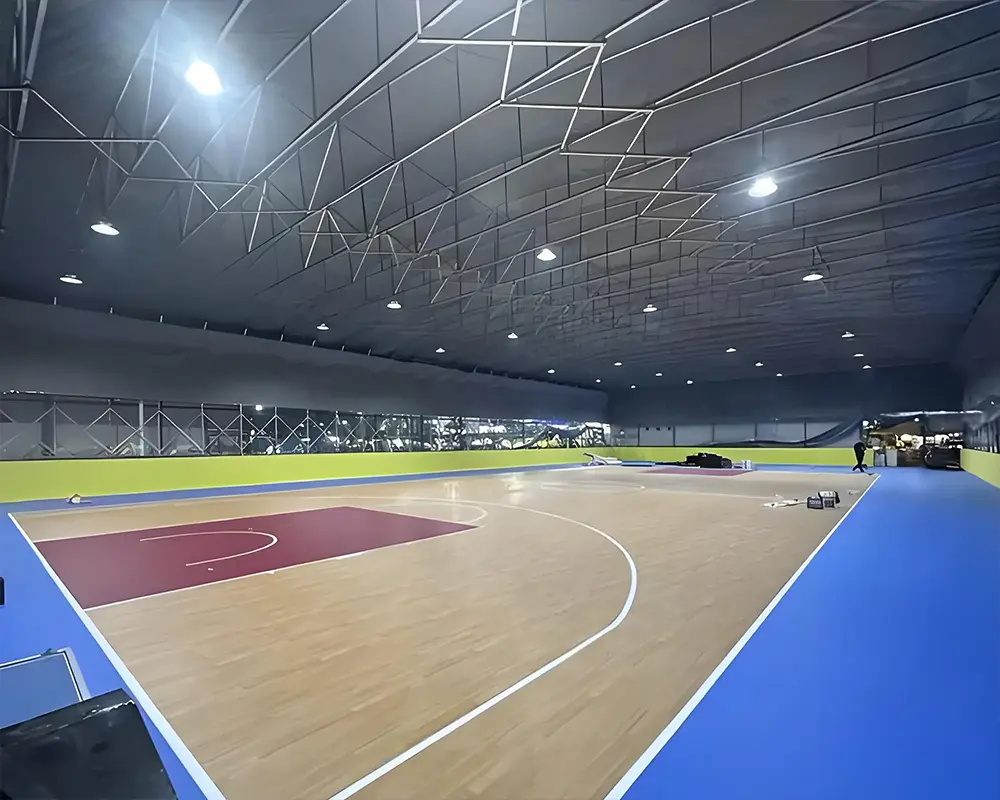
Key Features: Excellent indoor sound insulation; ball rebound rate ≥90%; impact absorption rate 25%-40%; friction coefficient precisely controlled within the golden range, balancing joint protection and force feedback; seamless thermal welding joints eliminate hard-to-clean areas, requiring only a floor scrubber and water for daily cleaning, without the need for sanding or renovation.
Excellent cost-performance ratio, costing only 1/3 to 1/2 of solid wood flooring, with a lifespan of 8-15 years.
2.3 PP Modular Basketball Court Tiles
We have introduced this professional outdoor material several times before. Its modular design allows for quick installation and extremely low maintenance costs. Initial construction and material procurement costs are even lower than PVC. It is ideal for temporary events and venue renovations.
Advantages: Features an industrial-grade precision interlocking structure, allowing for hand installation without glue; High concentration of UV stabilizers and aging-resistant additives, capable of withstanding extreme temperatures from -30℃ to 70℃, and will not fade or become brittle after 5-8 years of outdoor exposure.
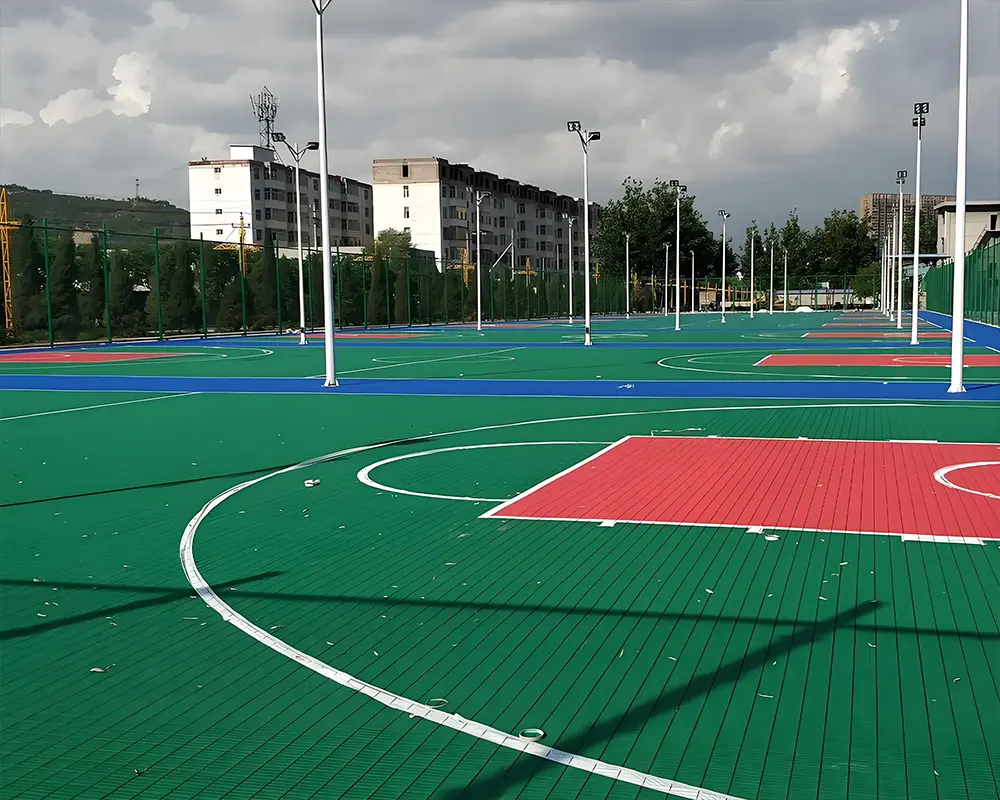
The perforated drainage structure forms a comprehensive drainage network, allowing rainwater to quickly permeate and flow away.
Daily maintenance only requires water rinsing; damaged individual planks can be disassembled and replaced individually, saving on overall renovation costs.
2.4 Polyurethane and Acrylic Sports Flooring
These materials are mainly laid as liquid coatings, directly applied to cement or asphalt base layers. Seamless installation provides excellent water resistance and protection against outdoor sun exposure, rain, and salt spray.
However, it has relatively poor cushioning performance. Initial procurement and construction costs vary, and cracking in the concrete base layer can directly lead to surface cracking, making later repairs difficult. Color variations are common, requiring a complete recoating every 5-8 years.
2.5 Rubber Sports Flooring
Rubber sports flooring is divided into two main categories: natural rubber and synthetic rubber, renowned for its exceptional cushioning and durability. High-density rubber rolls/sheets, 4.5-8.0mm thick, feature a non-slip textured surface and a dense cushioning layer, allowing for seamless splicing or click-lock installation. Similar to PVC/vinyl sports flooring, it is more expensive, heavier, and has higher installation costs.
Impact absorption rates can reach 40%-60%, providing excellent knee protection and significantly reducing the risk of injury during high-intensity training. It boasts extremely high wear and tear resistance, a lifespan of over 10 years, and can withstand the long-term pressure of heavy equipment. Suitable for professional physical training halls, youth basketball training bases, and heavy-duty areas of multi-purpose gymnasiums.
3. FAQ
What kind of wood is used for NBA basketball courts?
All NBA teams’ home court floors use North American hard maple, with a 22mm thick panel and a suspended joist structure. It boasts exceptional ball bounce consistency and impact absorption performance. All 22 NBA championship teams use this type of flooring in their home courts.
What is the best flooring for an outdoor basketball court?
The optimal material for outdoor basketball courts is modified PP modular interlocking suspended flooring. It features superior UV resistance and weather resistance, full drainage, easy installation, reusability, and extremely low maintenance costs.
How long does a basketball court floor last?
With proper use and maintenance, North American hard maple solid wood flooring can last 30-40 years; high-quality PVC sports flooring lasts 10-15 years; PP interlocking suspended flooring lasts 5-8 years; polyurethane flooring lasts 10-15 years; and acrylic flooring lasts 4-6 years. The specific lifespan depends on material quality, installation standards, and daily maintenance.
Can you lay basketball flooring over concrete?
Yes. PP modular interlocking flooring can be laid directly on a flat concrete base without complicated preparation. PVC sports flooring and polyurethane flooring require the concrete base to be leveled, cured, and moisture-proofed to ensure flatness, strength, and moisture content meet standards before laying. Solid wood flooring requires a suspended joist structure built on a concrete base and cannot be laid directly on concrete.