
Choosing the right volleyball court material is one of the most crucial aspects of constructing any volleyball sports facility. Whether indoors or outdoors, the material directly impacts player performance, joint protection, and long-term maintenance costs. Based on Dongxing Volleyball Court Flooring‘s experience serving users, we provide a comprehensive overview of volleyball courts, tailored to different applications, uses, and frequencies, offering helpful assistance and advice to various court builders and operators.
1. Why is flooring material important for volleyball?
The volleyball court surface is more than just where players stand; it affects the precision of every movement, as is true in any ball sport.
To choose a high-quality material, it should possess the following properties: Shock absorption and cushioning to reduce joint stress. Volleyballs are propelled upwards to a certain height over the net; jump serves and returns require jumping through the floor. In intense team matches, falls are common, and a hard surface would be disastrous.
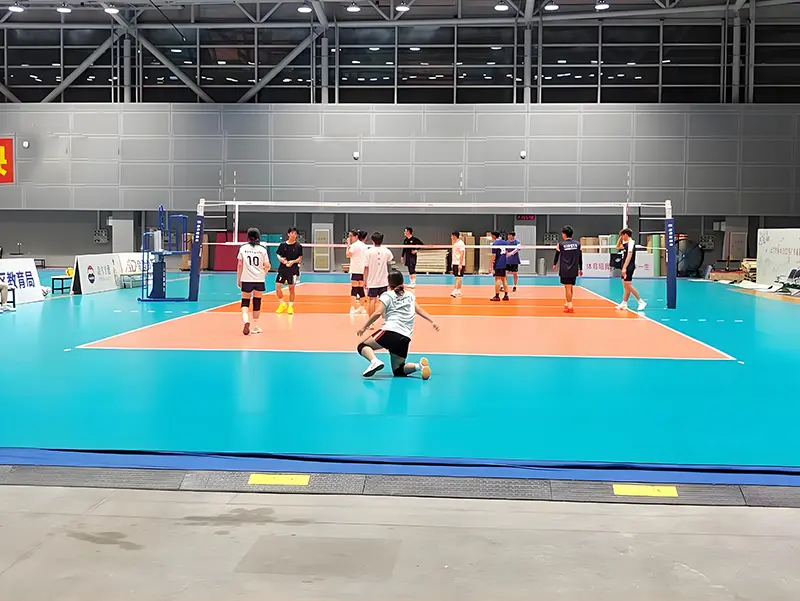
Good friction for accurate force application and slip resistance.
Friction ensures that players’ steps and pre-jump movements are unaffected when preparing to receive the ball; slippage ruins the entire court experience.
Good ball rebound is crucial. The bounce and rebound of the volleyball shouldn’t be too high or too low. Otherwise, the ball will bounce too high upon landing, easily veering off the court and becoming difficult to retrieve, which is undesirable.
A detail often overlooked is that in professional matches, even small differences in volleyball material can affect the outcome.
2. Indoor Volleyball Court Flooring Classification
Hardwood Flooring
Hardwood sports flooring has always been the first choice for professional indoor venues. Whether for basketball or volleyball courts, it’s not only aesthetically pleasing but also offers excellent performance, achieving a perfect balance. However, it often comes at a higher price and requires more maintenance compared to other materials. If choosing solid wood flooring, maple is the best option.
PVC Flooring
PVC materials are very popular in indoor sports due to their high degree of customization. Players can choose any color, pattern, and even their own logo. As a composite resilient flooring, it offers a cost-effective option. It can also mimic the grain of real maple wood; Blue Maple is one of our most popular product lines, as well as gem patterns.

More materials are compared here:
| Material | Shock Absorption | Durability | Best Use |
|---|---|---|---|
| Hardwood | High | High | Professional indoor |
| PVC Vinyl | High | Medium-High | Schools, clubs |
| Polyurethane | Medium | High | Multi-purpose courts |
| Rubber | Medium | High | Training areas |
| Sand | High | Medium | Outdoor/beach |
3. Outdoor Volleyball Court Materials
Sand Courts
Beach volleyball is a fantastic sport for leisure activities at the beach or in the community. The soft surface provides a unique volleyball experience, but the sand needs to be kept level.
Artificial Turf
Maintenance costs are lower than sand, making it suitable for multi-functional venues. For example, you can also use it as a soccer or tennis court.
Interlocking Sport Tiles
For outdoor use, PP modular interlocking flooring systems offer optimal weather resistance and rapid drainage, unaffected by rain or snow. There’s no need to worry about moisture or UV damage; rigid PP is completely unaffected by these issues.
4. Best Practices for Choosing the Right Material
Determine the material type, thickness, and dimensions based on your desired volleyball court construction and its intended use. Regarding PVC roll flooring, 4.5-5.0mm thickness is suitable for general needs, 6.0-8.0mm is suitable for professional requirements, and 10.0mm is suitable for high-end venues. If you also want to create FUTAL court lines on your volleyball court, that’s perfectly feasible. Both types of court lines can be drawn together, and we can provide detailed design and roll installation solutions, using the minimum amount of PVC rolls and welds to completely cover the entire court.
Performance parameters to pay attention to: Cushioning and shock absorption performance, resilience, dry and wet friction and slip resistance, and deformation stability. These are the most basic and essential conditions; otherwise, it can easily lower the volleyball experience and cause additional replacement and maintenance costs.
5. FAQ
What is the best material for indoor volleyball courts?
PVC. Balancing performance and price, it’s the best material besides wood flooring.
What is the best material for outdoor volleyball courts?
PP interlocking tiles, or acrylic and sand surfaces, depending on the players and court requirements.
What is the lifespan of PVC volleyball flooring?
With proper maintenance and cleaning, the lifespan can be extended to 8-12 years.
What customization options are available?
Volleyball and other court line markings, colors, logos, and patterns.