
Choosing the right outdoor playground flooring is more than just about aesthetics. The surface must provide effective cushioning in case of falls, withstand outdoor weather conditions, and be low-maintenance and within budget.
1. Why is outdoor playground flooring important?
1.1 Preventing Fall Injuries
More than half of children’s injuries in playgrounds are related to fall impacts. A qualified impact-absorbing playground surface can absorb the impact force through elastic deformation, significantly reducing the risk of head, limb fractures, and traumatic brain injury.
Critical Fall Height: This refers to the maximum height from which a child can fall to the ground without the impact value being within a safe threshold. The maximum operating height of playground equipment must be lower than the corresponding critical fall height of the ground surface; this is the core selection principle for safe playground flooring.
1.2 Accessibility in Playgrounds
According to the ADA (American Association for the Disabled) Act, public playgrounds must ensure the access rights of children with mobility impairments; wheelchairs and walkers must be able to easily access play areas.
Loose surfaces such as sand and wood chips cannot meet accessibility standards. Flat, firm, and resilient rubber surfaces are currently the mainstream choice that balances safety and accessibility.
1.3 Weather Resistance
The outdoor environment is complex, and the surface material must withstand multiple climate tests. It must have rapid drainage, withstand prolonged sun exposure and high temperatures, not release harmful substances, have an easy-to-de-ice surface, and be non-brittle and slip-resistant at low temperatures.
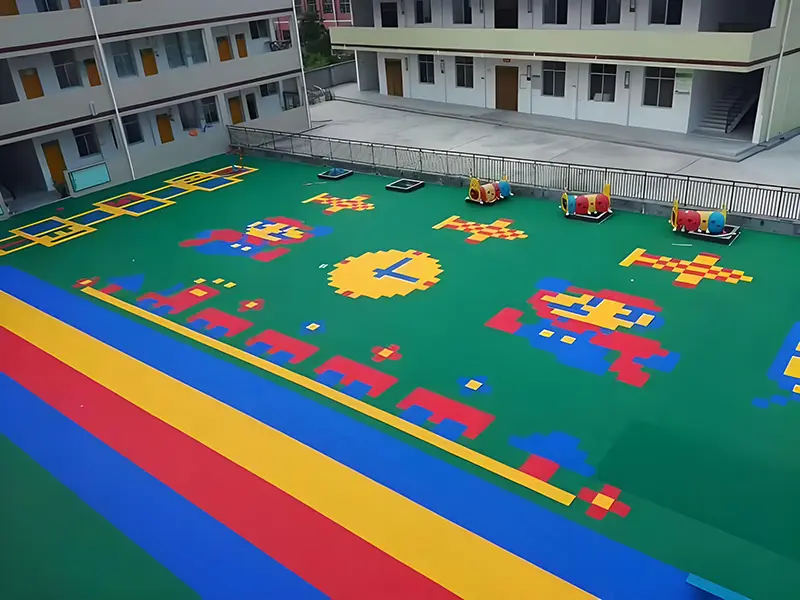
2. Types of Outdoor Playground Surface Materials
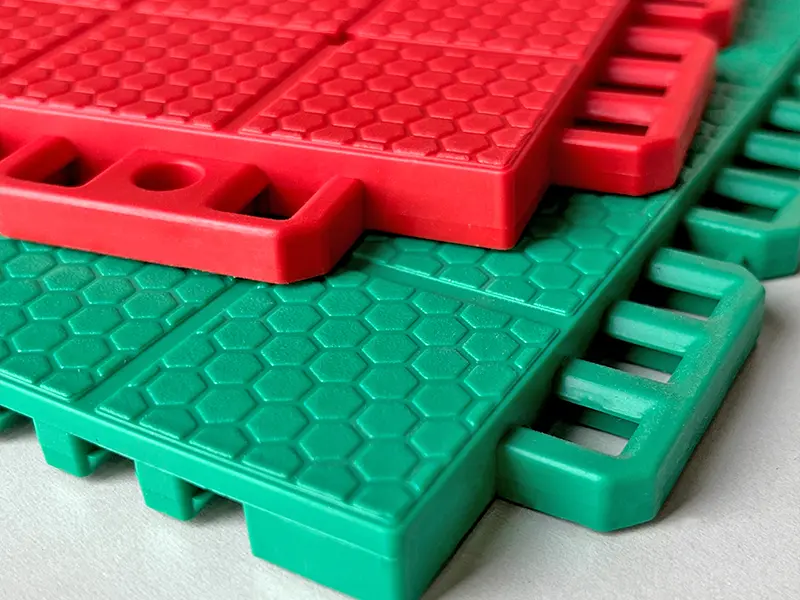
2.1 Modular Interlocking Playground Tiles
These are an upgraded product of rubber floor tiles and offer the most balanced overall playground safety surface.
Easy DIY installation; Good shock absorption; Good drainage; UV resistant and weather-resistant, suitable for all-weather conditions; Extremely low maintenance cost; Multiple thicknesses available to cover different areas.
2.2 Rubber Playground Tiles
Rubber tiles are square blocks of flooring made from recycled or virgin rubber pressed at high temperatures. They are one of the most widely used safety materials for playgrounds.
Stable shock absorption, good anti-slip effect, and better weather resistance than most loose materials.
Requires a high degree of flatness of the base; traditional adhesive installation makes the joints prone to dirt accumulation, and the adhesive may warp after aging; each tile is relatively heavy.
2.3 Engineered Wood Fiber
Engineering wood fiber is a standardized processed special wood chip with uniform size, no sharp edges or impurities. It is the only loose protective flooring material that meets safety standards.
Extremely low initial purchase cost; natural and environmentally friendly, with acceptable shock absorption.
Easily washed away by rain and compacted by foot traffic, requiring regular loosening and replenishment.
Suitable for suburban parks with limited budgets.
2.4 Rubber Mulch
Rubber mulch is made from recycled rubber processed into granules, serving as a loose protective flooring alternative to sawdust.
It absorbs impact better than wood fiber; it is less prone to rotting and insect infestation.
It is easily displaced and washed away by rain, requiring regular maintenance.
Suitable for small backyards and infrequently used playgrounds.
2.5 Poured-in-Place Rubber
Poured-in-place rubber, also known as EPDM, consists of a base layer of cushioning rubber granules and a surface layer of colored EPDM granules. It is mixed with polyurethane adhesive on-site, poured, and compacted to form a seamless, elastic surface, commonly used in high-end playgrounds.
It is seamless, aesthetically pleasing, and can be customized with complex patterns and shapes.
It is highly dependent on the skill of the construction team, resulting in inconsistent construction quality; cracking and blistering are prone to occur after the adhesive ages.
Suitable for large municipal parks, theme parks, and high-standard demonstration schools.
3. How to Choose the Best Playground Flooring?
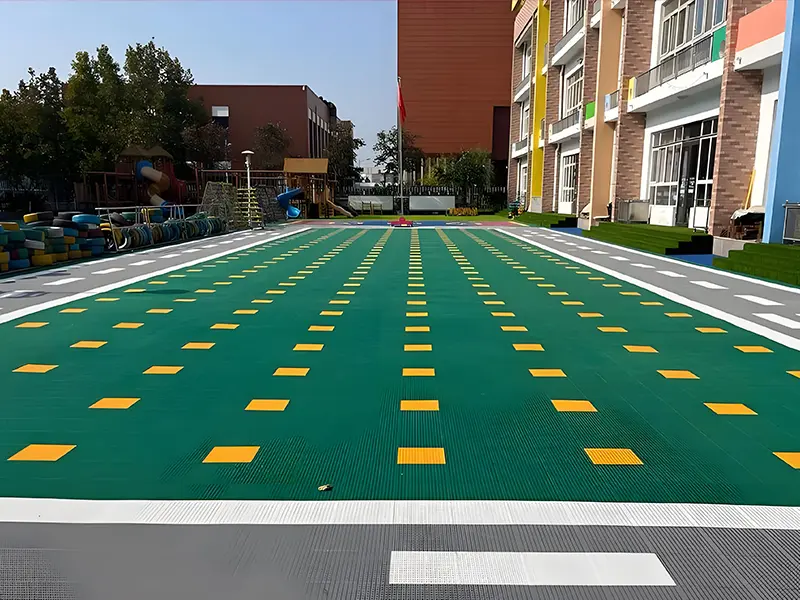
Modular interlocking flooring is recommended for playgrounds in schools, municipal parks, daycare centers, and apartment complexes. Rubber pavers or cast-in-place rubber flooring are recommended for backyard playgrounds and public park playgrounds.
There is no single flooring material that perfectly suits every situation; only the optimal solution best suited to specific applications.
Playground Flooring Safety Standards: Compliance with authoritative safety standards is the core basis for ensuring child safety and a key indicator of the venue’s professionalism.
ASTM F1292: American Society for Testing and Materials (ASTM) standard for impact absorption in playground flooring.
ASTM F1951: Standard for accessible playground flooring.
EN 1177: Mandatory European Union standard for safe playground flooring.
ADA Accessibility Standard: The Americans with Disabilities Act (ADA) requires all public playgrounds to guarantee accessibility for children with disabilities, and the flooring must meet wheelchair accessibility requirements.
4. Playground Flooring Costs
Initial Costs: Loose-textured materials have the lowest initial investment, rubber pavers are in the middle range, and cast-in-place rubber flooring and artificial turf have the highest initial investment. However, initial costs only account for a small portion of the total lifecycle cost.
Annual Maintenance Costs: Loose materials such as sand and wood fiber have the highest maintenance costs, requiring 10%-30% replenishment annually, along with significant manpower for loosening and maintenance. In-situ cast-in-place rubber and artificial turf have moderate maintenance costs, but repairs after damage are expensive. Modular interlocking pavers have the lowest maintenance costs, requiring only routine cleaning, and the cost of replacing a single damaged paver is negligible.
Total Cost of Ownership (TCO): Over a 10-20 year lifespan, the TCO of modular interlocking pavers is significantly lower than most materials. Although the initial investment is slightly higher than loose materials and ordinary rubber pavers, the savings on high installation costs, extremely low maintenance costs, and exceptionally long lifespan make them among the most cost-effective materials in the long run. Sand and wood fiber, with the lowest initial costs, will have a cumulative investment exceeding that of modular pavers over 5-8 years.
5. Why Choose Modular Interlocking Playground Flooring?
Quick Deployment:
No professional construction team or large equipment is needed. Ordinary personnel can quickly lay the flooring, reducing the construction period by over 70% compared to traditional solutions. Renovation projects can be carried out in sections, significantly reducing the time the site is closed.
Reduced Maintenance Costs:
Daily cleaning and rinsing are sufficient; no need for periodic loosening or replenishment. Damaged sections can be replaced individually, eliminating the need for complete renovation, significantly reducing maintenance workload and costs.
Easy Replacement:
Replacing individual modular tiles creates a seamless look with the original floor, maintaining a clean and uniform appearance.
All-Weather Adaptability:
The bottom drainage structure allows for rapid drainage, enabling immediate use after rain. The UV-resistant and high/low temperature resistant formula is suitable for both northern and southern climates and indoor/outdoor environments.