
As a sports flooring provider with extensive manufacturing experience, we won’t dwell on the specifics of material selection here; the common materials used for indoor and outdoor courts are already well-known to buyers. When creating pickleball courts for sports clubs, the choices made significantly impact the player experience. While club operators naturally want to cut costs, this must not come at the expense of the playing experience—only by balancing the two can long-term benefits be realized.
Many factors influence the playing experience—a topic of shared interest among manufacturers, buyers, operators, and players alike. We have compiled key questions and requirements from past clients, along with insights gained from our after-sales service, to offer advice and purchasing strategies to pickleball clubs worldwide.
1. Ball Rebound
Ball rebound is the most critical factor. Compared to other ball sports, pickleball is more sensitive to rebound characteristics—or, put another way, it places higher demands on the flooring. If the ball doesn’t bounce properly, the court is essentially unusable.
PVC pickleball mat generally do not suffer from such quality issues, provided you choose a reliable supplier that guarantees product quality; meeting this standard is a baseline requirement. Whether you prefer a dense, firmer mat or a cushioned version with a foam backing, PVC remains the most popular material choice for clubs.
If you remain concerned about rebound performance, you can request free samples to test the ball’s actual bounce yourself, or have us conduct the testing and provide a report. Relying on visual inspection alone is insufficient.
2. Marking Pickleball Court Lines
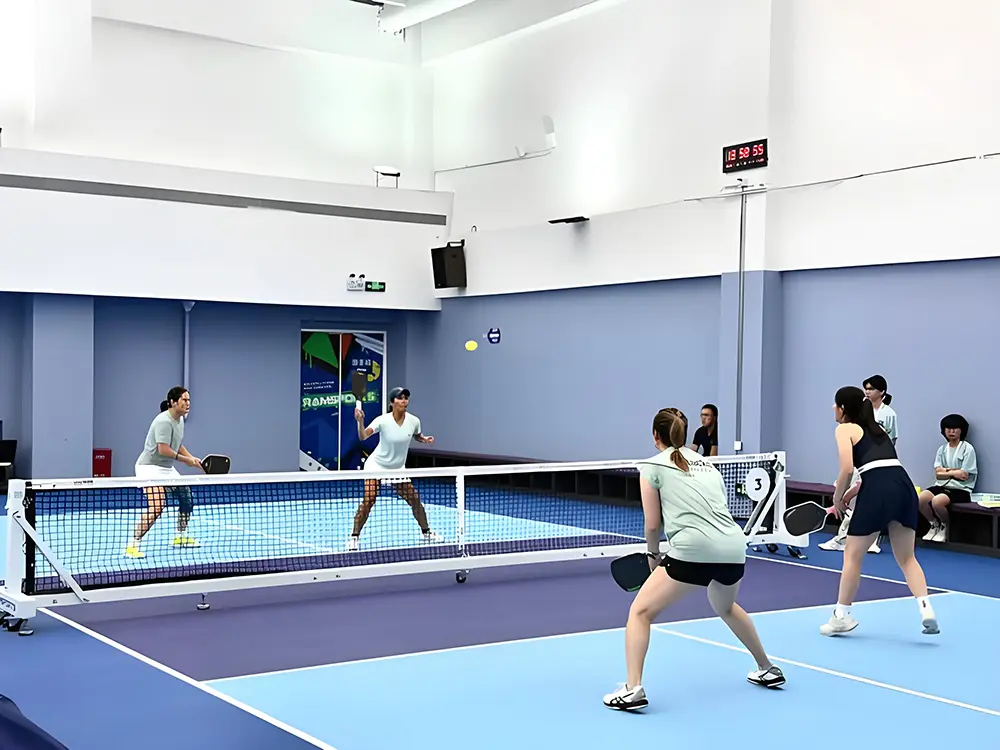
Standard pickleball court lines are marked according to international specifications. Since a single pickleball court is typically composed of five rolls of PVC flooring, the seams require precise handling. Beyond standard welding and installation, the court lines must align perfectly across the seams; there should be no misalignment or offsets.
Do not underestimate the importance of this detail. Such issues occur frequently with some suppliers—particularly those lacking professional expertise. We admit that we have encountered similar problems in the past, which is why this issue stands out so clearly to us; manual line marking, in particular, can be prone to imperfections.
To address this, we are continuously making improvements; we now use machine-printed lines exclusively. This perfectly resolves issues with court line misalignment during the splicing of flooring rolls, resulting in clean, uniform lines free of rough edges.
3. Edge Curling
Installed pickleball court flooring may experience edge curling, where the edges lift or even curl up like a lotus leaf. This detracts from the court’s appearance and negatively impacts the playing experience.
Curling is typically caused by significant temperature fluctuations—such as thermal expansion during high heat followed by contraction upon cooling—or by major changes in ambient humidity.
Other causes include improper installation and product quality issues. Defects in the PVC flooring roll’s structural composition—such as a poor-quality internal fiberglass layer or residual stress from prolonged storage—can also lead to this problem.
Since many factors are involved, it is essential to choose proper installation methods and high-quality products, while maintaining stable temperature and humidity levels in the court environment; otherwise, you may face high replacement and maintenance costs.
4. Insufficient Thickness
Pickleball flooring used in clubs is typically 3.0mm thick (unless a 3.5mm option is specifically requested); this refers to the total thickness of the flooring roll. While measuring is the most straightforward way to check this, it is important to note that meeting the total thickness requirement does not guarantee that performance standards are met.
Beyond total thickness, the thickness of the wear layer is critical. The wear layer should be at least 0.5mm thick, with 0.7mm or greater recommended. Manufacturers employing advanced PU surface treatment technology typically produce flooring that is odorless, resistant to repeated rolling pressure from nets and equipment, waterproof (preventing seepage), and mark-resistant against wheels. These qualities depend on the wear layer and surface treatment technology; if the wear layer is substandard, the overall lifespan of the pickleball flooring will be significantly reduced.
5. Multi-purpose Court Flooring
For certain multi-purpose sports facility projects, we have utilized our “GEM” pattern vinyl sports flooring (Model 1301G). This versatile pattern serves as an ideal choice for courts designed to accommodate multiple sports, allowing a single surface to be used for various ball games.
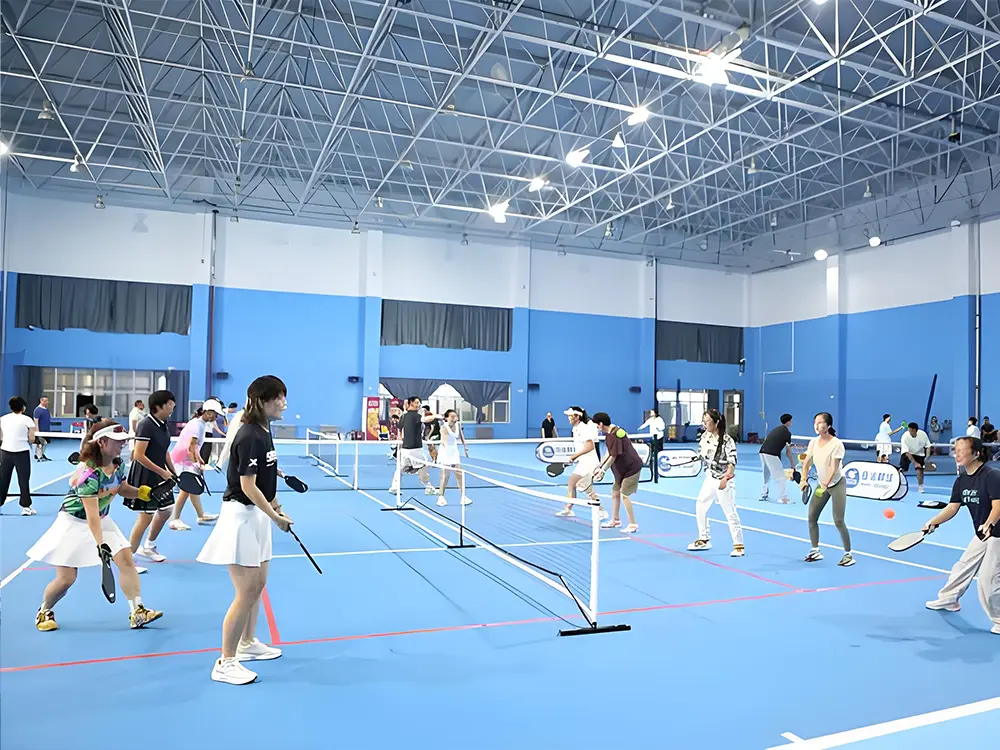
There is nothing inherently wrong with this approach; however, issues arise when a single court is used for multiple sports—such as basketball, pickleball, and tennis. While this offers significant cost savings for the facility owner, players often complain about the confusion caused by the overlapping court lines. Even with color-coding to distinguish the markings, players generally prefer dedicated, standalone courts.
Therefore, when planning your club or commercial facility, consider whether multi-functionality is truly necessary. It is best to avoid crowding too many different sports onto a single court surface.
Summary
The points discussed above represent five critical factors—beyond the basic material type—that directly influence quality and the user experience when selecting flooring for your court. These considerations apply to any sports flooring selection. If BWF or FIBA certifications are required, the screening process becomes simpler: you can select based on those standards and then focus primarily on the manufacturer and price.
Drawing on our extensive experience and an understanding of what truly matters to players, we can help you select the most suitable flooring solution. While we do not provide installation services, we offer expert guidance, after-sales support, and reliable, high-quality pickleball flooring materials.