
Basketball gym flooring is a crucial material used in school gyms, sports clubs, and professional training centers, directly impacting the playing experience.
Basketball gym flooring can affect:
- Player safety
- Game performance
- Ball bounce consistency
- Maintenance cost
- Facility lifespan
The best basketball gym flooring isn’t always the most expensive option. The right choice depends on the gym’s usage, indoor or outdoor environment, budget, and performance requirements.
1. Sports Program Requirements
Professional arenas: Typically compare performance for professional events, using FIBA certification as a standard, choosing FIBA basketball flooring to meet professional training and competition requirements.
School gyms: Prioritize safety and durability; floor renovation is costly, and high usage on campus necessitates a good playing experience.
Basketball clubs: Good color scheme and standard playing performance are important; FIBA or standard-compliant flooring is most suitable.
2. What Makes a Good Basketball Gym Floor?
Basketball involves numerous jumps, sudden stops, and landings, placing higher pressure on the knees and ankles. Therefore, shock absorption capacity must meet certain requirements.
Furthermore, the rebound performance of the basketball upon landing directly determines the effectiveness of dribbling and passing; otherwise, it can easily affect the fairness of the game and player performance.
For PVC basketball flooring, calcium-free high-density foam ensures the stability of the sports flooring material, making it less prone to tearing and denting. Combined with a wear-resistant surface layer and anti-slip pattern, it achieves stable rebound and anti-slip performance during sudden stops. It also boasts a lifespan of 5-10 years.
Of course, professional basketball stadiums use high-end wood flooring systems. For material options, please refer to the table below:
3. Maple Hardwood Basketball Court Flooring
3.1 What is Maple Basketball Court Flooring?
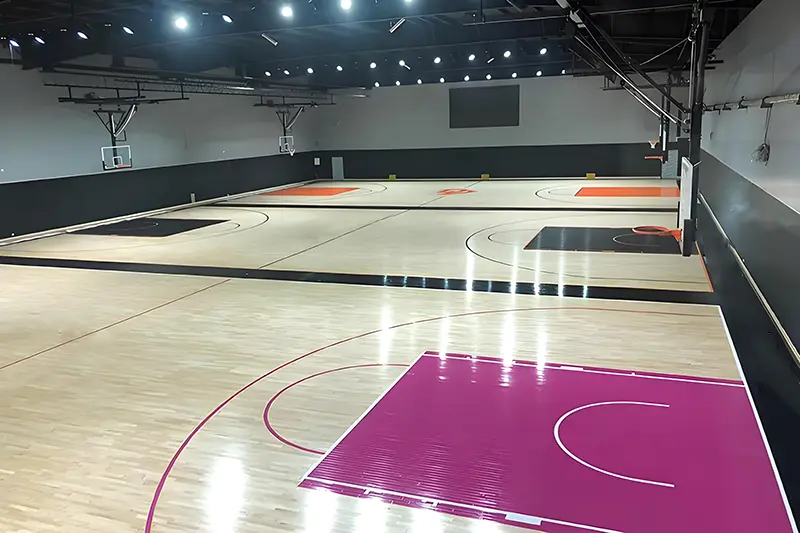
Maple basketball court flooring is a traditional and classic series of basketball court flooring and is the standard configuration for top-level professional competitions worldwide. From the NBA to the CBA, from Olympic venues to university gymnasiums, maple flooring is almost synonymous with professional basketball courts.
It’s not just a single layer of wood, but a complete Sprung Subfloor System. The top layer is a maple panel, beneath which lie a moisture-proof layer, a multi-layered joist structure, and an elastic padding layer, forming a cohesive system with cushioning and rebound properties. This structure absorbs the impact of athletes’ jumps and landings while providing stable support and feedback.
3.2 Advantages
Maple wood has a dense grain and moderate hardness, providing athletes with clear and stable foot feedback during changes of direction, sudden stops, and jumps, avoiding the problems of excessive softness causing collapse or excessive hardness causing foot jolts.
The uniform surface hardness of maple wood results in excellent consistency in the rebound height and angle of basketballs after landing, contributing to precise ball control and stable shooting rhythm. The warm color and fine grain of maple wood, after lacquering, present an elegant matte texture. Combined with the court lines and logo, the overall look is professional and high-end, making it highly appealing for both live viewing and television broadcasts.
Maple wood boasts a warm color and fine texture. After a finishing process, it presents an elegant matte finish, complementing the court lines and logo for a professional and high-end look, making it highly appealing for both live viewing and televised broadcasts.
A high-quality maple basketball flooring system, under normal use and maintenance, can last 20 to 30 years or even longer.
3.3 Disadvantages
High initial investment; high-quality maple (especially North American hard maple) raw materials are expensive, and strict requirements exist regarding grade, moisture content, and grain consistency.
High material and installation costs due to the multi-layered structure including the joists, elastic pads, and moisture-proof layer.
Professional maple basketball courts must be equipped with a constant temperature and humidity system to stably control the relative humidity within the range of 40% to 60% and the temperature between 18℃ and 24℃.
4. PVC Vinyl Basketball Floor
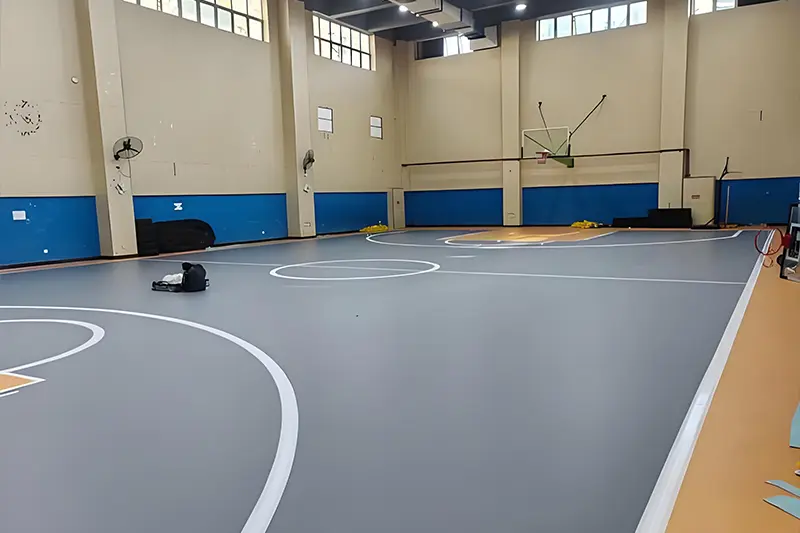
PVC Vinyl sports flooring is currently one of the most widely purchased and used flooring materials for indoor sports venues, and it is also a core product series of our factory. Dongxing PVC basketball flooring has already passed FIBA certification.
4.1 Advantages
Good elasticity and shock absorption performance, providing athletes with a noticeable cushioning effect when running, jumping, and landing.
Simple daily cleaning, low maintenance, installation, and procurement costs, meeting the needs of professional competitions and below.
Non-absorbent and moisture-resistant, with a rich variety of customizable colors and patterns, including realistic maple wood grain.
Suitable for schools and multi-functional sports venues with moderate budgets.
4.2 Disadvantages
PVC flooring’s surface hardness and elasticity uniformity are not as good as solid wood flooring, resulting in slightly less consistency in the height and angle of basketball bounce.
In high-frequency, high-intensity use scenarios, the wear layer of PVC flooring typically wears out faster and has a shorter overall lifespan than solid wood flooring, although its lifespan can still be maintained for 5-10 years.
5. Modular Interlocking Basketball Flooring
Interlocking basketball tiles are very popular in South America and other hot tropical climates, primarily because they provide good drainage, UV resistance, and standard playing performance in outdoor settings. Furthermore, the interlocking design ensures high stability and very low maintenance costs. It can even be used as a portable, multi-functional court, repeatedly assembled and disassembled.
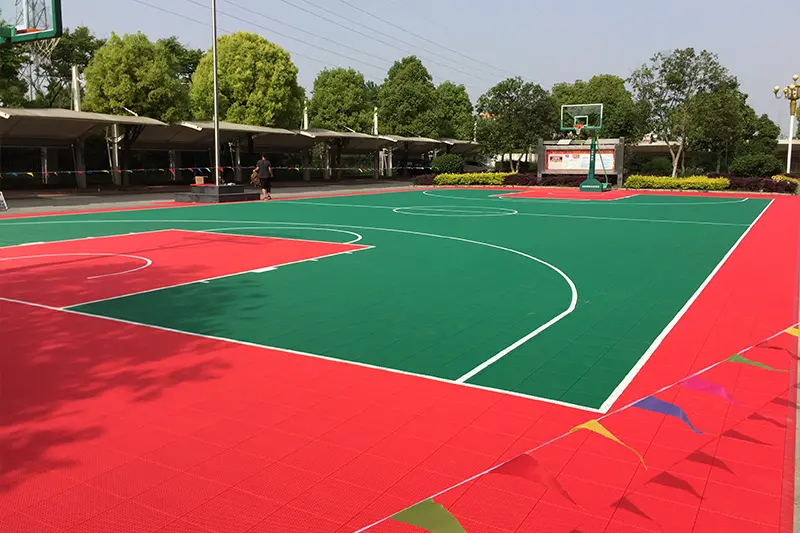
It easily withstands high or low temperatures; the PP material will not rot or mold.
It is the best material option for outdoor community centers, backyard basketball courts, and temporary games.
6. How to Choose the Right Basketball Court Flooring?
Outdoor Basketball Courts: Faced with sun exposure, rain, temperature fluctuations, and freeze-thaw cycles.
Acrylic: The “standard answer” for outdoor public courts. UV resistant, rain resistant, temperature resistant, and extremely low cost.
PP Interlocking Flooring: Highly weather-resistant, with a perforated drainage design to prevent water accumulation, and can be installed and disassembled at any time.
Indoor Basketball Courts:
For official matches, professional team training, or high-level competitions, solid wood sports flooring is essential; it is the gold standard for professional events.
PVC basketball flooring can meet the requirements of some competitions and all non-competition venues, offering comfortable foot feel, easy maintenance, waterproof and moisture-proof properties, and a wide variety of colors and patterns.
Finally, besides material selection, construction cost should also be considered, taking into account performance, cost, maintenance, and demand.
7. Choose to source directly from the factory
If you are a professional construction contractor or a sports club project, requiring both customization and wholesale, then factory visits are an effective way to determine if a sports flooring supplier is a legitimate factory. This allows you to achieve a high degree of customization flexibility and obtain the most original procurement quotes.
We can provide solutions for the three core basketball flooring materials mentioned above, and we have professional production lines. Requesting samples from us allows you to understand the quality and actual performance.