
Yes—high-quality garage floor tiles interlocking can support regular vehicle traffic and many heavy-duty garage applications, but durability depends on more than the advertised weight capacity. Tile material, structural design, thickness, load distribution, interlocking system, subfloor condition, and the type of equipment all matter.
A tile’s load rating alone does not tell the whole story.
1. Are Interlocking Garage Floor Tiles Strong Enough for Cars?
Passenger Cars
For sedans, coupes, hatchbacks, and compact cars, interlocking garage floor tiles are more than capable of handling daily parking and driving. A typical passenger vehicle weighs between 1,300–1,800 kg (2,860–3,970 lbs), distributed across four tire contact patches. Each contact patch is roughly the size of an adult hand—about 150–200 cm² each. This means the actual pressure applied to any single tile is well within the capacity of even mid-grade interlocking tiles. The weight is spread across multiple tiles through the interlocking system and further distributed by the tile’s underside support structure. For regular residential use with passenger cars, quality garage floor tiles will last for years without cracking, denting, or shifting.
SUVs and Pickup Trucks
When you move up to SUVs, pickup trucks, 4WD vehicles, and light trucks, the load equation changes but still remains manageable for heavy-duty tiles. A full-size pickup or large SUV can weigh 2,500–3,500 kg (5,500–7,700 lbs), with higher axle loads especially at the front. The tire contact patches are larger than passenger cars, but the total weight per square meter at the contact point increases. Premium polypropylene tiles rated for 15–20 tonnes per m² handle these vehicles easily in static parking scenarios. For frequent driving, turning, and braking—common in workshop environments—you’ll want a thicker tile with a robust interlocking system to handle both vertical load and lateral shear forces.
RVs, Vans and Trailers
RVs, campers, vans, trailers, and commercial vehicles represent the upper end of residential garage use. A large motorhome can weigh 4,500–9,000 kg (10,000–20,000 lbs) or more. Here’s the critical point most buyers miss: vehicle gross weight ≠ load applied to one tile. Even a 10-tonne RV distributes its weight across multiple axles and tires, and each tire contact patch spreads load across several tiles through the interlocking grid. That said, heavy RVs require industrial-grade tiles with sufficient thickness and structural ribbing. You should also account for stationary loading over long periods—some materials can develop permanent indentation if a heavy vehicle sits in the exact same spot for months at a time.
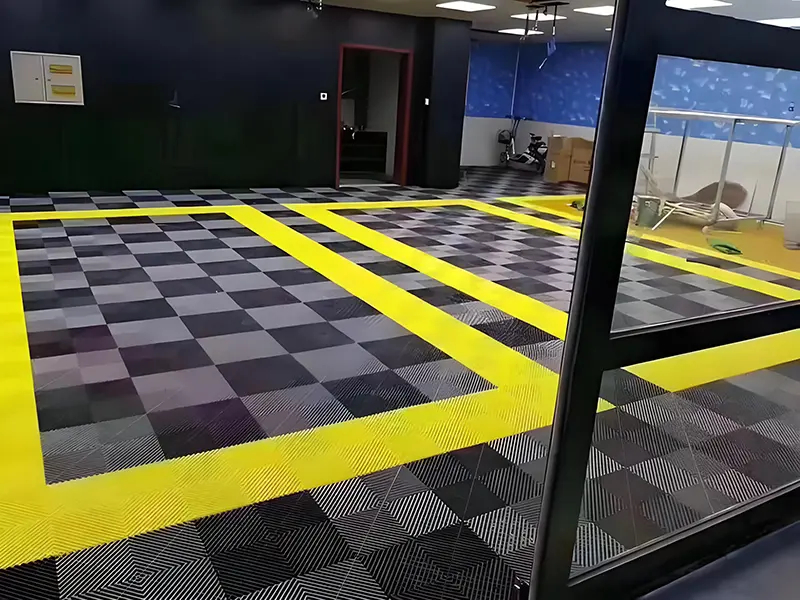
2. How Much Weight Can PP Garage Flooring Tiles Hold?
A garage floor tile load rating—often expressed as tonnes per square meter (t/m²) or pounds per square foot (psf)—measures the maximum evenly distributed compressive load the tile can support without structural failure. This is a laboratory measurement where weight is spread uniformly across the entire tile surface.
Residential-grade interlocking tiles typically carry load ratings from 5–15 t/m² (1,024–3,069 psf), while heavy duty garage floor tiles for commercial use range from 15–30+ t/m² (3,069–6,138 psf).
But here’s what you need to understand: real-world loads are never perfectly distributed. A vehicle’s tires concentrate weight on small contact patches. A jack stand concentrates weight on an even smaller area. The garage flooring weight capacity number on the box tells you the tile’s maximum compressive strength under ideal conditions—not its real-world performance under point loads, rolling traffic, or lateral forces.
This is why two tiles with identical advertised weight capacities can perform very differently in the same garage. One might have a thick solid core with heavy underside ribbing, while the other is a thin hollow-core tile that only achieves its rating through full-surface compression testing.
3. Static Load vs. Rolling Load
Static load and rolling load represent two completely different stress regimes for interlocking floor tiles—and one is far more demanding than the other.
Static load refers to weight that sits stationary on the tile surface. A parked car, a stationary tool chest, or a resting workbench all apply static load. Under static conditions, the tile material experiences constant compressive stress but no abrasion, impact, or lateral movement. Most tiles have a high static load rating because plastic and PVC materials handle steady compression well.
Rolling load refers to weight that moves across the tile surface—vehicles driving in and out, rolling tool cabinets, pallet jacks, and forklifts. Rolling loads are far more demanding because they introduce:
- Repeated compression and decompression as the wheel passes over each tile
- Shear forces that push tiles horizontally against each other
- Abrasion between the wheel and tile surface
- Impact stress from seams, edges, and minor subfloor imperfections
- Point-loading concentration at the wheel contact patch
A tile with a 20 t/m² static load rating might only be rated for 5–8 t/m² in rolling load applications. This is why heavy duty garage floor tiles for commercial and industrial environments are specifically tested and rated for rolling traffic, not just static compression.
4. Distributed Load vs. Point Load
This is the single most important distinction for anyone buying garage floor tiles—and the one most frequently misunderstood.
Distributed load spreads weight across a large surface area. A car tire, for all its weight, still distributes force across a contact patch roughly 150–200 cm². The interlocking tile system then spreads that load across multiple tiles and down to the subfloor through the underside support grid. Most vehicles apply distributed loads that quality tiles handle easily.
Point load concentrates weight on a very small area. Common examples include:
- Floor jack wheels and saddles
- Jack stand feet
- Caster wheels on heavy equipment
- Motorcycle kickstands
- Pallet jack wheels
- Vehicle lift feet
A 2-tonne vehicle distributed across four tires creates manageable pressure per square centimeter. But a 2-tonne floor jack sitting on a single 5 cm diameter saddle creates extreme localized pressure that can punch through thinner tiles, crack interlocking edges, or create permanent indentations.
This means a floor can support a heavy vehicle but still require special precautions for a floor jack. You could safely park a 3-tonne pickup on your tiles, yet damage them with a 1-tonne jack stand if you place it directly on the tile without a load-distributing pad.
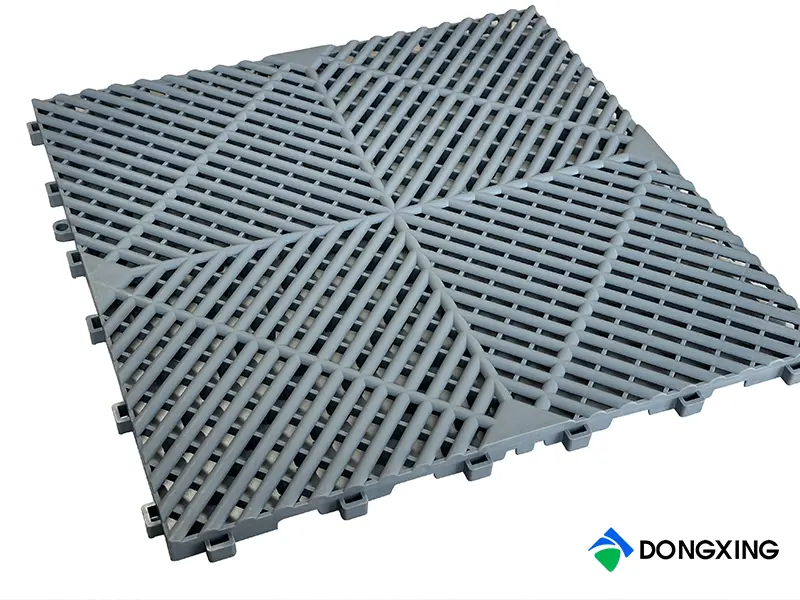
5. Can You Use a Floor Jack and Jack Stands on Garage Flooring Tiles?
Floor Jacks
A standard floor jack concentrates its entire lifting force through two small front wheels and a lifting saddle. The wheels have very small contact areas, creating high point loads as you roll the jack into position. The saddle itself—usually 5–8 cm in diameter—applies the full lifting force to an extremely small surface area when under load.
Budget tiles (under 5 mm thickness) can crack, dent, or develop stress fractures under floor jack loads, especially if the jack is pumped hard or used near tile edges. Premium heavy-duty tiles with thicker walls and dense support grids handle floor jacks much better, but concentrated loads still exceed design parameters for many products.
Jack Stands
Jack stands are even more concerning than floor jacks because they apply static point load indefinitely. While a floor jack is used briefly, a jack stand holds a vehicle for hours or days. The small, hard metal foot of a jack stand concentrates the entire axle weight onto a tiny area. Over time, this can cause permanent indentation in PVC tiles or cracking in brittle polypropylene formulations.
The stress is highest when jack stands are placed on or near interlocking joints, where the tile has less structural support.
How to Protect the Tiles Under a Jack
You can protect your tiles by using a load-distribution pad under jacks and jack stands. Common solutions include:
- A 12×12 inch piece of 12–18 mm plywood
- A steel plate at least 6 mm thick
- Purpose-made rubber load distribution pads
- A section of thick heavy-duty rubber matting
Always follow the tile manufacturer’s point-load and jack-use specifications. Some premium industrial tiles are specifically engineered to support car jacks directly, while others clearly state that jacks require load distribution plates. There is no universal answer—construction varies dramatically between brands and product lines.
6. Can Garage Flooring Tiles Handle Car Lifts and Heavy Equipment?
This is where residential garage use crosses into commercial and industrial territory. Garage floor tiles can work with vehicle lifts and heavy workshop equipment, but they cannot replace structural engineering.
Two-Post and Four-Post Car Lifts
Do not simply compare the tile load capacity to the lift capacity and assume it will work. Vehicle lifts introduce multiple stress factors that go far beyond basic weight ratings:
- Concentrated loads: Each lift column base applies massive point load to the floor
- Anchor bolts: Drilling through tiles to anchor the lift to the slab breaks the interlocking grid
- Base plates: Lift base plates concentrate load on specific tile locations
- Concrete slab requirement: Lifts depend on the concrete slab for structural support, not the floor covering
- Dynamic loading: Raising and lowering vehicles creates shock and vibration
The best practice is: The lift’s structural loads should be transferred to the concrete slab according to the lift manufacturer’s installation requirements.
Tiles can be installed around the lift columns as a surface covering for the rest of the bay. Some installers cut tiles to fit around lift base plates, while others leave the lift area as bare concrete. The tiles protect the floor from spills, tire marks, and dropped tools—but they do not contribute to the lift’s structural load capacity.
Tool Chests and Rolling Cabinets
A common question is: Will rolling toolboxes damage garage floor tiles?
The answer depends on three factors: wheel diameter, caster material, and total weight.
A fully loaded professional tool chest can weigh 250–500 kg (550–1,100 lbs) or more. If it rolls on four small, hard casters (50 mm diameter or less), each caster applies significant point load. Hard nylon or steel casters are worse than rubber casters because they don’t deform to spread the load.
Rolling heavy toolboxes back and forth repeatedly also abrades the tile surface over time. Thicker tiles (6 mm+) with dense wear layers handle rolling tool cabinets much better than thin budget options. For very heavy rolling equipment, consider using wider rubber wheels or placing dedicated runner strips in high-traffic tool paths.
Engine Hoists, Workbenches and Workshop Equipment
Engine hoists, hydraulic presses, workbenches, welding tables, air compressors, and other shop equipment fall into two categories: stationary load and rolling load.
Stationary equipment like workbenches and welding tables applies static distributed load through their legs. As long as each leg has a reasonable foot pad area, most heavy-duty tiles handle these without issue. The load is constant but not moving, so abrasion and impact aren’t factors.
Rolling equipment like engine hoists and mobile air compressors combines weight with movement. Engine hoists are particularly demanding because they carry heavy loads on relatively small wheels, and the load shifts as the boom extends. For frequent use of rolling heavy equipment, specify industrial-grade tiles rated for rolling load, not just static compression.
7. Can Interlocking Garage Floor Tiles Handle Forklifts and Pallet Jacks?
If you’re looking for garage floor tiles for forklifts or commercial garage floor tiles for warehouse and workshop environments, you need to move past residential-grade products entirely. Heavy duty garage flooring for forklift traffic is engineered differently from tiles designed for passenger cars.
Forklifts
Forklifts represent one of the most demanding applications for modular flooring. When evaluating garage tiles heavy equipment suitability, consider:
- Total weight: A standard 2.5-tonne forklift actually weighs 4–5 tonnes itself, plus load capacity
- Wheel type: Solid rubber or polyurethane wheels create high point loads
- Wheel load: Front wheels carry 70–80% of the total weight
- Turning: Pivot turns scrub the tile surface and apply extreme lateral shear forces
- Repeated traffic: Forklifts follow the same paths daily, causing concentrated wear patterns
Not all interlocking tiles are suitable for forklift use. Industrial garage flooring for forklifts typically requires:
- Minimum 7–8 mm thickness
- Solid or heavily ribbed construction (not thin hollow-core)
- Reinforced interlocking systems that resist shear
- High wear-resistant surface formulations
- Specific rolling load ratings from the manufacturer
Pallet Jacks
Pallet jacks (pump trucks) are often underestimated but can be more damaging than forklifts per kilogram of load. The reason is simple: pallet jacks have very small, hard wheels.
A typical hand pallet jack has four wheels 70–100 mm in diameter, made of hard nylon or polyurethane. When loaded with 1,000–2,500 kg, these small wheels create extremely high point loads—much higher per unit area than forklift wheels.
Pallet jacks also frequently pivot and turn in tight spaces, applying both point load and torsional shear to the tile interlocks. For regular pallet jack use, specify heavy duty garage floor tiles with proven performance in warehouse applications, and pay special attention to the manufacturer’s pallet jack rating.
8. What Makes an Modular Garage Floor Tile Durable?
Tile Thickness
Garage floor tile thickness is the first spec most buyers look at—and it matters, but thickness alone isn’t enough.
Many interlocking tiles are hollow-core construction. A product advertised as “0.5 inch thick” might have 0.5 inch overall height but only 1–2 mm of actual wall thickness, with empty space inside. This is why two thick garage floor tiles with the same advertised thickness can have wildly different load capacities.
When evaluating heavy duty floor tile thickness, look beyond the overall measurement. Ask:
- Is it solid construction or hollow-core?
- How thick are the top wear layer and side walls?
- What’s the thickness of the underside support ribs?
- What is the actual load-bearing cross-section?
A 6 mm solid-core tile can outperform a 12 mm hollow-core tile under real-world conditions because the material is where the load is actually applied.
Structural Design
The underside of the tile determines how well it distributes load to the subfloor. Key structural features include:
- Underside ribs: Vertical ribs that run the length and width of the tile, transferring load from the top surface down to the subfloor
- Support grid: A lattice structure that creates multiple load paths and prevents flexing
- Load distribution: Better designs spread weight across a larger area of subfloor, reducing peak stress on any single point
- Hollow vs solid construction: Solid tiles resist point loads better; hollow tiles save material and cost but can collapse under concentrated weight
Premium tiles use engineered grid structures with varying rib thickness—thicker ribs at high-stress points like corners and interlocks, thinner ribs in the center where stress is lower.
Interlocking System
Vehicles don’t just produce vertical load—they also generate horizontal and shear forces, especially during turning, braking, accelerating, and entering or exiting the garage.
This means the interlocking mechanism matters as much as the tile body. A weak interlock can separate under lateral force, even if the tile itself can handle the vertical weight.
Quality interlocking systems feature:
- Positive locking that resists both vertical separation and horizontal shear
- Large contact surfaces between tiles to distribute lateral forces
- Tolerance for thermal expansion without unlocking
- Reinforced lock tabs that don’t snap under stress
Cheap single-tab interlocks work fine for light foot traffic but can pop apart under vehicle turning forces. Dual-lock or multi-tab systems provide much better lateral stability for vehicle applications.
Subfloor Condition
This is the factor most SEO articles ignore entirely: your tiles are only as good as the floor underneath them.
Interlocking tiles distribute load to the subfloor. If the subfloor is bad, even the best tiles will fail prematurely. Factors to consider:
- Concrete: The ideal subfloor—solid, flat, and rigid
- Asphalt: Softer and more temperature-sensitive; tiles may sink in hot weather
- Uneven concrete: High spots create concentrated stress on individual tiles; low spots allow tiles to flex and break
- Cracks: Can cause tile edges to break if they bridge the crack unsupported
- Soft spots: Weak concrete or poorly compacted aggregate under the surface
- Moisture: Can cause tiles to slip, grow mold underneath, or degrade adhesive (if used)
- Debris: Dirt, gravel, and concrete dust under tiles act as grinding compound when driven over
A good tile on a bad subfloor does not equal a good flooring system. Always prepare the subfloor properly—repair cracks, fill low spots, clean thoroughly, and address moisture issues before installation.
9. What Can Cause Polypropylene Garage Tiles to Crack or Deform?
Understanding failure modes helps you prevent them. Here are the most common causes of tile damage:
- Excessive Point Loads: Jack stands, floor jacks, forklift wheels, and other concentrated loads that exceed the tile’s point-load capacity are the #1 cause of cracking and denting.
- Incorrect Tile for the Application: Using residential-grade tiles in a commercial workshop, or thin budget tiles for heavy truck traffic, guarantees premature failure.
- Uneven or Unstable Subfloor: Tiles need a flat, rigid base. Dips, humps, cracks, and soft spots create unsupported areas where tiles flex beyond their limits.
- Heavy Equipment With Small Hard Wheels: Pallet jacks, hand trucks, and rolling machinery with small-diameter hard wheels create extreme point loads that punch through thinner tiles.
- Improper Installation: Forcing interlocks, leaving gaps, not using edge restraints, or installing on dirty subfloors all reduce system performance and durability.
- Extreme Temperature or UV Exposure: PVC and polypropylene soften at high temperatures and become brittle in extreme cold. Direct UV sunlight through garage windows can degrade some materials over time.
- Chemical Exposure: While most garage tiles resist oil and common automotive chemicals, strong solvents, battery acid, and certain industrial chemicals can degrade tile material and cause swelling, cracking, or discoloration.
- Excessive Impact: Dropped heavy tools, particularly from workbench height, can crack or chip tiles—especially brittle formulations in cold temperatures.
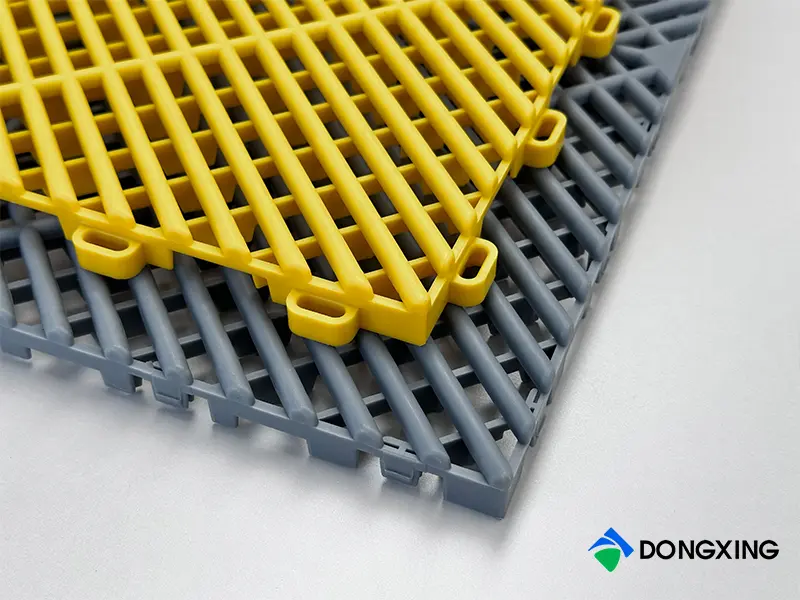
10. Do Interlocking Garage Floor Tiles Move or Separate Under Cars?
One of the most common concerns is: do garage floor tiles move when you drive on them? The short answer is that quality systems stay in place, but cheap or poorly installed ones can shift.
Why Tiles May Move
- Inadequate interlocking: Weak single-tab systems don’t resist lateral forces from turning tires
- Expansion: Thermal expansion can cause tiles to buckle or shift if no expansion gap is left at walls
- Poor installation: Tiles not fully clicked together will separate under stress
- Perimeter movement: Without edge restraints, the whole floor can creep toward the garage door over time
- Uneven substrate: Slopes or unevenness cause tiles to migrate downhill gradually
Why Quality Systems Stay in Place
- Locking mechanism: Precision-engineered interlocks create positive mechanical connection between every tile
- Friction: The underside texture and weight of the full assembly create friction against the subfloor
- Full-floor assembly: When locked together as a complete sheet, thousands of interlock points share lateral forces
- Perimeter restraint / edging: Properly installed edge trim holds the perimeter in place, preventing the whole floor from shifting
In a properly installed quality system, you should not see tiles move, separate, or pop up under normal vehicle use. If tiles do shift, it’s almost always an installation issue or a product not rated for vehicle traffic.
11. How Long Do Interlocking Garage Flooring Last?
Tile lifespan varies dramatically based on use case. A residential garage with two cars has a very different wear profile from an automotive repair shop with daily commercial traffic.
Key factors affecting service life:
- Material: Virgin polypropylene generally lasts longer than PVC under heavy loads; PVC offers better chemical resistance
- Thickness: Thicker tiles resist wear and impact longer
- UV exposure: Direct sunlight shortens lifespan of some plastic formulations
- Vehicle traffic: Frequency, weight, and type of vehicles
- Chemicals: Exposure to oils, solvents, cleaners, and road salt
- Temperature: Extreme heat and cold cycles accelerate material fatigue
- Installation: Proper subfloor prep and correct installation maximize lifespan
- Maintenance: Regular cleaning prevents abrasive grit from wearing the surface
For typical residential garages with 1–2 passenger cars, quality interlocking tiles can last 10–20 years or more. In commercial shops with daily vehicle traffic and heavy equipment use, expect 5–10 years from industrial-grade tiles, with high-traffic areas wearing faster than others.
12. Frequently Asked Questions
Q1. Are interlocking garage floor tiles strong enough for cars?
Yes, quality interlocking tiles easily handle passenger cars and most light trucks when properly rated and installed.
Q2. How much weight can garage floor tiles hold?
Residential tiles typically hold 5–15 t/m² distributed static load; industrial heavy-duty tiles range from 15–30+ t/m², but real performance depends on load type.
Q3. Can you put a car jack on garage floor tiles?
It depends on tile thickness and construction—always check the manufacturer’s specifications and use a load-distribution pad for safety.
Q5. Can garage floor tiles support SUVs and trucks?
Heavy-duty tiles rated for 15+ t/m² handle SUVs and pickup trucks easily, as weight distributes across four large tire contact patches.
Q6. Can garage floor tiles support an RV?
Large RVs require industrial-grade tiles with sufficient thickness; ensure the rating accounts for stationary long-term loading, not just rolling traffic.
Q8. Are interlocking garage tiles suitable for forklifts?
Only specific industrial-grade tiles rated for forklift traffic are suitable; standard residential tiles will crack under forklift point loads and turning forces.
Q9. Do garage floor tiles crack under heavy equipment?
They can if equipment creates point loads exceeding the tile’s rating, or if the wrong grade of tile is used for heavy commercial applications.
Q10. Do interlocking garage floor tiles move when you drive on them?
Properly installed quality systems with robust interlocks and edge restraints do not shift or separate under normal vehicle driving.
Q11. Does garage floor tile thickness matter?
Yes, but overall thickness alone is misleading—solid-core thickness, rib structure, and material density matter more than total height.
Q12. What material is best for heavy-duty garage floor tiles?
Virgin high-impact polypropylene is generally best for heavy load-bearing applications, while PVC offers superior chemical resistance and surface finish.
Q13. How long do interlocking garage floor tiles last?
10–20+ years for residential use, 5–10 years for commercial applications, depending on material quality, traffic level, and maintenance.