Badminton courts in the Philippines must contend with the country’s unique tropical climate, characterized by year-round high humidity, intense heat, monsoon rains, and strong equatorial UV radiation. Therefore, even when constructing indoor courts, the choice of flooring material must account for factors such as moisture resistance and temperature fluctuations to avoid the need for frequent renovations.
1. Tropical Humidity
The average annual relative humidity in the Philippines ranges from 70% to 85%, often soaring above 90% during the rainy season (June to November).
When selecting PVC sports flooring, one cannot rely solely on dry-state slip resistance; the material must also maintain a stable coefficient of friction under wet conditions.
In high-humidity environments, wood flooring is prone to warping, buckling, mold growth, and delamination. Even PVC flooring can suffer from edge curling if the quality is poor.
Therefore, it is advisable to choose flooring with independently verified wet-state slip resistance—specifically, a rating of R10 or higher according to the DIN 51130 standard. Flooring that holds BWF certification and has undergone testing by organizations such as LABOSPORT represents a superior choice.
2. Heavy Daily Use
Commercial badminton clubs typically operate their courts 12 to 16 hours a day, seven days a week, experiencing high usage rates across recreational play, league matches, and various training sessions.
The wear layer of PVC flooring determines the court’s lifespan; it is recommended to select specifications with a standard wear layer thickness of at least 0.7 mm.
Seams are prone to issues in high-humidity environments, so the welding rods and heat-welding techniques used during installation must meet established standards.
Continuous jumping and lunging movements can diminish the flooring’s shock-absorption capabilities over time. If the PVC foam layer lacks sufficient resilience, the material is prone to permanent compression or collapse.
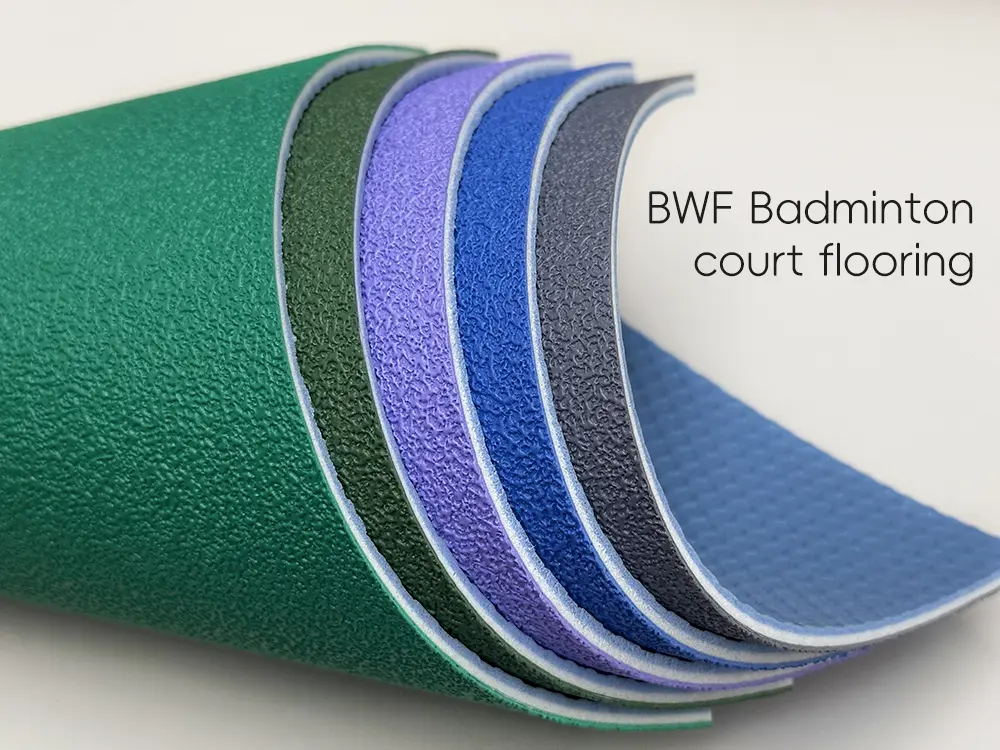
Therefore, when sourcing materials, it is advisable to request samples from suppliers to test the foam layer’s performance. For instance, with Dongxing Plastics’ badminton court flooring, if you fold the material 180 degrees, it quickly springs back to its original shape even after the crease is pressed down firmly; furthermore, it is difficult to tear apart by hand. This serves as an excellent method for evaluating the quality of the foam layer.
3. Indoor vs. Outdoor Environments
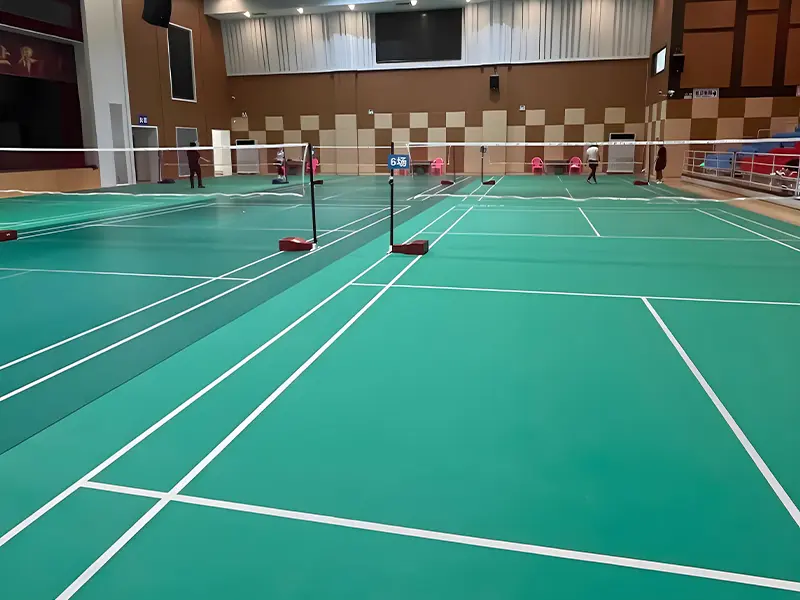
Indoor courts prioritize shock absorption, consistent ball rebound, slip resistance, and noise reduction.
Outdoor courts must withstand climatic conditions such as UV exposure, heavy rainfall, and temperature fluctuations.
4. Most Popular Badminton Flooring Options in the Philippines
PVC sheet flooring is the most popular material for indoor badminton courts worldwide; the “crystal sand” surface pattern is a common choice, with standard thicknesses ranging from 4.5mm to 8.0mm.
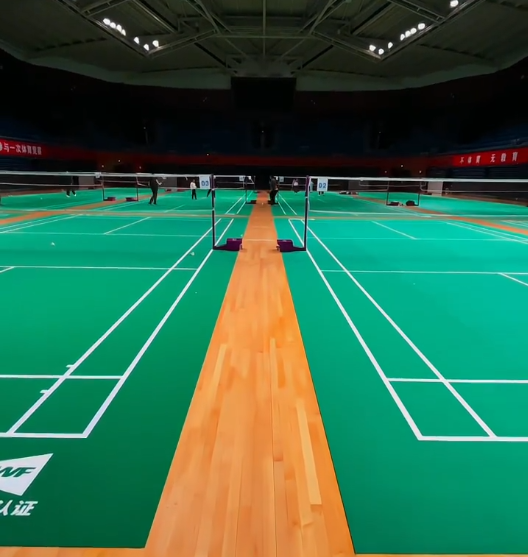
Professional badminton clubs or sports arenas often opt for a professional wood flooring base topped with PVC flooring. However, a common issue arises when the PVC is not permanently fixed: slippage can easily occur between the PVC and the wood subfloor. In such cases, we recommend a product like ours:
Thanks to its nitrile rubber backing, it stays securely in place without the need for permanent installation, ensuring the playing experience remains unaffected.
For more information on material selection, please refer to:
If you are looking for an outdoor court solution, UV-resistant modular sport court tiles would be the better choice.
5. Why Choose Dongxing Sport Flooring Supplier?
Dongxing Plastic is a leading global manufacturer of professional sports flooring based in China. With over 15 years of industry experience, we supply products to numerous well-known brands.
We maintain full control over every stage of production—from raw material formulation to the finished product—ensuring consistent quality and offering direct factory pricing.
Our 7.0mm badminton flooring is BWF-certified and has passed LABOSPORT testing.
It is designed to withstand high humidity, high temperatures, and intense UV exposure, making it ideally suited for the climate conditions of Southeast Asia.
We offer fully customized solutions, including color options, court line markings, OEM branding, and special thickness specifications.
We provide comprehensive installation manuals, video tutorials, and remote technical support.
We have successfully completed sports facility projects across Southeast Asia, India, Europe, and the Americas; please feel free to request samples and case studies.