
Unlike permanent, fixed field coatings, pickleball court modular floor tiles allow for easy installation with minimal setup and are easily dismantled and reused. Whether you’re building a backyard pickleball court or a sports center with multiple courts, modular interlocking floor tiles offer excellent flexibility and durability.
1. What are Modular Sports Floor Tiles?
Modular sports floor tiles are prefabricated, interlocking panels that can be laid directly on a flat, solid substrate, such as concrete, asphalt, or compacted aggregate. They are ideal for outdoor use. For detailed information, please refer to our product range:
A complete modular pickleball court system includes:
1.1 Interlocking Tiles
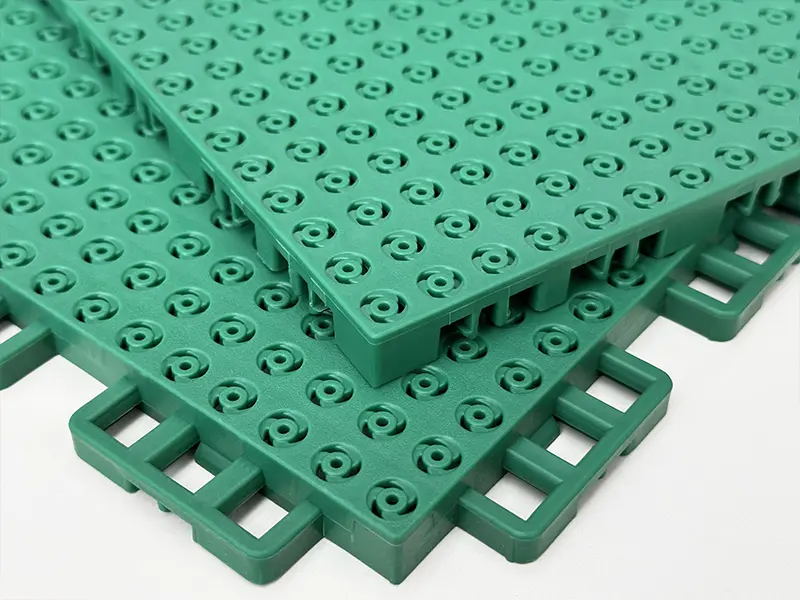
Made of environmentally friendly PP material, these are injection molded in one piece and available in various structures and models. They feature a textured surface for increased friction, a perforated structure for drainage, cushioning pads for impact resistance, and interlocking edges on all four sides. Standard sizes range from 12×12 inches (30×30 cm) to 20×20 inches (50×50 cm).
Expansion Joints:
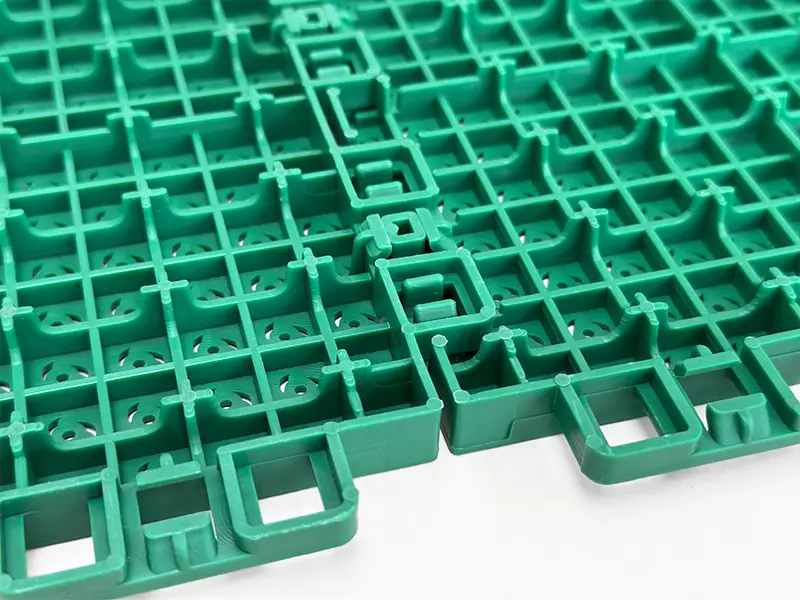
Not only indoor PVC flooring, but also interlocking flooring expands and contracts with temperature changes. Therefore, proper expansion joints should be installed around the perimeter of the court during installation. The joints between two pieces of sports flooring are designed with this in mind; the interlocking mechanism preserves these expansion joints. They prevent bending, deformation, and surface separation under extreme high or low temperatures, ensuring long-term structural integrity.
Edge Ramps:
Sloping transition sections installed along the outer edge of the court. Edge ramps provide a smooth transition between the court surface and the surrounding ground, preventing tripping and improving player safety, while also facilitating wheelchair access, maintenance equipment, and pedestrian movement.
Corner Ramps:
Corner ramps with specially angled corners complete the perimeter of the court. Their slope matches the edge ramps, resulting in a clean and aesthetically pleasing appearance while eliminating sharp 90° right angles.
Court Marking:
International standard pickleball court lines—including baselines, sidelines, kitchen/non-volley lines, and center line—can be pre-marked for you, or you can paint them yourself using durable paint or embedded tape after installation. Pre-marking speeds up installation and ensures accurate lines.
2. Professional Pickleball Court Tiles System
Globally, the popularity of modular pickleball courts is largely due to their advantages over traditional court construction methods, and users are highly concerned about ball rebound, as this directly affects the playing experience and has higher performance requirements.
Learn about our products:
2.1 Faster Installation
No adhesives required, snap-fit assembly.
No professional construction required, semi-skilled workers can complete the work.
Minimal base preparation, low requirements for surface flatness.
Ready to use immediately after assembly, no need to wait for drying or curing.
2.2 Improved Player Comfort
Pickleball involves frequent pauses, starts, lateral movements, and repetitive impacts. Hard surfaces like exposed concrete transmit high impact to joints, leading to fatigue and overuse injuries.
Adding cushioning pads can better reduce knee fatigue during prolonged play.
It reduces ankle stress during quick changes of direction.
It absorbs the impact of hard surfaces on the lower back.
This makes it perform well among older players, and acrylic and PVC pickleball mats are no exception, as middle-aged and older players make up a significant proportion of pickleball players.
2.3 Key Features
Shock absorption is typically 10% to 25%.
All-weather durability, with added UV inhibitors, able to withstand extreme temperatures, suitable for various climates. Prevents fading and brittleness caused by prolonged sun exposure, maintaining color and performance for over 5 years.
Does not retain water; rainwater drains directly.
Unlike acrylic finishes that require regular renovations, only occasional high-pressure cleaning is needed.
The most concerning aspect is the consistency of the actual ball bounce, which is the most important factor to consider when purchasing interlocking sports flooring.
Unaffected by moisture, maintaining grip even in wet conditions reduces the risk of slipping.
3. Modular Pickleball Flooring Materials
Polypropylene (PP)
High stiffness and structural strength
Excellent chemical and moisture resistance
Good UV stability when properly formulated
Cost-effective for large-scale production
Fully recyclable
Copolymer Polypropylene (PP)
Impact copolymer polypropylene is the preferred premium material for high-end commercial and competitive pickleball courts. It is a blend of polypropylene with rubber or vinyl modifiers to enhance its toughness, but at a higher price.
Superior low-temperature impact resistance
Reduced brittleness in cold climates
Better overall durability and longer service life
More stable performance under extreme temperature conditions
Lower risk of cracking under heavy equipment or impact
4. Best Applications for Pickleball Tiles
Schools:
Colleges and universities can quickly install this surface system on existing asphalt or gymnasium surfaces, meeting budget cycle requirements, and it can be used for a variety of sports and activities.
Sports Clubs:
Clubs, fitness centers, and professional commercial pickleball courts benefit from rapid deployment, easy expansion, and low maintenance costs. Multi-field layouts can be added in phases.
Community Parks:
Municipal parks and recreation departments are choosing modular paving bricks to build public pickleball fields faster and at a lower overall cost than all-asphalt and acrylic structures.
Backyards/Homes:
More and more homeowners are building pickleball fields in their backyards. This is practically the best DIY solution, making it easy and convenient—no construction team required, and the field can be dismantled or relocated if the homeowner moves.
Multi-functional Sports Facilities:
The most common application of modular flooring is basketball courts. For creating a multi-functional outdoor court, interlocking flooring can transform the same space into pickleball, basketball, futsal, roller hockey, and other sports fields.
5. How to Choose the Best Pickleball Court Manufacturer
Check the manufacturer’s relevant certification systems to ensure compliance with quality standards, such as ISO 9001 Quality Management System and ISO 14001 Environmental Management System. This avoids encountering low-quality products made with recycled materials.
Practical test results on pickleball rebound, UV resistance, and weather resistance are even better. High-quality sports flooring factories can provide comprehensive after-sales service, guarantee product quality, and have a proven track record of successful installations. Pickleball court flooring companies with long-term operations and complete production capabilities are often the better choice. Therefore, it’s important to pay attention to a manufacturer’s monthly production capacity, number of production lines, and inventory levels. This directly verifies a factory’s strength, demonstrating not only the quality of its products but also the completeness of its entire production system.
Furthermore, requesting sample testing is currently the most effective and direct method, especially for sports facility companies. If a short-term on-site factory visit is not possible, it allows for quick confirmation of product quality and whether the purchase is worthwhile. For long-term cooperation, a factory visit is undoubtedly the most effective approach.
For pickleball courts, whether indoors or outdoors, Dongxing Plastic offers complete flooring material solutions. A variety of materials are available to suit different venue needs, and logo, color, and pattern customization is possible, providing more flexible purchasing options and reducing your procurement costs.