
Outdoor basketball court flooring differs from indoor flooring, requiring consideration of temperature and outdoor climate effects while ensuring athletic performance and durability. We’ve previously discussed the best flooring materials for outdoor basketball courts, but choosing between acrylic-coated courts and interlocking flooring tiles requires careful evaluation and comparison. These are two key materials for outdoor courts, and we’ll provide an in-depth comparison from multiple perspectives to help you make the most suitable choice.
1. Overview
1.1 Interlocking Sport Court Tiles
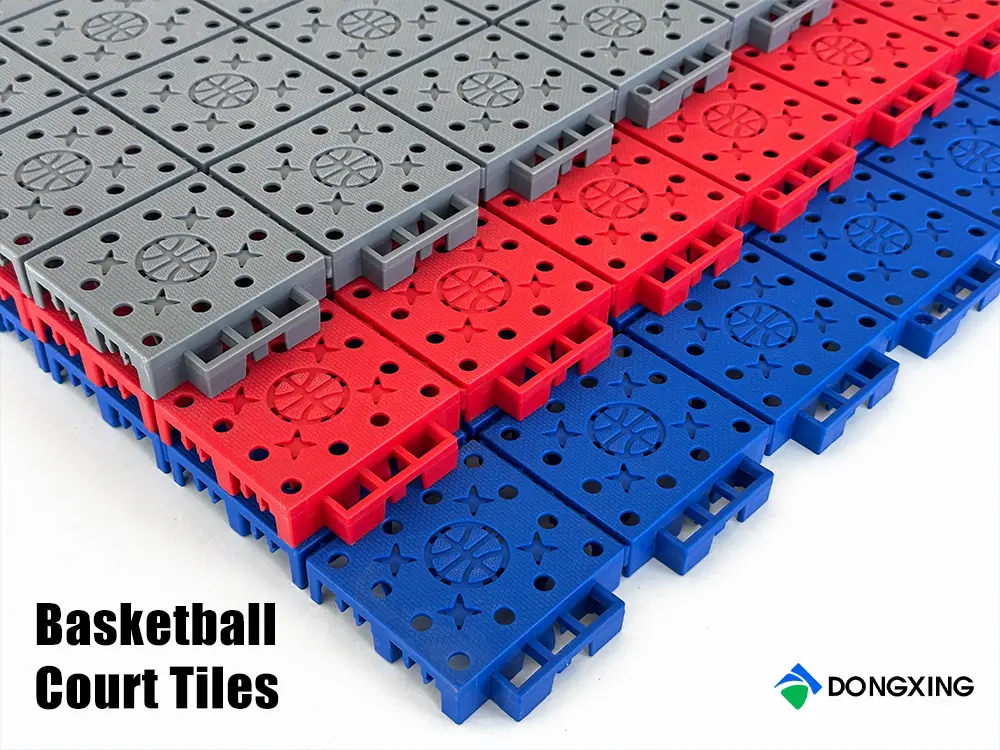
These tiles allow for flexible disassembly, low maintenance, and minimal requirements for the underlying surface. The modular structure uses interlocking installation, suspended above the ground, and combined with multi-point support and cushioning pads, provides professional athletic performance characteristics such as drainage, weather resistance, rebound, and slip resistance.
Product Recommendations:
Single tiles come in various sizes, typically between 25-36cm, and offer a variety of structural patterns. They are stable in all-weather temperatures ranging from -40℃ to +70℃.
1.2 Acrylic Basketball Courts
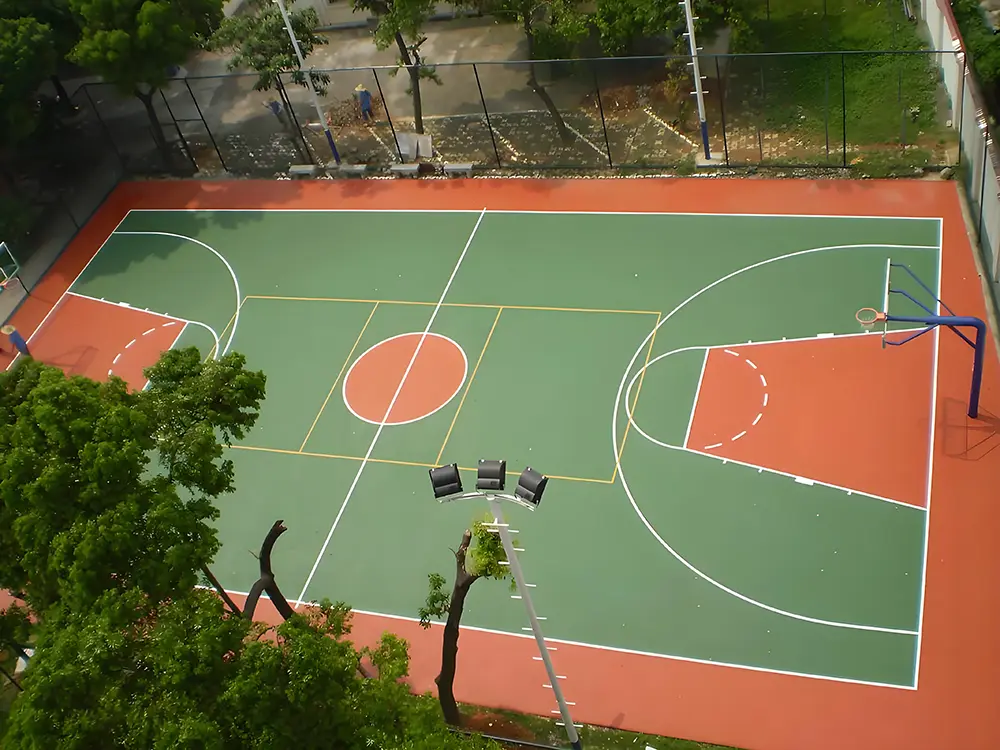
As a liquid water-based coating system, acrylic courts require application to cement or asphalt surfaces, demanding a high degree of surface flatness. Interlocking tiles are mainly divided into hard acrylic and elastic acrylic, with added quartz sand to provide a non-slip texture. The advantage is excellent wear and weather resistance, but the disadvantage is insufficient elastic cushioning.
2. Sports Performance Comparison
Interlocking basketball court flooring offer better ball rebound, approaching the level of indoor wood and pvc vinyl flooring. The surface features a three-dimensional friction texture design, maintaining stable grip over the long term.
Acrylic flooring offers high ball speed and low rebound, suitable for fast-paced games. Its non-slip performance depends on the quartz sand content and particle size; after a certain period of use, the quartz sand will wear down, requiring recoating.

3. Installation and Maintenance
Installation of interlocking tiles for a basketball court can be completed in 1-3 days for a standard basketball court, and no professional construction team is required; it can be done by oneself by following the steps.
Acrylic flooring has a construction cycle of approximately 5-10 days. Each coat of paint needs to dry completely before the next step can be applied, making it more susceptible to weather conditions. It also requires a surface flatness of ≤3mm/m.
While acrylic flooring may seem cheaper initially, it requires recoating after 3-5 years, making the overall cost higher than interlocking flooring.
The lifespan of acrylic courts is highly dependent on the quality of the base. If the base settles or cracks, the surface layer will be damaged. Basketball court tiles, on the other hand, only require replacement of individual tiles even if damaged, eliminating the need to replace the entire court.
4. Climate Adaptability
In tropical and rainy/humid regions, interlocking tiles allow for rapid drainage, preventing water accumulation without compromising slip resistance.
Acrylic is more weather-resistant to high temperatures. PP tiles may experience slight fading or deformation under prolonged high temperatures, especially with lower-quality products.
Pure and environmentally friendly PP is non-toxic and odorless, while acrylic flooring produces an odor during installation, which requires ventilation and drying to dissipate.
5. Procurement Recommendations
Modular interlocking tiles are more suitable for community sports centers, high schools and universities, temporary adaptable courts, and multi-purpose sports courts.
In arid regions with low rainfall, and with a professional construction and maintenance team, acrylic flooring is a good option for those seeking the feel of a traditional basketball court.
Acrylic coatings are more like traditional sports flooring materials, and now offer more choices. For example, the increasingly popular pickleball courts use outdoor mat flooring rolls with a PVC base and an acrylic surface coating, combining the advantages of both.
If you are looking for flooring suppliers and solutions for your basketball court, please request free samples for testing.