
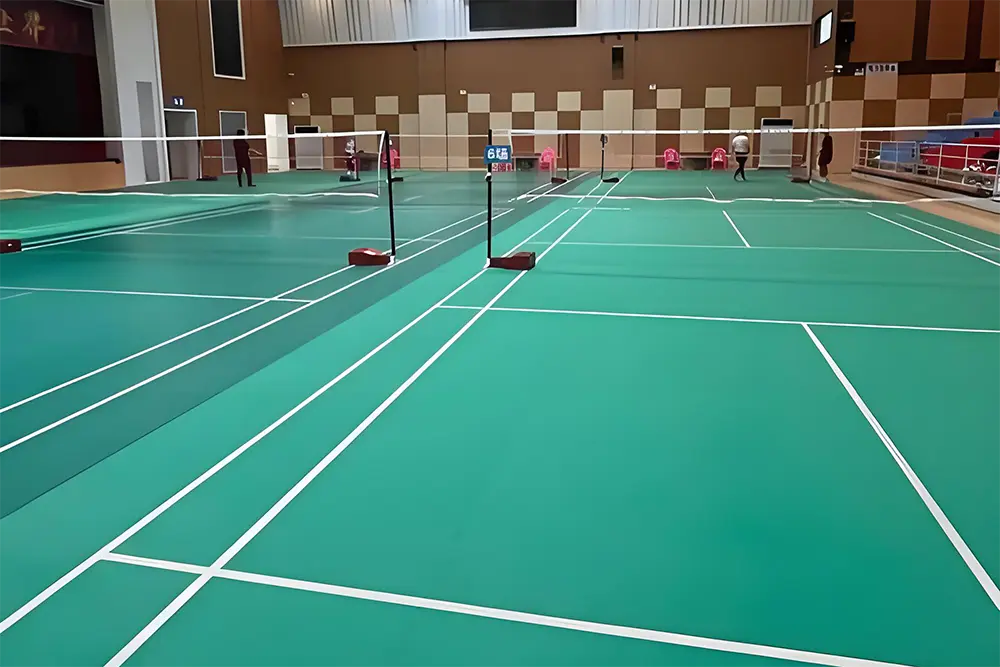
Professional badminton courts, as high-intensity sports venues involving shuttle runs, jumps, and sudden stops, rely heavily on surface materials that directly impact safety, foot feel, and long-term operating costs. PVC badminton court material is currently the mainstream choice for venues worldwide. Ensuring its long lifespan not only saves on maintenance and replacement costs but also boosts revenue, maximizing economic and usage benefits.
Managers of badminton courts often encounter the same problem: some courts experience bulging, cracking, fading, and elastic collapse after only 2-3 years, while others, with proper use, can last stably for 8-12 years. Surface wear is also a concern. With continuous high-frequency use, such as in clubs, many friction marks can be seen on the surface under reflected light, even if they haven’t yet caused any actual damage.
1. Factors Affecting the Lifespan of Badminton Mats
1.1 Badminton Flooring Quality
Raw materials are key to quality, which is why we consistently emphasize the importance of 100% PVC materials and rejecting recycled waste. Substandard raw materials will inevitably result in defects, no matter how good the processing. The fundamental material determines the quality.
Different modifier formulas are added during PVC raw material processing. The proportions and usage of these modifiers will affect the finished badminton flooring. So, what is the correct approach?
- Environmentally friendly polyester plasticizers: Highly compatible with PVC resin, anti-aging.
- Phenylene plasticizers: Low cost, high plasticizing efficiency. However, they are prone to migration and exudation, have poor weather resistance, and cause the flooring to age quickly.
- Foaming regulators: Determine the closed-cell structure of the foam layer, resilience, and moisture resistance.
- Imbalanced plasticizer ratios: May lead to insufficient elasticity, easy denting, and insufficient load-bearing capacity.
- Dongxing Plastics Factory uses strict process formulas, and the complete production process can be observed.
1.2 The Impact of Thickness on Durability
Thicker is not always better, but thicknesses less than 4.5mm usually cannot guarantee a long service life. For example, 3.5mm badminton PVC flooring is typically only suitable for very low-frequency home court use. Professional clubs and badminton courts should choose a minimum thickness of 4.5mm for badminton flooring. For information on badminton flooring thickness, please refer to: Sports Vinyl Flooring Thickness: A Complete Guide
The thickness of the abrasion layer often plays a decisive role in the lifespan of the floor. Professional-grade abrasion layer thickness is ≥0.5mm, while high-end flooring can reach 0.7-1.2mm. Fortunately, if you have special requirements, you can customize different abrasion layer thicknesses through us.
1.3 Foam Layer
The foam cushioning layer is a direct indicator of the quality of a badminton flooring material. As we have mentioned many times, the standard is that the foam layer density must meet the requirements; it should quickly return to its original shape after being rigidly bent and should not easily tear.
Otherwise, even a thicker foam layer is useless; the key is to look at the density.
1.4 Frequency of Use
Intensity of use is the direct cause of wear and tear. Professional commercial badminton courts are open 8-12 hours a day, with multiple players engaging in continuous competitive sports. The floor is constantly subjected to the impact of jumping, friction from shoes, and the wear and tear from moving tables and chairs, resulting in a wear rate far exceeding that of low-frequency courts. Therefore, the importance of the wear-resistant layer is evident.
1.5 Daily Maintenance
Surface cleaning alone is only suitable for simple daily maintenance. Regular in-depth inspections should be performed. For example, checking for stubborn stains, weld seams, and signs of delamination or bulging.
1.6 Installation
Proper installation ensures that badminton flooring will not develop serious problems such as bulging, sagging, unevenness, or delamination. The correct installation procedure must be followed.
2. Choose the Best Badminton Flooring to Extend its Lifespan
Prioritize models with calcium-free closed-cell foam, a wear-resistant layer thickness within the standard range, and a double fiberglass stabilizing layer. For example, our BWF badminton court mat (crystal sand) can meet the high-frequency use requirements of professional badminton clubs, professional competitions, and daily training.
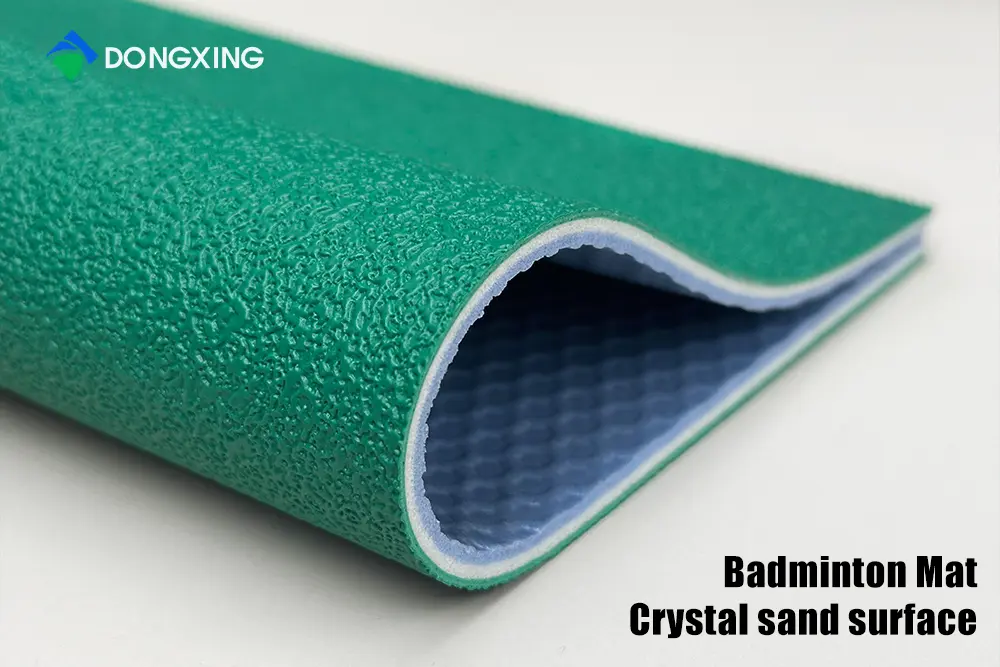
Of course, choosing the appropriate model based on the usage scenario is the best way to save costs while still meeting needs.
3. Standard Sports Flooring Installation
The subfloor must be hard, free of sand, flat, and dry. A flatness error of ≤2-3mm should be checked with a 2-meter straightedge. This is the most basic requirement for the subfloor before laying any sports flooring material.
Maintain an indoor temperature of 10-35℃ and relative humidity ≤70% during construction, avoiding construction during the rainy season or humid weather.
Use environmentally friendly adhesive specifically for PVC sports flooring, employing a full-coverage application process or partial application of adhesive tape.
Leave an 8-10mm expansion joint in the wall as per specifications to prevent deformation due to compression.
Align the rolled material in the same direction and compact it with a professional roller to remove internal air.
Weld the flooring material to the wall using a process that conforms to construction specifications.
For any installation questions, please request an installation guide and practical video.
4. Regular Maintenance
Daily cleaning with a soft-bristled mop or microfiber dust-free mop to remove surface dust, sand, and feather debris. Sand is the biggest culprit for the floor’s wear layer; timely cleaning prevents minor scratches caused by foot friction. For everyday stains, dilute a neutral detergent, wring out the mop, and wipe. Never use strong acids, strong alkalis, or hard-bristled brushes, as these can corrode the surface and scratch the wear layer.
For low- to medium-frequency courts, apply a PVC-specific maintenance agent every 2-3 years. For high-frequency commercial courts, perform annual maintenance. This will fill in minor surface scratches, restore slip resistance, and improve wear resistance by 10%-15%.
Keep the indoor environment well-ventilated and dry, avoiding prolonged periods of confinement and dampness. In summer, avoid direct airflow from air conditioners; in winter, avoid close proximity to heaters.
5. Summary
To ensure the optimal lifespan of your badminton floor, remember that quality is 30% material, installation is 30%, and maintenance is 40%. This reduces long-term operating costs and can extend the lifespan of your court to over 10 years.