
The thickness of professional-grade sports PVC flooring significantly impacts actual athletic performance. The total thickness is determined by its multi-layered composite structure, each layer serving a different function, but thicker isn’t always better. We’ll delve into the thickness range, the thickness of each structural layer, and their impact on the actual playing experience, providing optimal thickness selection recommendations.
1. Thickness of Different PVC Structures
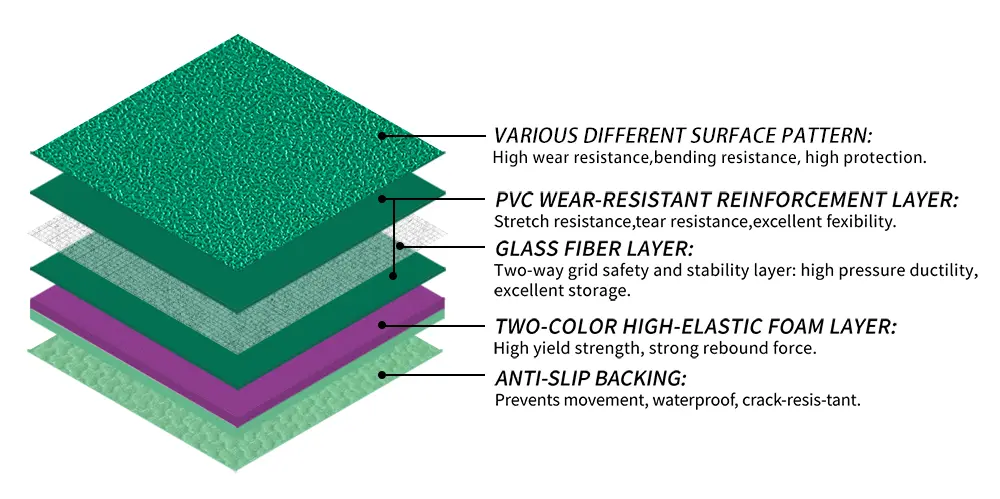
Abrasion Layer
This layer is less affected by friction and wear from shoes, directly determining the lifespan of the sports mat. Therefore, when choosing PVC flooring, the thickness of the abrasion layer is crucial, far exceeding the overall thickness.
The abrasion layer thickness should ideally be between 0.7-2.0mm. Thinner layers may compromise quality. Depending on the sports venue’s requirements, 0.7-0.8mm is suitable for casual play, while 1.0mm-2.0mm meets professional sports standards.
In the Southeast Asian market, some sports flooring buyers easily fall into the trap of focusing on low prices. Therefore, to obtain a reasonable quote, it’s essential to determine core parameters like the abrasion layer thickness, rather than overly focusing on the overall price.
Fiberglass Layer
Sandwiched between the wear-resistant layer and the foam layer, a double layer is essential. A single layer of fiberglass is unlikely to provide effective and stable performance, although it is cheaper.
Thickness range: 0.2mm-0.4mm. When focusing on the overall thickness of the PVC mat, pay attention to whether the thickness of each structural layer meets the standards. The fiberglass layer allows the PVC sports mat to achieve reliable stability, preventing deformation and collapse.
Foam Cushioning Layer
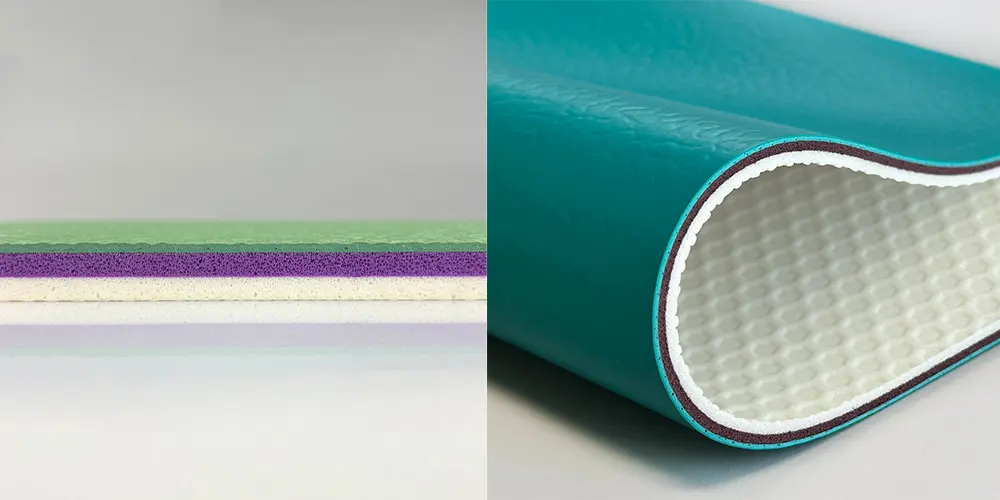
As the main structure of the entire PVC vinyl sports floor, it is responsible for impact absorption, energy rebound, and vertical deformation control, directly determining the floor’s protective effect on athletes’ joints. It is also the thickest part.
Range: 4.0mm-11.4mm, corresponding to an overall thickness of 4.5mm-12.0mm.
The key focus for the foam layer should be its density, not its thickness. In terms of performance, density is more important than thickness.
For example, in 6.0mm thick vinyl sports flooring, high-density closed-cell foam is much stronger than low-density open-cell foam; otherwise, it’s prone to poor shock absorption, easy collapse, and insufficient rebound. The most intuitive way to judge is to fold the flooring 180 degrees by hand, like folding a piece of paper in half, press it firmly, and then unfold it. If the crease doesn’t quickly return to its original shape, and you can see obvious creases and tears in the foam layer, then the quality is poor. Good PVC flooring won’t leave marks and can quickly return to its original shape; this is the most intuitive and simple inspection method.
Total Thickness
Flooring meeting sports performance requirements should have a minimum thickness of 4.5mm and a maximum of 12.0mm, but thicknesses above 10.0mm are generally less common. Most indoor badminton and basketball sports use thicknesses of 5.0, 6.0, 7.0, or 8.0mm. Volleyball courts typically use 8.0mm or 10.0mm.
Pickleball Court Mat Thickness
There’s one exception: pickleball courts, whether indoors or outdoors, are generally 3.0 or 3.5mm thick. Unlike other ball sports, their structure isn’t a foamed cushioning layer, but rather a dense PVC substrate or a semi-foamed structure.
2. How to Choose the Appropriate Thickness
Different sports have different force application logic, footwork characteristics, and impact intensity, leading to variations in the required PVC flooring thickness. Based on our experience, we recommend the following thicknesses for several globally popular sports courts:
Badminton: 4.5mm-6.0mm is suitable for most venues; 7.0mm is the optimal choice for BWF event certification.
Basketball: 6.0mm-8.0mm is the standard range. Basketball involves high-frequency jumps and landings, high-intensity physical contact, and lateral sliding movements, resulting in an impact intensity more than twice that of badminton.
Table Tennis: For stability and no loss of momentum, 4.5mm thickness is the preferred choice.
Volleyball and handball: Due to the high jump height and significant impact upon landing, an 8.0mm thickness is the preferred choice.
Whether for professional sports venues, clubs, or regular recreational use, if you have a certain budget, the 6.0-8.0mm range is most suitable. For low-frequency use, 4.5mm-6.0mm is sufficient. For special venues and high-requirement applications, choose thicker materials.
In summary
we have extensive production and service experience with surface materials for sports facilities. We can precisely match your specific needs to the thickness of the different structural layers mentioned above, creating a customized solution that better meets usage requirements while controlling your budget, rather than simply choosing a general thickness range. Furthermore, we will recommend suitable specifications based on the actual usage venue, improve venue design and paving planning, and provide free samples for quality testing; testing methods will be provided simultaneously.