
In healthcare environments—ranging from operating rooms and ICUs to general wards and laboratories—gaps and seams are unacceptable, as they can increase the risk of spreading bacteria and viruses.
Seamless medical-grade Vinyl flooring, featuring heat-welded seams and coved (curved) wall-base transitions, creates a continuous, impermeable surface. Implementing a seamless PVC sheet flooring system requires rigorous standards for both material selection and the execution of welded seams. Drawing on our experience supporting a wide range of medical projects, we offer insights into the key considerations and best practices for the procurement and installation of seamless hospital flooring.
1. What Is Seamless Healthcare Vinyl Flooring?
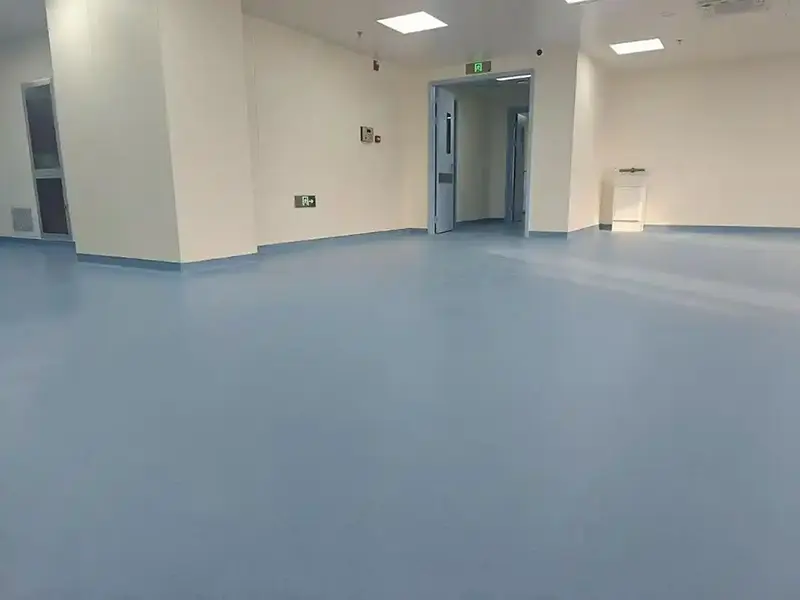
Seamless healthcare vinyl flooring is a system, not just a material. It combines sheet vinyl flooring (typically homogeneous or heterogeneous rolls 2 m wide) with precision installation detailing to produce a monolithic, cleanable surface with no exposed joints or dirt-trapping edges.
Heat-welded seams: the foundation of a true seamless surface
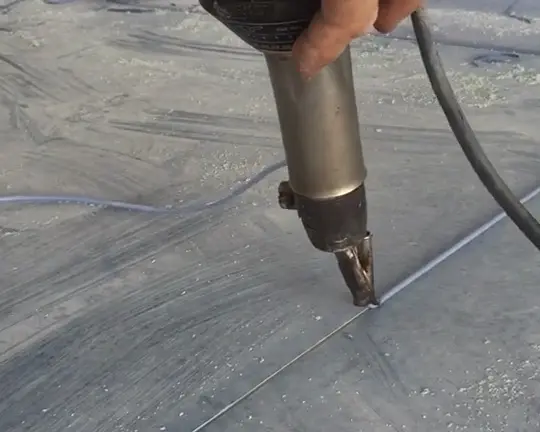
When two vinyl sheets meet at a joint, simply butting them together leaves a microscopic gap that can trap moisture, body fluids, cleaning chemicals, and bacteria. Heat welding eliminates this gap by melting a compatible vinyl welding rod into a prepared groove along the seam, chemically fusing both sheet edges into one unified surface.
When executed correctly, the welded seam is watertight, mechanically strong, and visually flush. However, seam integrity depends on three factors that are often overlooked:
- Fresh-edge cutting and true net fit: Factory edges can be crushed or uneven during transport. Professional installers trim a fresh edge on each sheet and set a precise gap—usually around 0.8 mm—before grooving. A gap that is too wide reduces bond area; a gap that is too tight causes peaking and an inconsistent groove depth.
- Groove quality: The U-shaped groove must be centered, clean, and cut to roughly two-thirds of the material thickness. An off-center, too-shallow, or contaminated groove produces a weak weld that can open under repeated cleaning and wheeled traffic.
- Material compatibility: Welding rods must match the vinyl formulation (PVC type, plasticizer content, and additive package). Mixing rod materials—for example, using a generic PVC rod with a specialized homogeneous sheet—leads to poor fusion, discoloration, and premature seam failure under hospital disinfectants.
Coved skirting: closing the wall-floor hygiene gap
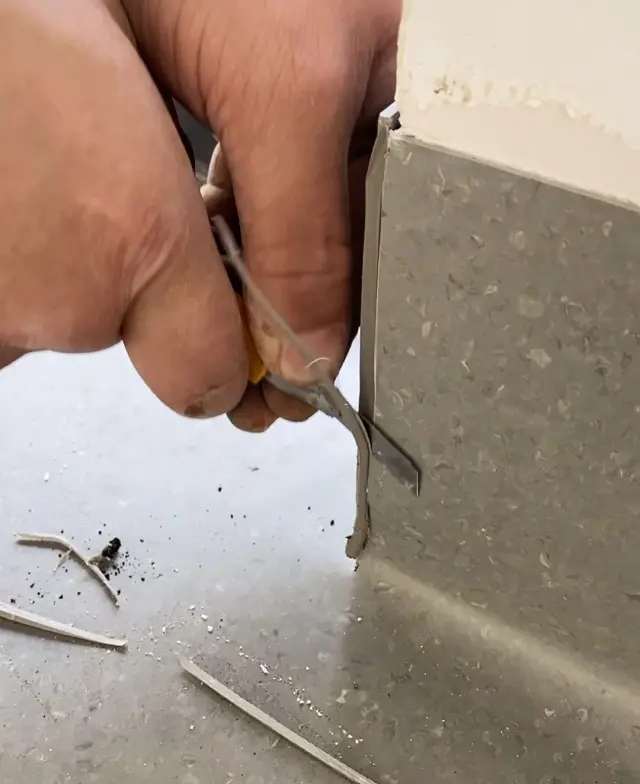
Even with perfectly welded field seams, the junction between floor and wall is the most common hygiene failure point in hospitals. Coved skirting (also called flash coving or coved flooring) solves this by bending the vinyl sheet upward along the wall in a smooth, rounded arc, typically 100 mm or higher, and sealing it to the wall surface.
The cove is formed around a rigid cove former, adhered with compatible adhesive, and welded at inside and outside corners. The result is a continuous, curved transition with no 90° inside corner where dust, moisture, and pathogens can accumulate. For highest-risk areas such as operating rooms and clean rooms, the cove is fully welded to wall cladding for a complete room-envelope seal.
2. Why Seamless Flooring Matters for Hospital Hygiene
In healthcare facilities, hygiene is not measured by how clean a floor looks after mopping—it is measured by how effectively the surface supports the removal and inactivation of pathogens. Seamless construction directly improves hygiene performance at three levels.
Seams and corners are the hardest places to clean
Unsealed seams, raw edges, and square wall-floor junctions create micro-environments that mops, cloths, and disinfectants cannot fully reach. Dried body fluids, detergent residues, and fine dust become trapped in these gaps. Over time, they form a biofilm that resists routine cleaning and can harbor bacteria such as Staphylococcus aureus, C. difficile, and other healthcare-associated infection (HAI) pathogens.
Properly welded seams and coved wall bases eliminate these hard-to-clean recesses. The entire floor-and-cove surface can be wiped, mopped, or disinfected as one continuous plane, leaving fewer sites where contaminants can persist.
A continuous surface speeds up effective daily cleaning
Hospital environmental services teams work under time pressure and follow defined protocols—often using a two-bucket or three-bucket mopping system with detergent and disinfectant steps. A seamless, smooth, non-porous vinyl surface allows consistent contact between the cleaning solution and the floor, so the disinfectant can achieve its labeled contact time across the full area.
By contrast, floors with many grout lines, damaged seams, or textured gaps force staff to slow down, scrub selectively, or rework areas. In a busy ward, that difference translates into either longer cleaning windows or less thorough disinfection—neither is acceptable.
Liquid spill containment and biofluid management
When blood, urine, IV fluids, or chemical reagents spill, a sealed floor system contains the liquid on the surface, preventing it from seeping under the sheet, reaching the subfloor, or wicking into wall bases. This is critical for two reasons:
- Contamination control: The spill can be fully cleaned and disinfected at the surface, without leaving hidden moisture that would support microbial growth.
- Structural protection: Unsealed seams allow repeated liquid intrusion, which breaks down adhesive, promotes subfloor mold, and eventually causes the floor to lift or bubble—creating new hygiene hazards.
It is important to note that spill performance is not guaranteed by material alone. It depends on the complete system: sheet quality, weld integrity, cove detailing, adhesive compatibility, and the facility’s actual spill response and disinfection procedure.
3. Key Features to Look for in Healthcare Vinyl Flooring
Not all vinyl flooring is suitable for hospital use. When evaluating products, focus on performance attributes that directly support hygiene, safety, and long-term service life. Always verify claims against manufacturer technical data sheets and independent test reports.
Surface structure, water absorption, and cleanability
Healthcare vinyl should have a dense, non-porous wear layer with low water absorption. Quality homogeneous vinyl is effectively impermeable. The surface finish matters too:
- A smooth or lightly textured surface cleans most efficiently.
- Deep embossing, while visually attractive, can trap soil and make disinfection less reliable in high-risk areas.
- Advanced surface treatments (PUR or UV-cured coatings) reduce stain uptake from iodine, betadine, and disinfectants, and preserve cleanability over years of aggressive cleaning.
Chemical compatibility with hospital disinfectants
Hospitals use a range of cleaners and disinfectants—quaternary ammonium compounds, sodium hypochlorite (bleach solutions), hydrogen peroxide, alcohol-based agents, and phenolic formulations. A flooring product that performs well with neutral detergent may degrade, discolor, or become brittle when exposed to stronger hospital disinfectants over time.
Before selection, confirm the product’s chemical resistance against the exact disinfectants used by the facility, at their specified concentrations and contact times. Chemical incompatibility is a leading cause of premature seam discoloration and surface degradation in hospitals.
Slip resistance for wet cleaning and wet-area safety
Frequent mopping means hospital floors are regularly wet. Slip-resistant flooring reduces fall risk for patients, visitors, and staff.
Common slip-resistance standards include:
- DIN 51130 / R-class ratings: R9 is typical for general corridors; R10 or higher is recommended for wet areas, bathrooms, and food service zones.
- EN 13893: Dynamic coefficient of friction testing for resilient floor coverings.
The right balance must be struck: higher slip resistance is safer when wet, but extremely aggressive textures can hinder cleaning and wheeled traffic (beds, trolleys, wheelchairs). Healthcare-grade vinyl is engineered to meet both hygiene and safety requirements.
4. How to Choose and Install Seamless Hospital Vinyl Flooring
A great product can fail with poor installation. For a genuinely hygienic seamless floor, pay equal attention to system selection, substrate preparation, and post-installation inspection.
Select the right sheet system and detailing approach
- Homogeneous vinyl sheet is the standard for operating rooms, ICUs, and laboratories. It supports the cleanest welds, can be refurbished by buffing, and offers the longest service life under heavy disinfectant use.
- Heterogeneous vinyl sheet with a reinforced wear layer is widely used in wards, corridors, and public areas, balancing hygiene performance with design options and cost.
- Always specify heat-welded seams for all clinical areas. Cold weld systems are not considered equivalent for high-hygiene healthcare applications.
- Specify coved skirting in all patient care and clinical areas; for maximum hygiene, specify fully welded inside/outside corners and a sealed top edge termination.
Substrate conditions make or break the installation
The subfloor must be flat, dry, firm, and clean before any vinyl goes down:
- Flatness: High spots and low spots cause uneven seam pressure, telegraph through the sheet, and make consistent grooving impossible. Use a self-levelling compound where needed.
- Moisture: Excessive concrete slab moisture is the single biggest cause of weld failure and floor bubbling. Conduct moisture testing (calcium chloride or relative humidity) and install a moisture barrier if readings exceed the manufacturer’s limit. Moisture vapor pushing up through seams weakens the weld bond from below.
- Strength and compatibility: The substrate must be sound and clean. Loose screed, oil residues, or incompatible old adhesives prevent proper bonding and can contaminate weld grooves.
Post-installation quality checks
Before handing over a healthcare floor, inspect every seam and transition:
- Visually check that welds are flush, consistent, and free of scorch marks, underfilled sections, or exposed gaps.
- Run a fingernail or blunt probe along seams to detect lifting edges or weak bonds.
- Check for blisters, bubbles, or delamination, especially near walls and coves.
- Verify that coves are fully adhered, corners are neatly welded, and top edges are properly terminated and sealed.
- Confirm the floor is flat under wheeled load and free of indentations from installation traffic.
5. How to Evaluate a Seamless Healthcare Vinyl Flooring Supplier
Choosing the right supplier is as important as choosing the right product. Here is what to verify before you commit.
Verify product specifications and compliance documentation
A credible supplier should be able to provide:
- Full technical data sheets with wear layer thickness, total thickness, weight, and dimensional stability.
- Independent test reports for: abrasion resistance (EN 660-2 / ISO 24344), slip resistance (DIN 51130 / EN 13893), chemical resistance against common hospital disinfectants, antibacterial performance (ISO 22196 where claimed), and fire reaction (EN 13501-1 or equivalent).
- Relevant certifications such as CE, ISO 9001 quality management, and ISO 14001 environmental management.
- Project case histories in hospital and healthcare settings, not just general commercial references.
Look beyond material unit price: calculate total lifecycle cost
The cheapest roll price rarely delivers the lowest long-term cost. A complete healthcare flooring project includes:
- Substrate preparation (levelling, moisture barrier, primer)
- Installation labor (including certified heat-weld technicians)
- Coved skirting materials and forming
- Welding rods, adhesives, and consumables
- Ongoing maintenance (re-coating, periodic refurbishment)
- Expected service life before replacement
A higher-quality sheet with a robust wear layer and proven chemical resistance will often deliver better value over a 15–20 year service life than a budget product that needs replacement in 8–10 years.
Why Dongxing Plastic stands out for healthcare vinyl solutions
At Dongxing Plastic, we manufacture healthcare-grade homogeneous and heterogeneous vinyl sheet flooring designed specifically for hospital and clinical environments. Our products are formulated to withstand repeated disinfection, support reliable heat welding, and deliver consistent hygienic performance across wards, operating suites, laboratories, and long-term care facilities.
We supply not just sheet material, but a complete system: matching welding rods, cove formers, compatible adhesives, and technical installation support. Our in-house engineering team can review project drawings, advise on detailing, and help you avoid the costly seam and cove failures we see on under-specified projects. If you are specifying seamless vinyl for a hospital build or refurbishment, we welcome you to request product samples, full test reports, and project pricing.
6. Real-World Welding Rod Problems: Lessons from Healthcare Flooring Projects
After supplying and supporting hundreds of medical flooring installations, we have seen the same welding rod issues cause project delays, hygiene risks, and warranty disputes. Below is our field-tested summary of what goes wrong and how to prevent it.
6.1 Material mismatch: the invisible cause of weak seams
Problem: The installer uses a generic PVC welding rod with a specialized healthcare vinyl sheet. The rod may have a different plasticizer ratio or polymer formulation, so it never fully fuses with the sheet edges. The weld may look fine initially, but after months of bleach mopping and wheeled traffic, the seam shrinks, discolors, or opens up.
Solution: Always use the manufacturer’s matching welding rod for the specific product line. At Dongxing Plastic, every healthcare sheet grade has a corresponding rod formulated from the same base compound, ensuring chemical fusion and consistent resistance to disinfectants.
6.2 Color mismatch: visible seams that ruin aesthetics and create doubt
Problem: The rod color does not match the sheet, resulting in a visible line across the floor. In healthcare environments, a visible seam can also create the perception of a hygiene gap, even if the weld is technically sound.
Solution: Specify color-matched rods from the same manufacturer. Custom color matching is available for project-specific shades. Avoid substituting rods from stock based on a visual guess under warehouse lighting.
6.3 Groove preparation failures: most weld problems start here
Problem: The groove is off-center, too shallow, too wide, or contaminated with dust and adhesive residue. The rod does not bond to both sides equally, so the seam is weak on one edge and can peel open.
Solution:
- Only groove the seam you are about to weld—do not groove an entire ward in advance.
- Vacuum or brush the groove immediately before welding.
- Check groove depth at the start of every seam and at substrate transitions.
- Use sharp groover blades; dull blades tear the PVC instead of cutting a clean channel.
6.4 Temperature and speed errors: scorching or cold welds
Problem: The heat gun is too hot and scorches the surface, or the technician moves too fast and the rod does not fully melt into the groove. Both produce a seam that fails prematurely.
Solution: Follow the manufacturer’s temperature range (typically 340–450 °C depending on product) and maintain a steady travel speed. Allow adhesive to fully cure—usually 24 hours—before welding. Wet adhesive releases vapor that disrupts the weld bond and creates bubbles in the seam.
6.5 Premature trimming: sunken seams that trap dirt
Problem: The installer skives off the excess weld bead too soon, while the rod is still warm and soft. As it cools, it shrinks downward, leaving a slight trench along the seam that collects dirt and makes cleaning harder.
Solution: Allow the weld to cool completely before the first skive pass, then do a second light pass for a flush, smooth finish. This is a small detail that makes a huge difference in long-term cleanability and visual quality.