
In electronics manufacturing, semiconductor wafer fabs, precision laboratories, and clean production lines, electrostatic discharge (ESD) protection systems are of critical importance. Their primary purpose is to prevent damage to—or the ignition of—equipment and instruments within these sensitive or contamination-controlled environments.
“Static-dissipative, homogeneous, solid-core vinyl flooring” offers an effective solution to this challenge: it provides a controlled, durable pathway that safely channels static electrical charges to a grounding system, thereby preventing destructive electrostatic discharges.
1. What Is Static Dissipative Pressed Homogeneous Vinyl Flooring?
To understand the product, it helps to break its name into three working properties: static dissipative, pressed and homogeneous vinyl. Each one addresses a different risk in an ESD environment.
1.1 What “static dissipative” means
A static dissipative floor does not conduct electricity like a metal plate, and it does not block it like an insulator. It sits in a middle resistance band that allows static charge to leak off slowly and predictably toward ground, rather than accumulating on a person or discharging suddenly.
The basic principle. Charge generated by walking or equipment contact enters the vinyl surface, travels through the conductive or semiconductive network distributed in the material, passes through the conductive adhesive and grounding hardware, and reaches the building earth electrode. The resistance of this path is carefully tuned: high enough to avoid an abrupt, fast discharge, low enough that body voltage stays within the limits set by ESD standards (commonly below 100 V when tested as a floor-plus-footwear system).
Why electronics environments need it. In an EPA, the floor is the contact point for personnel and mobile equipment. A dissipative floor converts the body into a slowly grounded object: as someone walks, charge is continuously bled off through shoes and floor, so voltage never climbs to a damaging level. Without this path, the same body acts as a charged capacitor waiting to discharge onto the first pin it touches.
Under the ANSI/ESD classification widely used in the industry:
– Conductive: resistance to ground ≤ 1.0 × 10⁶ Ω
– Static dissipative: resistance to ground > 1.0 × 10⁶ Ω and < 1.0 × 10⁹ Ω
– Insulating / standard PVC: above roughly 10⁹ Ω, with no controlled discharge path
IEC 61340 and related standards set the upper bound for ESD flooring at about 1 × 10⁹ Ω resistance to ground, and evaluate the complete person–footwear–floor system rather than the material alone.
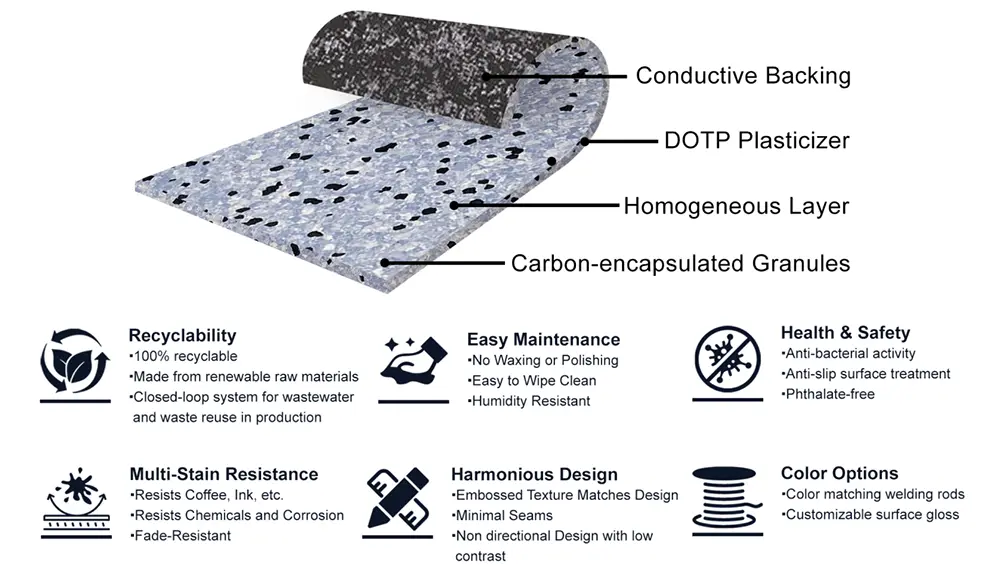
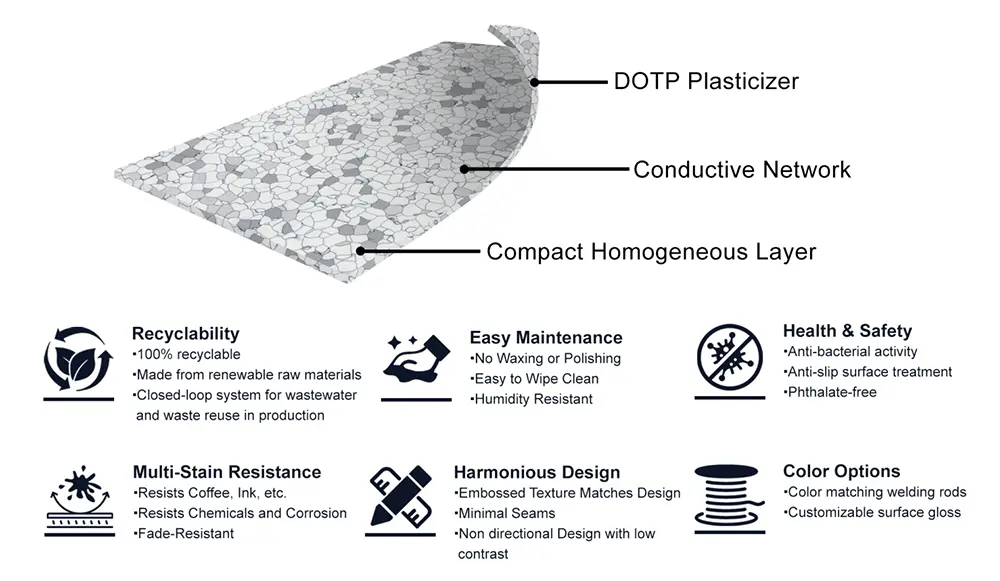
1.2 What “pressed vinyl flooring” means
Pressed vinyl flooring is formed in a hot-press (compression molding) process rather than by continuous calender rolling. The compound is layered or fed into a press, compressed under heat and pressure into dense slabs or tiles, then cooled and cut to size.
Key characteristics of the pressing route:
– Higher bulk density and dimensional stability: pressing compacts the compound uniformly, giving tiles a flat, stable body that resists warping and edge movement.
– Uniform thickness: pressure applied over the full area produces consistent gauge, which matters for seamless welding and even adhesive transfer.
– Tile-oriented format: pressing is especially common for square and rectangular tiles that are installed in grids, often paired with copper grounding strips between rows.
The alternative, calendering, squeezes the compound through rollers into continuous sheet. Both routes can produce good ESD floors, but pressing tends to be associated with dense tile construction, while calendering is typical for long rolls.
1.3 What “homogeneous vinyl flooring” means
Homogeneous vinyl is a single compound from the wear surface to the backing — there is no separate top wear layer, no laminated conductive film and no sprayed anti-static coating. The same formulation runs through the full thickness of the tile or sheet.
This distinction is the most important one in ESD Vinyl flooring:
– Through-thickness electrical network: the conductive functional additives are mixed into the whole batch, so the dissipative or conductive network exists at the surface, in the middle and at the bottom of the material.
– Performance does not depend on a surface film: a coated heterogeneous floor can lose its static-control function if the top coating wears away, is sanded during renovation, or is covered by insulating polish. On a homogeneous floor, light wear, scrubbing or recoating cannot strip away the electrical layer because there is nothing to strip.
– Consistent appearance and behavior: color, pattern and electrical properties remain consistent across the material, which also simplifies replacement of damaged tiles years after installation.
1.4 How the three properties combine
| Property | Role in the ESD system | Risk it removes |
|---|---|---|
| Static dissipative | Controls the resistance band and bleed-off rate of charge toward ground | Sudden, damaging ESD events; uncontrolled body voltage |
| Pressed | Delivers a dense, flat, dimensionally stable slab or tile | Warping, uneven gauge, adhesive and welding problems |
| Homogeneous | Keeps the conductive network through the full thickness | Loss of ESD performance when the surface wears or is refinished |
1.5 How it differs from ordinary homogeneous vinyl
Not every homogeneous vinyl floor is an ESD floor. Standard homogeneous vinyl used in hospitals, schools and retail interiors has the same through-thickness construction but an insulating formulation. The difference is the functional conductive additive package and the electrical testing behind it. A genuine static dissipative homogeneous floor must demonstrate its resistance band in tested reports; homogeneous structure alone does not make a floor dissipative.
1.6 Why precision production needs this combination
In an electronics or precision plant, flooring faces heavy rolling traffic, chair castors, chemical spills, frequent cleaning and a service life of 10–15 years or more. A dissipative-only product on a weak or coated substrate can fail electrically within a few years; a durable homogeneous slab protects both the mechanical performance and the static-control function across the whole service life. That is why specification sheets for semiconductor and electronics rooms increasingly ask for pressed homogeneous static dissipative vinyl rather than a generic anti-static floor.
2. How Is Static Dissipative Pressed Homogeneous Vinyl Flooring Manufactured?
The manufacturing route is where marketing claims meet real engineering. A credible ESD vinyl floor can be traced from formulation to tested batch, and the steps below describe how that is typically done.
2.1 PVC raw material selection
- PVC resin: suspension-grade polyvinyl chloride sets the mechanical backbone; the K-value determines hardness, melt flow and wear resistance.
- Plasticizers: added in a proportion that gives the sheet or tile the required flexibility and foot feel, while avoiding migration over time.
- Stabilizers: protect the compound during high-temperature processing; modern floors commonly use lead-free calcium–zinc systems for compliance and safety.
- Fillers: such as calcium carbonate, used to tune stiffness, dimensional stability and cost balance, without disrupting the conductive network.
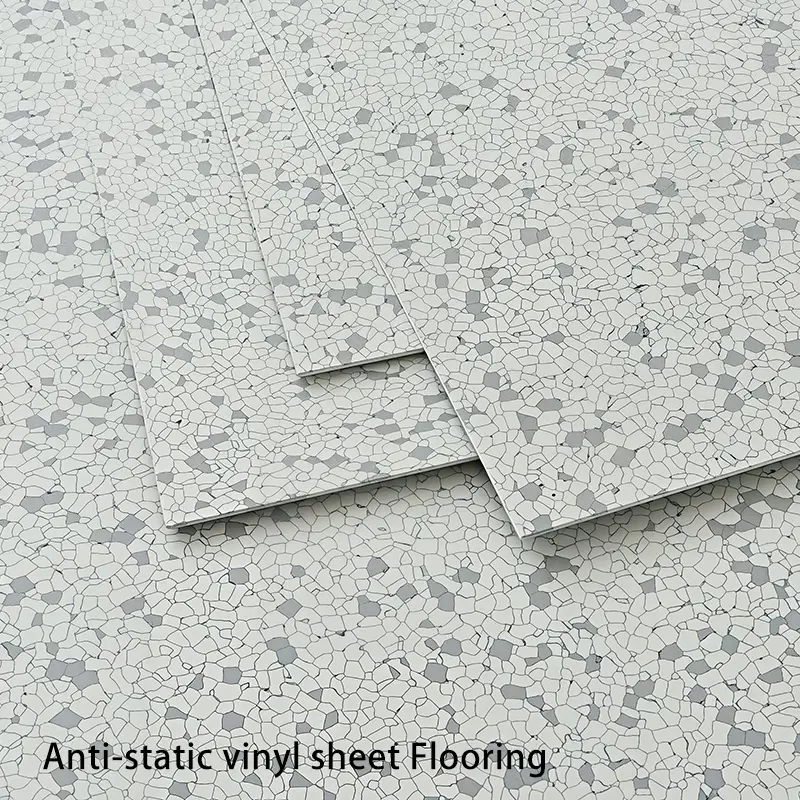
- Pigments: deliver the color and marble or speckle pattern visible on the finished floor.
- Functional additives: the conductive or semiconductive package that defines the ESD performance.
2.2 Functional additives and formulation
The electrical performance is engineered at the formulation stage, not painted on afterward. Common conductive functional fillers include:
- Carbon black: the most widespread conductive additive, forming interconnected particle chains (a percolation network) through the PVC matrix.
- Graphite: supports the conductive network and can influence surface smoothness.
- Carbon fiber or metal-treated particles: used in certain conductive grades to lower resistance further.
The dosage and dispersion are tightly controlled. Below the percolation threshold the material stays insulating; above it, resistance drops sharply. The formulator lands the batch inside the target dissipative band (typically 10⁶–10⁹ Ω for static dissipative grades) and balances it against mechanical properties, color consistency and cost. Because the additive is mixed into the entire compound, the electrical network runs through the full thickness — the core advantage of the homogeneous design.
2.3 Mixing and compounding
Ingredients are combined in hot/cold blending equipment to produce a dry blend or granulated compound. Mixing uniformity is critical: poorly dispersed conductive additives create local high-resistance or low-resistance patches that fail point-to-point testing later. The compound is then pre-processed into sheets or granules ready for pressing.
2.4 Pressing and forming process
For the pressed tile route:
1. The compound is metered into molds or laid as stacked layers on the press bed.
2. Heat melts and fuses the material; pressure compacts it into a dense slab of controlled thickness.
3. The slab is cooled under control to lock in flatness and dimensional stability.
4. It is cut into tiles (or sheet) with trimmed edges, and any embossed surface texture is formed at this stage.
Density, thickness tolerance and cooling rate are monitored because they directly affect both flatness and electrical consistency across the batch.
2.5 Surface treatment
After forming, the surface may receive a protective treatment such as a PUR or UV-cured coating that improves stain resistance, reduces dirt pickup and simplifies maintenance. On a homogeneous floor this treatment is a wear and cleaning aid, not the source of the static-control function. Some conductive grades also include a conductive backing or bonded carbon layer to improve the contact path to the adhesive below.
2.6 Electrical performance testing
Each production batch is checked against the project specification, typically including:
– Surface resistance and resistance to ground per standards such as ANSI/ESD STM7.1, IEC 61340-4-1 or ASTM F150.
– Point-to-point resistance across the tile or sheet to confirm there are no dead or over-conductive spots.
– Walking body-voltage testing where the floor is evaluated together with suitable footwear, following methods such as ANSI/ESD S97.2 or IEC 61340-4-5; the system must keep generated voltage below the EPA threshold (commonly 100 V).
Resistance readings are recorded against ambient humidity and temperature, because ESD measurements are climate-dependent.
2.7 Quality inspection and release
Final inspection covers thickness, flatness, edge quality, color match, pattern consistency and packaging, together with batch traceability records. A responsible manufacturer keeps the test report per lot so that installers and specifiers can verify that the delivered floor matches the resistance band quoted in the datasheet.
3. Static Dissipative vs. Conductive vs. Standard Anti-Static Vinyl Flooring
ESD flooring terminology is often used loosely. In practice, the categories are separated mainly by resistance range, how fast charge leaves the material, and the test method used to verify it.
3.1 Comparison table
| Attribute | Standard anti-static / ordinary PVC | Static dissipative vinyl | Conductive vinyl |
|---|---|---|---|
| Typical resistance to ground | > 109 Ω; often above 1011 Ω | 1.0 × 10⁶ – 1.0 × 10⁹ Ω | ≤ 1.0 × 10⁶ Ω |
| Charge behavior | Charge builds up; low tribocharging claimed, but no guaranteed ground path | Charge bleeds off at a controlled, moderate rate | Charge conducts away rapidly through a low-resistance path |
| Discharge speed | No controlled discharge; sudden ESD possible | Slower, regulated discharge | Fastest bleed-off |
| Main purpose | Reduce friction-generated charge in general areas | Protect ESD-sensitive products in an EPA; the most common specification | Rapid charge removal in conductive-zone processes, explosive or high-speed environments |
| Typical test methods | Not specified for ESD; no electrical class required | ANSI/ESD STM7.1, IEC 61340-4-1, ASTM F150; system walking-voltage test | Same resistance standards, evaluated to the conductive lower band |
| Suitability for electronics EPA | Not adequate as the primary floor | Standard choice for assembly, labs and test rooms | Selected when process requirements call for it |
3.2 Static dissipative versus conductive flooring
The difference between dissipative and conductive floors comes down to resistance and discharge speed.
– Static dissipative flooring holds charge in the 10⁶–10⁹ Ω band. It allows static to drain slowly and in a controlled manner, which matches how most EPAs protect personnel and products: enough grounding to keep body voltage below 100 V, without an abrupt discharge path.
– Conductive flooring has resistance below 10⁶ Ω. It provides the fastest charge conduction path and is chosen for specific processes that require immediate bleed-off, or in settings where explosive atmospheres or special cleanroom protocols demand it.
A useful engineering caution: a very conductive path can also discharge quickly. Most electronics assembly environments are therefore specified in the dissipative band, while conductive grades are reserved for particular zones and applications defined by the ESD control plan.
3.3 Static dissipative versus standard anti-static flooring
“Anti-static” is a loose marketing term rather than a precise electrical class. A product labeled anti-static may only be formulated to generate less charge through friction (lower tribocharging), without offering a verified conductive path to ground.
The key distinctions:
– Static charge generation: an anti-static floor may reduce the charge produced when walking, but cannot remove charge that already exists; a dissipative floor actively routes existing charge to ground.
– Electrical resistance: anti-static products are not guaranteed to fall in the 10⁶–10⁹ Ω band; dissipative floors are tested and certified to that band.
– Charge dissipation: dissipative floors provide a defined resistance path; ordinary anti-static PVC relies on low charging tendency only.
– Applicable test methods: dissipative floors are verified with ESD resistance and walking-voltage standards; a general anti-static claim usually carries no such tested qualification.
In short, a static dissipative floor is a tested, engineered member of the ESD control system; a generic “anti-static” floor is not, unless its datasheet proves otherwise.
4. Where Is Static Dissipative Homogeneous Vinyl Flooring Used?
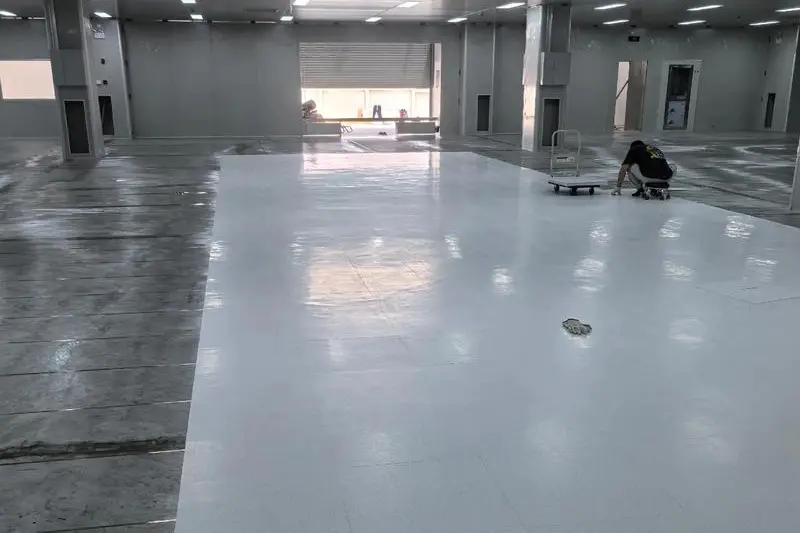
The product is deployed wherever personnel, carts and sensitive equipment share a static-controlled space.
Electronics Manufacturing
SMT lines, PCB assembly, final assembly, inspection and packing areas handle bare boards and populated products that are highly ESD-sensitive. A homogeneous dissipative floor provides durable static control under heavy castor and footwear traffic, and withstands the cleaning cycles typical of production halls.
Semiconductor Facilities
Wafer fabs, die attach, test and packaging rooms combine cleanroom requirements with extreme sensitivity to voltage. Flooring here must hold its resistance band under controlled humidity, weld seamlessly for cleanability and resist chemical and cleaning-agent contact.
Laboratories
R&D labs, calibration rooms, metrology and instrumentation areas contain measuring equipment whose readings can be disturbed by static. A dissipative floor keeps personnel and bench surroundings at a stable ground reference, protecting both instruments and the samples under test.
Pharmaceutical Facilities
Pharma production and packaging rooms often share cleanroom hygiene requirements with static control, especially where electronic sensors, blister packaging equipment or intermediate electronic components are present. Homogeneous vinyl is easy to clean and seal-welded for joint hygiene.
Data Centers and Technical Rooms
Server rooms, network closets and control rooms house sensitive electronic hardware. Dissipative flooring prevents static buildup during cable work, equipment swaps and maintenance, and supports the grounding environment required by IT equipment suppliers.
Other common settings include optoelectronics and display plants, EV battery and cell assembly, medical device manufacturing, and precision assembly of aerospace or automotive electronic parts.
5. How to Choose the Right Static Dissipative Homogeneous Vinyl Flooring?
Specifying an ESD floor is a system decision, not a material choice alone. The following checklist helps buyers compare suppliers and avoid under- or over-specifying.
5.1 Define Your Project’s ESD Requirements
– Confirm whether the project calls for the dissipative band (10⁶–10⁹ Ω) or a conductive grade below 10⁶ Ω.
– Identify the sensitivity of the products handled and the EPA classification required by the customer or industry.
– ANSI/ESD S20.20, IEC 61340-5-1 / EN 61340-5-1, and the relevant floor material test methods (STM7.1, IEC 61340-4-1, ASTM F150).
– Decide whether the floor will bond to the building earthing through copper strips, a conductive adhesive grid or both, and how the floor-plus-footwear system will be verified after installation.
5.2 Evaluate Product Structure and Manufacturing Quality
– Confirm the conductive additive runs through the full thickness, rather than residing only in a surface layer or coating.
– Check for uniform color, speckle and density; inconsistent compounding often shows up as variation in appearance and resistance.
– Confirm whether tiles are pressed or sheet is calendered, and match the route to the format and dimensional stability your installation needs.
– Look for batch-level testing, traceability and documented reject criteria.
5.3 Check Test Reports and Product Documentation
Third-party or in-house test reports showing surface resistance, resistance to ground and point-to-point readings, with test standards and ambient conditions noted.
Technical datasheets specifying thickness, wear classification, dimensions, color options and chemical resistance.
Compliance declarations such as RoHS, and any regional certifications required for the destination market.
Installation and maintenance guidance, including approved adhesives, cleaning agents and restrictions on insulating waxes or polish.
5.4 Consider Installation Compatibility
- Use the adhesive specified for ESD flooring so the electrical path between floor and subfloor is not broken by an insulating bedding layer.
- Plan the strip grid layout, spacing and connection to the earth electrode according to the design; strips must make continuous contact under the floor.
- The subfloor must be flat, dry, sound and itself bonded into the grounding scheme; moisture and unevenness compromise both adhesion and conductivity.
- Verify bonding to the building earthing system, and schedule periodic resistance checks after handover as part of the EPA maintenance program.
6. FAQ
Does static dissipative vinyl flooring require grounding?
Yes, it normally needs a matched grounding system to drain static safely.
Is homogeneous vinyl flooring suitable for ESD environments?
Only homogeneous vinyl formulated and tested for static dissipation can be used in ESD areas.
What is the difference between static dissipative and conductive vinyl flooring?
They differ mainly in resistance range and the speed of static charge removal.