
When building an outdoor tennis court, securing a reliable tennis court flooring manufacturer that can control material quality, production stability, delivery time, and after-sales support are crucial considerations.
Factories with years of experience in outdoor interlocking sports flooring production and a strong reputation are often prioritized. We will share insights from both our own experience and that of factories on how to assess a manufacturer’s capabilities, understand their production processes, evaluate OEM capabilities, verify product certifications, and mitigate procurement risks when sourcing directly from modular tennis court flooring factories.
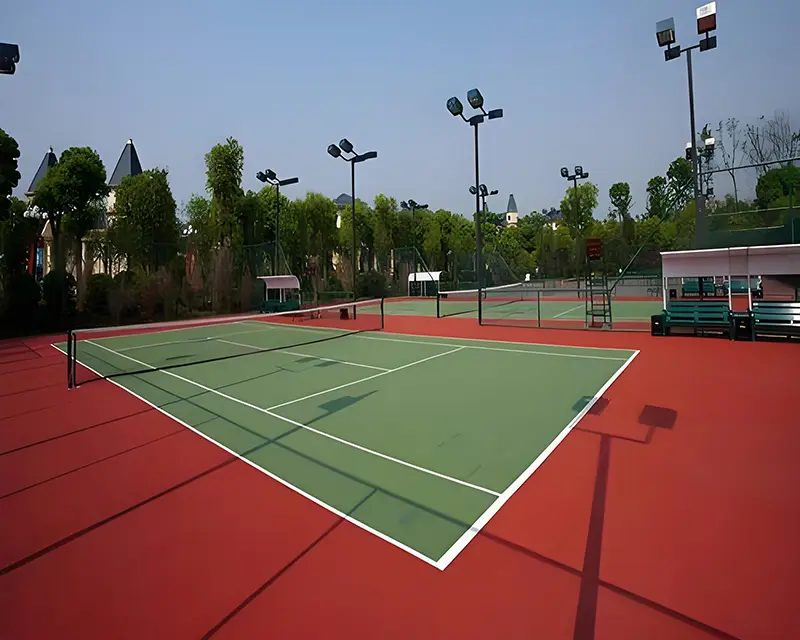
1. Why Buy Directly from a Tennis Court Flooring Factory?
Lower Costs
Even though many suppliers claim to be original manufacturers, they may still be just distributors. If you’ve attended well-known trade shows and met with numerous vendors as a purchasing company, you’ll understand this all too well.
Eliminating middlemen (typically adding 20%–35% of the value) allows you to get factory-direct prices. For large orders, this means significant savings that can be used for purchasing court accessories, marking lines, or scaling up projects.
More Flexible Customization
Real sports flooring factories control the entire production chain, so customization is integrated into the production process from the beginning, rather than being negotiated afterward:
Colors: Pantone color schemes can be customized according to brand logos or school colors.
Logos: Molded integrated logos are available for clubs, resorts, or event venues.
Special Sizes: Custom non-standard sizes, thicknesses, or even different qualities are possible.
Stable Quality
Trading companies often switch suppliers between orders in pursuit of lower prices, resulting in variations in color, hardness, and locking mechanism between different batches.
Long-term contracts with unified raw material suppliers
Use fixed molds and maintain them regularly
Adopt standardized production parameters and standard operating procedures
Faster delivery speed: Direct cooperation with chain sports flooring factories ensures transparent and controllable production planning. No need to wait for intermediaries to relay information, negotiate priorities, or coordinate multiple parties.
2. What Is Modular Tennis Court Flooring?
Modular tennis court flooring is a suspended interlocking tile system designed specifically for tennis play, both indoor and outdoor. Each tile connects to its neighbors via a precision locking system, creating a seamless, level playing surface without adhesives or permanent installation.
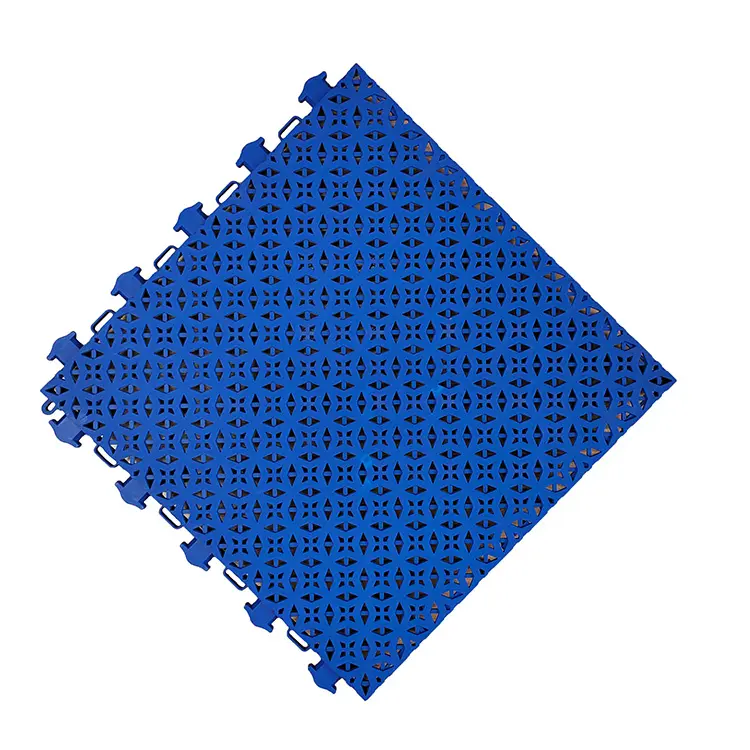
Interlocking Tile Design
The interlocking mechanism is the defining feature of modular systems:
No adhesive required: Tiles snap together mechanically, eliminating glue fumes, curing time, and messy installation
Rapid installation: An experienced crew can lay 400–600 m² per day on a properly prepared base
Removable and reusable: Tiles can be disassembled, relocated, or reconfigured for events, tournaments, or facility renovations
Modular repair: Individual damaged tiles can be replaced without tearing out the entire court
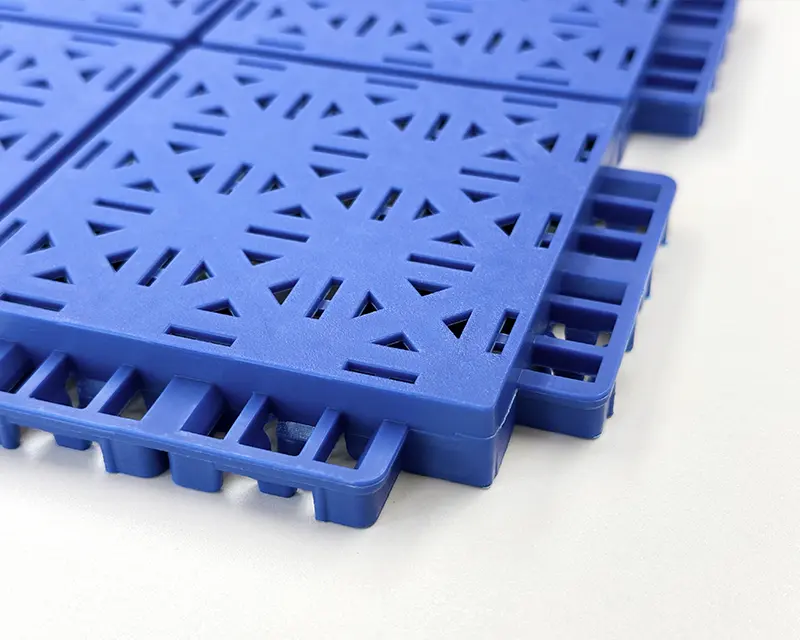
Materials Used
High-quality interlocking tennis court flooring is engineered from carefully formulated polymer compounds, not generic plastic.
Primary base materials
Virgin Polypropylene (PP): The standard base resin, offering excellent rigidity, chemical resistance, and dimensional stability
Modified PP: Impact-copolymer PP blended for improved low-temperature toughness and reduced brittleness
Performance additives
UV-resistant additives:
Hindered Amine Light Stabilizers (HALS) and UV absorbers protect against sun degradation, preventing brittleness and color fading for 8–12 years of outdoor service
Impact modifiers:
Elastomeric additives increase shock absorption and reduce the risk of tile cracking under heavy foot traffic and cold weather
Anti-aging materials:
Thermal stabilizers and antioxidants slow polymer degradation from temperature cycling and oxidation
Color masterbatch:
High-quality pigments (often from suppliers like BASF or Clariant) ensure color consistency and UV color fastness
At Dongxing, our standard PP tennis court tiles use 100% virgin copolymer PP with a full UV stabilization package, formulated to withstand temperature ranges from –30°C to 60°C.
3. Manufacturing Process of Modular Tennis Court Flooring
We test:
Melt flow index (MFI) to verify polymer consistency
Density and impurity levels
Color value (Lab scale) for color masterbatch
Moisture content to prevent bubbles in molded parts
Rejected materials are returned to suppliers immediately—they never reach the production floor.
Color Mixing
PP granules are weighed and blended with color masterbatch, UV stabilizers, and impact modifiers in automated high-speed mixers. The blending ratio is recipe-controlled and recorded for every batch, ensuring color uniformity across production runs. For custom Pantone colors, we prepare small test batches and validate with a spectrophotometer before full production.
Injection Molding
This is the core process. The blended compound is fed into large-tonnage injection molding machines where:
The material is heated to 200–240°C until fully molten
The molten PP is injected under high pressure (80–150 MPa) into precision steel molds
Pressure is held during the packing phase to compensate for material shrinkage
Mold design determines tile thickness, surface texture, support pillar structure, and—most critically—the interlocking mechanism geometry. At Dongxing, our molds are CNC-machined to ±0.02 mm tolerance for consistent locking fit.
Cooling
After injection, the mold remains clamped while internal cooling channels circulate water to solidify the tile. Cooling time is carefully calibrated—too short causes warping; too long reduces output efficiency. Typical cycle times for a standard 250×250 mm tennis tile range from 45 to 70 seconds.
Surface Finishing
Once demolded, tiles undergo edge trimming to remove any flash or sprue remnants. Some premium models receive additional surface treatment for enhanced slip resistance. Each tile is visually inspected for cosmetic defects before moving forward.
Quality Inspection (FQC)
Finished tiles pass through our final quality control station where we verify:
Dimensional accuracy (length, width, thickness)
Locking system fit and snap-in force
Flatness on a reference plate
Surface defects, voids, or discoloration
Tiles that fail any check are either reworked or recycled as scrap—never packed for shipment.
Packaging
Approved tiles are counted and packed into reinforced corrugated cartons with protective interleaving. Cartons are labeled with product model, color, quantity, batch number, and production date. For full container orders, we optimize pallet stacking to maximize container utilization and reduce shipping cost per square meter.
More information on PVC flooring manufacturing processes: Dongxing Quality Control
4. Key Features of a High-Quality Interlocking Tiles Manufacturer
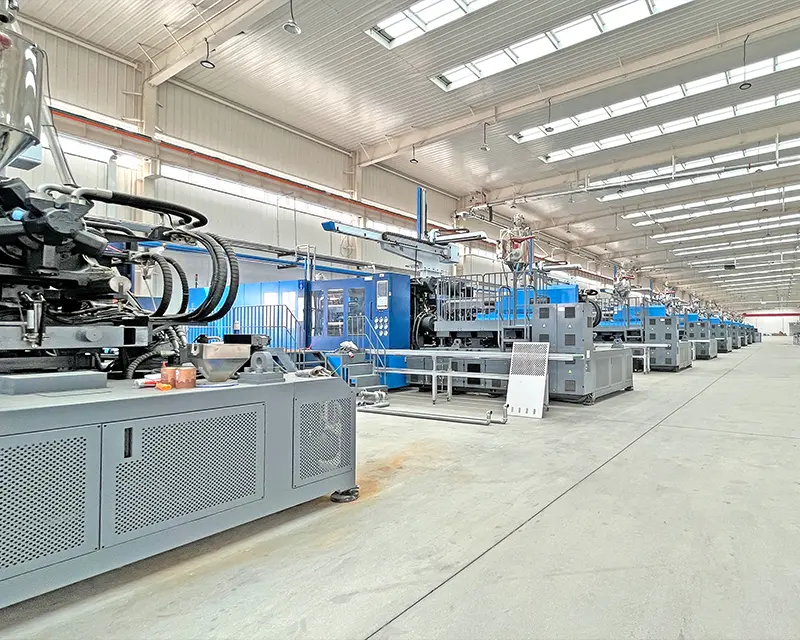
Advanced Injection Molding Machines
The quantity, size, and automation level of injection equipment directly determine capacity and quality consistency.
What to look for:
Automatic production lines: Automated material feeding, robotic demolding, and inline inspection reduce human error and improve consistency
Large-tonnage injection machines: Machines of 300 tons or above are needed for multi-cavity molds producing large-format tiles with uniform density
In-house mold shop: A factory that designs and maintains its own molds can iterate faster, customize quicker, and ensure mold precision long-term
Strict Quality Control
- Dimensional inspection: Calipers and coordinate measuring for tile size and locking tolerance
- Locking system testing: Cyclic assembly/disassembly testing to verify snap durability and resistance to breakage
- Load testing: Static load and rolling load tests (typically ≥2,500 N) to verify structural strength
- UV aging test: Accelerated weathering chambers (per ASTM G154) simulating years of sun exposure
- Slip resistance testing: Dry and wet friction coefficient measurement per EN 13036-4
- Ball rebound testing: Standard tennis ball drop tests to verify consistent bounce height and pace classification
5. How Much Does Tennis Court Tiles Cost?
Please contact us for an accurate quote, especially if you are purchasing in wholesale, due to the following factors.
Thickness
Thicker tiles (15–20 mm) use more material and offer better shock absorption and durability, but cost more. Economy tiles may be as thin as 10–12 mm.
Material grade
100% virgin copolymer PP costs more than homopolymer PP or recycled PP blends. Modified PP with elastomer modifiers sits at the top end.
UV additives package
Basic UV protection extends life to 3–5 years; premium HALS-based systems deliver 8–12 years of outdoor performance but add 10–15% to material cost.
Surface texture
Molded textures (diamond, snowflake, dot pattern) vary in mold complexity. Specialized anti-slip textures or dual-surface designs cost more.
Color
Standard colors (blue, green, red, yellow) are produced regularly and cost less. Custom Pantone colors require setup and minimum batch quantities.
MOQ
Larger orders receive volume discounts. Prices typically drop at 500 m², 1,000 m², and full-container thresholds.
Shipping destination
Freight costs vary dramatically by destination port and current shipping market conditions. DDP delivery includes customs duty and inland transport.
OEM requirements
Custom logos, special packaging, private labeling, and custom dimensions all add tooling and setup costs for OEM tennis flooring projects.
6. Why Choose Dongxing Factory?
We have a 35,000 square meter production base equipped with over 14 injection molding machines and 12 automated production lines, providing strong bulk delivery capabilities.
We are ISO 9001 and ISO 14001 certified.
Comprehensive OEM/ODM capabilities: Customize colors, logos, sizes, and patterns.
Global export experience: Support most trade terms and provide complete export documentation. Understand the certification requirements of various regions. Transparent partnerships; factory visits are welcome.