Every court-seller’s page will tell you that multi-purpose PP sports flooring is “versatile, durable, and easy to install.” All true — and almost useless to a buyer.
What those pages don’t tell you: that a tile which plays beautifully for pickleball can feel dead under a basketball; that “cheap” PP tiles start chalking, fading and cracking within 18 months; that the most common reason a court fails is rarely the product — it’s what happens (or doesn’t happen) on installation day.
We design, mold and ship interlocking polypropylene sports tiles from our own factory, and this guide is the conversation we actually have with importers, contractors and facility managers before they place an order. No brochure talk — just the engineering, cost and field reality you need to buy the right tile the first time.
1. What Is Multi-Purpose PP Sports Flooring?
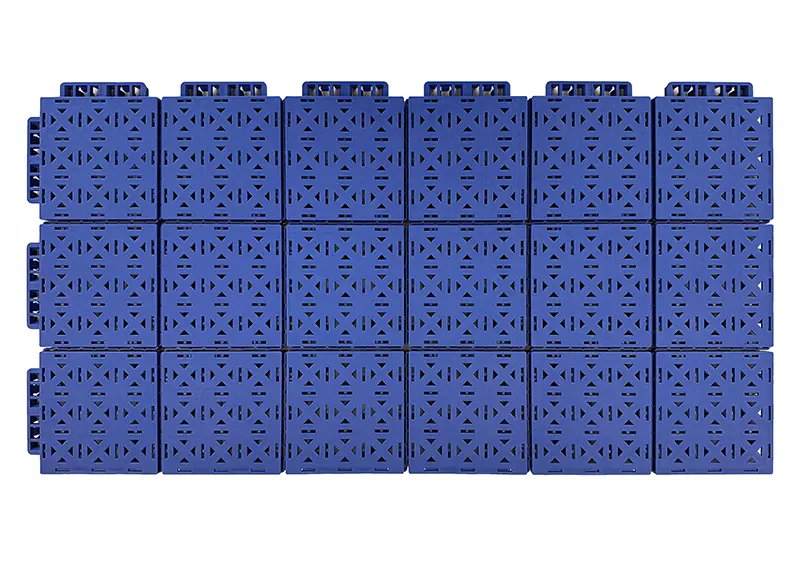
Multi-purpose PP sports flooring is a suspended, modular surface made of injection-molded polypropylene (PP) tiles that snap together with built-in interlocking connectors — no glue, no welding, no curing time.
Each tile is one injection-molded piece with four functional layers:
- Wear surface: embossed texture (stone, grid, honeycomb, or stud patterns) that creates grip without catching skin or ball seams.
- Drainage perforations: holes that let rain pass straight through, so the court stays dry minutes after a storm.
- Structural ribs underneath: the engineered underside that carries load and determines how the tile flexes under impact.
- Interlocking edges + optional cushioning pads: four-side locking connectors for stability, and add-on pads that boost shock absorption for joint-heavy sports.
Because every tile is identical and tool-free, one 12″×12″ (304.8×304.8 mm) or 16″×16″ (400×400 mm) module can be expanded into a full court by semi-skilled workers in a single day — then dismantled and moved to the next venue. That modularity is the entire reason the word “multi-purpose” appears in the product name: the same material, sized to the same venue, is asked to serve many sports and many seasons.
2. Why “Multi-Purpose” Is the Hardest Promise in Sports Flooring
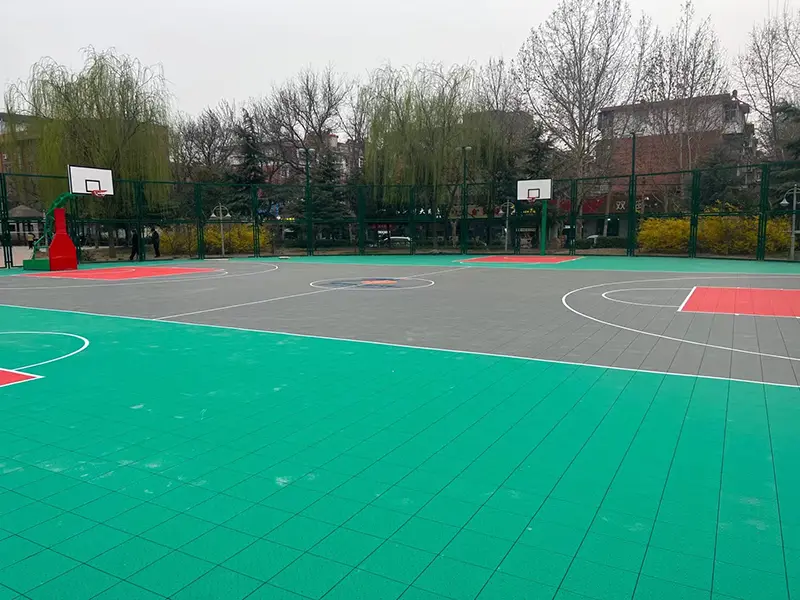
Different sports demand conflicting performance from the same floor.
| Sport | Performance Requirement & Tile Guidance |
|---|---|
| Badminton, Table Tennis | Stable high bounce (compliant with EN 12235), firm, thin‑touch surface; smooth texture, flatness is crucial. |
| Basketball | Vertical deformation + shock absorption, stable rebound, easy to cut. Medium‑thickness tiles, textured surface, cushioning pads provide support. |
| Pickleball Court Tiles | Comfortable shock absorption, realistic bounce, lateral grip; “optimal ball bounce” tiles offer both forgiveness and responsiveness. |
| Volleyball | High shock absorption, suitable for repeated jumps/landing. Thicker tiles or cushioning pads; impact protection is more important than ball bounce. |
| Futsal | Lateral grip, uniform surface, quick changes of direction. Medium thickness, high‑grip texture, flat surface. |
| Roller Hockey, Roller Skating Floor | Hard, flat, predictable rolling. Smooth, firm, completely flat surface. |
3. What Are the Requirements for “Multi-Functional” Modular Sports Floor Tiles?
1. Material Mixing
Impact-resistant copolymer polypropylene (PP, a blend of polypropylene and thermoplastic elastomers/rubber modifiers) is tougher than standard homopolymer polypropylene and less prone to breakage in cold climates. Some systems also incorporate “soft connections” — flexible joints between tiles — that absorb impact and reduce noise without compromising the performance of the sports surface. This is precisely the difference between budget-friendly tiles and high-end multi-functional sports floor tiles.
2. Thickness Grading
12.7 mm tiles are lightweight and inexpensive; 15–16 mm is the industry standard for shared outdoor spaces; 20–25 mm is suitable for high-traffic areas or event spaces. Our advice is: thickness isn’t always better. In multi-sports shared spaces, overly thick tiles increase costs and result in a dull, lifeless feel without providing a corresponding performance improvement.
3. Surface Texture + Cushioning Pads
Texture controls grip and ball rebound; additional cushioning pads allow for adjustment of the same tile’s hardness (badminton) or softness (basketball) depending on the primary sport played on the court.
4. Technical Specifications
Most spec tables list numbers without explaining why you should care. Here is the buyer’s translation guide.
| Parameter | Typical Range | What it really tells you |
|---|---|---|
| Material | Virgin impact‑copolymer PP + HALS UV stabilizer | Virgin + UV stabilizer = the single biggest quality signal (see §6) |
| Tile size | 250×250 / 304.8×304.8 / 400×400 mm | Larger tiles cover faster but are stiffer and harder to ship; 12″×12″ is the world standard for sports |
| Thickness | 12.7 – 25 mm | 15 mm = workhorse; 20 mm+ = heavy traffic/events; thicker ≠ better on shared courts |
| Weight per tile | ~350 – 600 g | A cheap quality probe: heavier usually means more virgin material and denser structure; suspiciously light tiles are usually hollow or recycled |
| Temperature range | ‑40°C to +80°C | Confirms the tile survives cold (brittle risk) and hot (softening/buckling risk) climates |
| Shock absorption | ~10% – 40% (DIN 18032‑2 / EN 14808) | % of impact the floor absorbs; higher = better joint protection, but too high = sluggish ball response |
| Slip resistance / COF | Pendulum test per EN 13036‑4 | Must stay safe wet — this is a safety spec, not marketing |
| Ball rebound | Per EN 12235 | Consistency matters more than absolute value: the ball should bounce the same across the whole court |
| Load capacity | Stated per m² or per tile | Tells you if equipment (basketball posts, machines) can sit on it |
| Drainage | Perforated surface + elevated base channels | The reason outdoor play resumes minutes after rain |
| Service life | 8 – 15 years (weather‑dependent) | Realistic outdoor life; indoor lasts longer |
Two specs buyers over-focus on, and one they ignore:
- Over-focus: thickness. Two 15 mm tiles can behave completely differently because of internal rib design and material grade.
- Over-focus: price per square meter. It says nothing about the next ten years.
- Ignored: ball-rebound consistency and flatness tolerance. This is what actually decides whether players enjoy the court — and it’s rarely in the quote.
5. Total Cost of Ownership
Buyers compare the unit price per square meter. Owners should compare the cost per year over the court’s life — and that’s where the ranking flips.
Illustrative 10-year scenario (assumptions stated openly: medium size ~500 m², moderate climate, budget-grade vs. premium-grade comparisons; actual prices vary by region, shipping and specification — always ask for a line-item quote).
The lesson we repeat to every importer: a tile that costs 30% more upfront but lasts 3× longer, never needs re-lining, and can be moved to the next venue is the cheaper product. Cheap tiles are cheap because something inside is cheap — and it will show up as a cost, not a saving, in year two or three.
6. The Recycled-Material Trap (How to Test a Tile Before You Buy)
The biggest difference between a “great deal” tile and a serious tile is rarely the design on top — it’s what’s inside the pellet.
To cut cost, some factories substitute recycled or regrind PP for virgin material. You cannot see it in a photo, but you will see it in the field:
- Chalking — a white powder rubs off the surface within months (the cheapest failure, and the easiest to hide in samples).
- Fast fading — colors wash out in one or two sunny seasons without proper UV stabilization (HALS).
- Brittleness — tiles snap at the locking tabs in cold weather; cracks spider out from impact points.
- Inconsistent density — some tiles flex, some don’t, so the court surface feels uneven.
Field tests you can do on a sample (no lab required):
- Weigh it. Compare two same-size tiles by hand. A premium 15 mm 12″×12″ tile should feel dense, not hollow. Suspiciously light = suspect.
- Bend the corner. A virgin impact-copolymer tile flexes and springs back. Recycled material whitens at the bend or cracks.
- Scratch the surface. Good PP resists scoring; recycled/soft blends mark easily.
- Ask for the UV report. Request an ASTM G154 accelerated weathering test report — and ask how many hours of UV exposure it survived before significant color shift.
- Demand it in writing. Ask the supplier to state the % virgin material and UV stabilizer type on the commercial invoice or spec sheet. A serious factory will not hesitate.
Rule of thumb from our production floor: if a price looks too good against the market, the corner that was cut is material. There is no free lunch in injection molding.
7. Field-Proven Installation Lessons (Mistakes We’ve Seen in Real Projects)
The product rarely fails on its own. These ten field lessons are the difference between a court that lasts a decade and one that fails in a season. (A documented reference point: this failure pattern is consistent with the “tenting” problem seen across markets when the perimeter expansion gap is skipped.)
- Substrate flatness is non-negotiable. The base must be virtually flat — a commonly cited tolerance is roughly 3 mm over 3 m. A pothole or a raised joint becomes a trip hazard and a stress point that lifts tiles.
- Always leave a perimeter expansion gap (8–12 mm). PP expands and contracts with temperature. Skip it and you get the classic “tenting” — tiles buckling up in the heat. This is the single most common installation error we see.
- Acclimatize the tiles. Let them sit in the ambient temperature 24 h before laying; installing stone-cold tiles in a hot climate invites later buckling.
- Mind the drainage slope (~1%). The base should shed water — but not so much that the court plays “uphill.”
- Anchoring in windy/coastal areas. High wind can lift a floating floor. Use perimeter anchoring or higher-lock tiles in exposed sites.
- Lay out from the center, not from a wall. Start centered and work outward so the cut half-tiles land at the edges, not in the middle of play.
- Fit edge and corner ramps. Sloped transition pieces prevent tripping, allow wheelchairs and maintenance carts, and stop the court from looking unfinished.
- Decide line strategy before installation.
- Cut clean. Use a sharp utility knife or fine saw; ragged cut edges catch shoes and snag.
- Don’t install on grass or soft ground without a proper compacted sub-base — tiles will rock, sink and unlock under play.
Installation itself is genuinely simple — that’s the point of the product. But “simple” still demands the 60 minutes of preparation and the perimeter details above.
8. Designing a True Multi-Sport Court: The Line Strategy
Here’s the problem nobody mentions until it’s painted: three sports on one court means three sets of lines — and visual chaos.
A badminton court is 13.4 m long; a pickleball court is 13.4 m long too — they share the same footprint, which is convenient. Basketball, futsal and volleyball have different sizes, so multi-line courts are inevitable. Done badly, players can’t tell which line belongs to which sport; done well, the court reads instantly.
Our practical approach for shared courts:
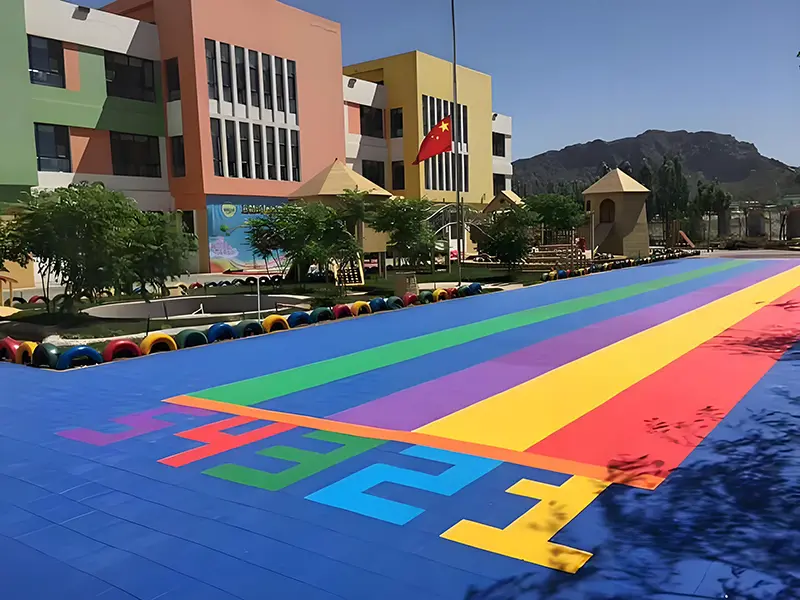
- Color-code the lines — e.g., white for pickleball, blue for basketball, yellow for badminton — so each sport has an unambiguous set.
- Ask for pre-printed lines from the factory rather than painting on site. Pre-printed (in-mold or heat-applied) lines stay sharp for years, never peel, and cut installation time dramatically. Painting over textured PP requires special coating and re-doing.
- Exploit shared footprints. Pickleball and badminton share a 13.4 m long court. Put two pickleball courts in the space of one basketball court. Plan the layout on paper before you order tiles — it changes how many of which color you need.
A good supplier should be able to draw your multi-sport layout with you and quote the exact tile + line counts. If they can’t, that’s a signal.
9. Maintenance That Keeps Tiles Alive (and What Kills Them)
Multi-purpose interlocking sports flooring is the lowest-maintenance court surface you can buy — but “low” is not “zero.”
Do:
- High-pressure wash 1–2 times per year; more if under trees or in dusty areas.
- Hose off mud and leaf litter regularly so drainage holes stay open.
- Spot-clean stains promptly with mild detergent.
Avoid (the real killers):
- Petroleum and solvent spills (oil, paint thinner) — they can soften or stain PP. Clean fast.
- Dragging sharp or heavy metal across the surface (furniture, equipment skids) — use a mat or lift, don’t drag.
- Hot tires on garage/utility tiles — if the same tile is used near vehicles, spec a higher-temp formulation.
- Concentrated heat sources (grills, coals) sitting directly on the tile.
The modular bonus: if one tile gets damaged, you unclip it and click in a spare. You never replace a whole court — which is why we always advise keeping a few spare tiles in every project’s stock.
10. The 9-Point B2B Buying Checklist
Before you sign a quote, run this list:
- Sport mix defined — primary sport + secondary sports; thickness, texture and pads chosen for the primary sport.
- Virgin material + HALS UV stabilizer stated in writing on the invoice or spec sheet.
- Third-party test reports — UV weathering (ASTM G154), impact, slip (EN 13036-4), ball rebound (EN 12235) — not just the factory’s own numbers.
- Certifications — ISO 9001 (quality management) and ISO 14001 (environmental management) are the baseline for a serious factory.
- Physical samples — weigh them, bend them, scratch them, put them in the sun. Never decide from photos.
- Production capacity and lead time — a real factory can name its monthly output, number of molds, and current lead time.
- Warranty terms — what exactly is covered, for how long, and under what conditions.
- Spare tiles and after-sales — can you order a small refill batch later? At what price?
- Total cost, not unit price — run the 10-year TCO, not the per-m² sticker.
11. FAQ
Q1: What is multi-purpose PP sports flooring?
It’s a modular court surface of injection-molded polypropylene tiles that snap together without glue. The same floor can serve pickleball, basketball, futsal, badminton, volleyball and more — indoors or outdoors.
Q2: Is PP sports flooring suitable for outdoor courts?
Yes — it’s specifically engineered for outdoor use, with UV-stabilized material, through-drainage, and a temperature range of roughly -40°C to +80°C. Rain drains through and the court dries quickly.
Q3: What sports can you play on PP interlocking tiles?
Pickleball, basketball, tennis, futsal, volleyball, badminton, roller hockey, handball, and general fitness training. Because no single tile is perfect for every sport, define your primary sport first.
Q4: How long does PP sports flooring last?
Typically 8–15 years outdoors depending on climate, UV exposure and maintenance — longer indoors. Quality of material (virgin vs. recycled PP) is the biggest variable.
Q5: Do PP tiles need a concrete base?
They need a hard, flat, stable base — concrete, asphalt, or compacted aggregate. The base must be reasonably level (roughly 3 mm over 3 m) and have a slight drainage slope.
Q6: How do you clean PP sports flooring?
High-pressure washing 1–2 times a year plus regular hosing. Avoid petroleum/solvent spills; keep drainage holes clear of debris.
Q7: PP tiles vs. acrylic court — which is better?
Acrylic wins for a permanent, competition-grade single-sport tennis court. PP tiles win for outdoor, multi-sport, budget-sensitive or relocatable venues — and cost less to own over 10 years because there’s no re-lining cycle.
Q8: Can I install PP sports flooring myself?
Yes. It’s a DIY-friendly click-lock system requiring no adhesives or specialists — but follow the base flatness, expansion-gap and edge-ramp rules above.