
A standard volleyball court occupies a large footprint. Unlike badminton, pickleball, or futsal courts, volleyball courts are often combined with futsal or other smaller court layouts; this multi-sport versatility not only maximizes utility but also reduces costs. Among the available PVC flooring options, the “GEM” pattern is the most popular choice for gymnasiums and sports centers—and it is the signature multi-purpose court pattern produced by our factory.
1. Key Features of PVC Volleyball Court Surfaces
Volleyball involves frequent jumping, spiking, landing, and sudden changes in direction, subjecting knee and ankle joints to impact forces up to 3–5 times the player’s body weight. Compliant with the EN 14904 sports flooring standard, our multi-layer composite PVC flooring offers an impact absorption rate of 20% or higher. The foam backing density is optimized to provide cushioning upon landing while ensuring rapid energy return to support the next jump.
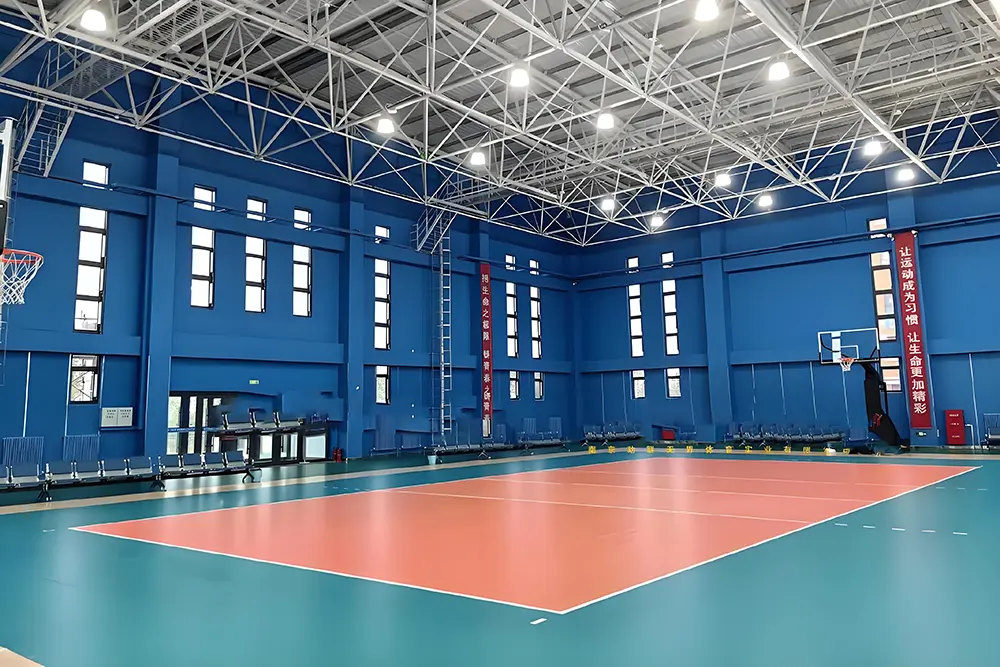
PVC sports flooring featuring the popular GEM pattern typically maintains a dynamic coefficient of friction between 0.45 and 0.6, ensuring stable traction in both dry and wet conditions—ideal for professional training and competition venues. With a wear layer thickness of 0.5mm to 0.7mm (or greater) and professional-grade sealing, the surface is impervious to water and easy to clean. It is also resilient enough to withstand heavy sports equipment rollers without sustaining permanent indentations.
In accordance with FIVB standards, a volleyball dropped freely from a height of 1 meter onto the PVC surface should rebound to 65%–75% of its original height, with a variance of no more than 5% across different points on the court. Ball rebound performance relies on a high-strength fiberglass stabilization layer and support layer; therefore, selecting high-quality PVC flooring with dual fiberglass reinforcement is essential.
Areas such as the service zone, the 3-meter line, and the zone near the net are subject to high-frequency wear. PVC Volleyball Court flooring made from pure PVC raw materials features a dense surface structure that offers superior resistance to scratching and compression. For high-traffic settings such as commercial sports halls and school gymnasiums, products featuring a thickened wear layer offer a service life of 8–10 years. Even in professional training facilities subject to intensive use, a lifespan of over 5 years is achievable with proper maintenance—far exceeding the 1–3 year lifespan of standard commercial flooring.
2. PVC Surface Requirements for Volleyball Courts
2.1 Thickness
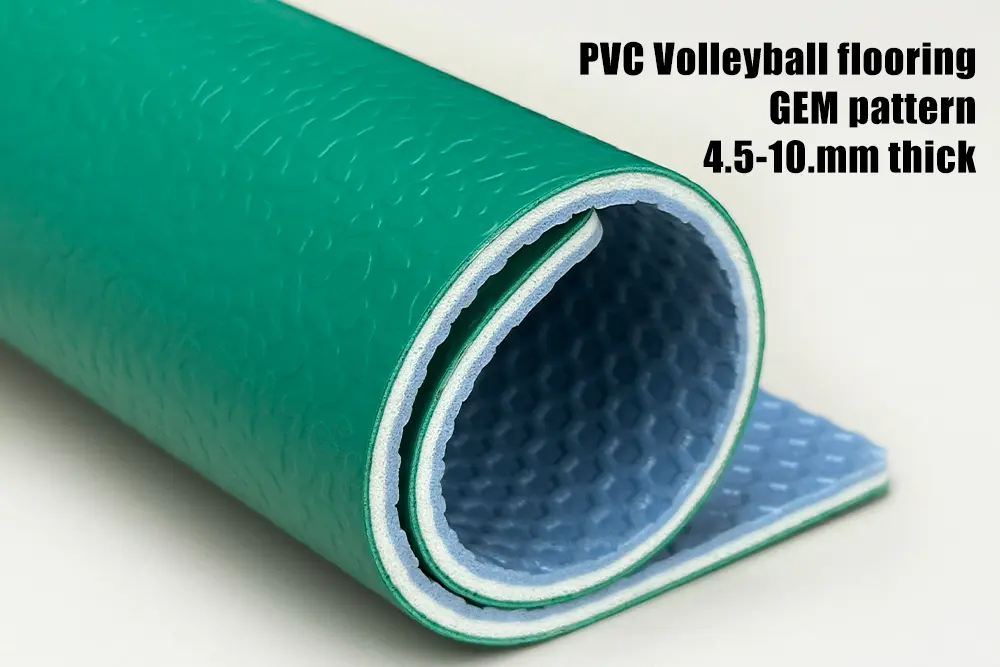
Vinyl sports flooring features a multi-layer composite structure; the total thickness and the ratio of the various layers directly determine the court’s performance.
Professional training facilities: Recommended total thickness of 7.0 mm–10.0 mm.
Standard competition venues: Recommended total thickness of 6.0 mm–8.0 mm.
Multi-purpose or low-frequency use venues: Recommended thickness of 4.5 mm–6.0 mm.
2.2 Wear Layer
A wear layer thickness of 0.5 mm–0.7 mm is suitable for volleyball courts with lower usage rates.
A thickness of 0.7 mm–1.5 mm is suitable for professional volleyball training facilities.
The nominal wear layer thickness may not always reflect the actual thickness, and surface damage can occur after several years of use; therefore, it is important to verify the actual thickness and confirm specifications via test reports when selecting a product.
2.3 Surface Treatment
UV curing treatments include surface UV and through-body UV; through-body UV offers superior stain and scratch resistance and is less prone to yellowing over time.
Opt for a matte surface finish with a gloss level below 10° to prevent visual glare caused by the reflection of venue lighting.
2.4 Installation
Full-glue installation: The flooring rolls are fully bonded to the concrete subfloor using adhesive, ensuring a flat, secure surface with no risk of shifting or curling; suitable for permanent professional volleyball venues.
Partial bonding: Adhesive is applied only at the edges and seams; this is more cost-effective and suitable for small-to-medium venues and semi-permanent courts.
Dry-lay/Portable installation: Flooring rolls are laid directly onto a flat surface and joined using tape; the flooring can be rolled up and stored at any time, making it suitable for multi-purpose venues and temporary event sites.
3. How to Select PVC Surfaces for Volleyball Court Projects
Check if there is a dedicated volleyball product line—such as Dongxing’s “Colorful Gem” pattern, which is custom-engineered for volleyball courts based on the standard “Gem pattern” series.
Verify in-house manufacturing capabilities; the supplier should own its own calendering and foaming production lines rather than relying on OEM outsourcing.
Assess whether the product has been fine-tuned for the specific biomechanics of volleyball—specifically regarding foam layer density and ball rebound optimization.
Ensure compliance with sports flooring standards such as the EU’s EN 14904; pay close attention to test reports for three key metrics: shock absorption, vertical deformation, and ball rebound.
Prioritize evaluating case studies of similar volleyball courts, focusing on established projects that have been in use for at least three years.
4. Why Dongxing Sports Flooring?
As a direct manufacturer, we offer highly flexible customization options while maintaining strict control over price and quality. With nearly 30 years of manufacturing experience, we supply high-quality PVC flooring that meets diverse specifications for sports flooring distributors, sports venues, and athletic facility projects. Clients are welcome to tour our production lines for various court flooring series; we possess the capacity for large-scale supply and guarantee on-time delivery.
Learn about and purchase our volleyball court flooring!