
When planning an indoor basketball court, flooring cost is always a core component of the budget. Even for indoor basketball court floors, different suppliers can offer significantly different prices. Therefore, accurately balancing cost and quality is crucial.
1. Average Indoor Basketball Court Flooring Cost
PVC Basketball Floor Wood Surface:
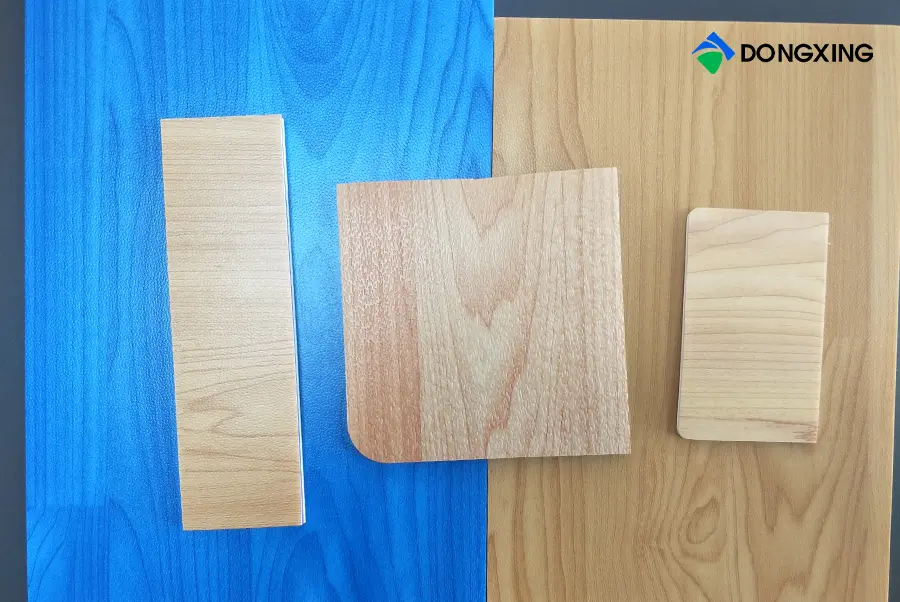
Maple and oak patterns are standard for basketball courts. As a supplier, our prices range from $6-13 / sqm. The price range is mainly due to the total thickness, wear layer thickness, base structure, surface texture, and whether FIBA certification is included.
Modular PP Tiles:
$0.5-$4/piece. Common single-piece sizes are 25cm×25cm or 30cm×30cm. Price differences arise from structural design and whether cushioning is included.
Note: The above are only wholesale reference prices for some models as a manufacturer. Actual prices are affected by multiple factors such as purchase quantity, specifications, and customization requirements, and there is no fixed price. For bulk procurement in engineering projects, it is recommended to request a formal quotation directly from the manufacturer. The manufacturer will match the optimal solution based on the site size, usage scenario, and budget level, and their quotes are usually more advantageous than those from distributors.
2. Factors Affecting Basketball Court Flooring
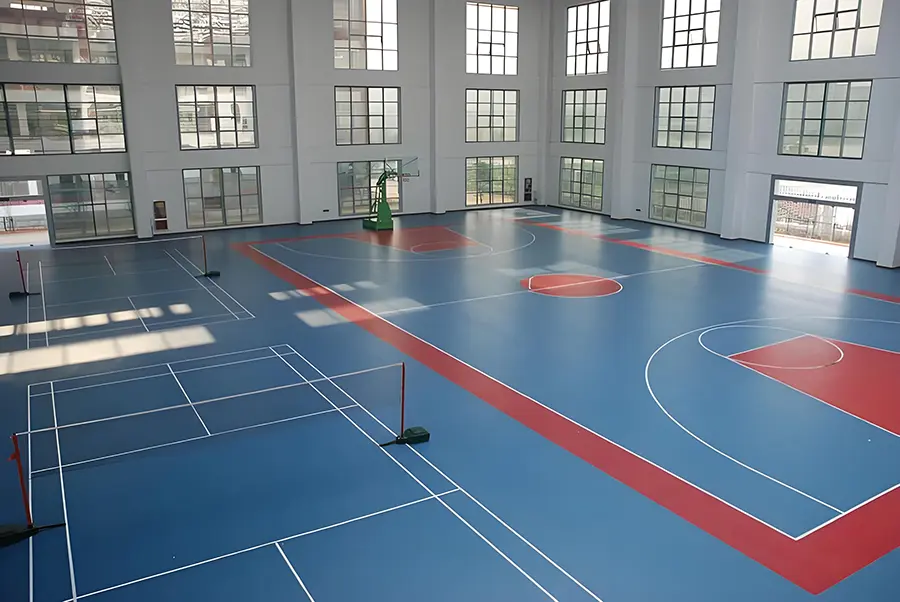
For indoor basketball courts, except for highly professional competitions where wood flooring is used, PVC sports flooring is the best choice. It offers the highest cost-effectiveness, and thickness is the core indicator determining the price and performance of PVC.
2.1 Thickness
4.0mm and below: Entry-level and does not meet the standards for regular basketball courts. The wear layer is relatively thin, suitable for community activity rooms and small fitness spaces with shorter daily usage. It has the lowest unit price and a normal lifespan of 3-5 years.
4.5mm-6.0mm: The mainstream thickness for standard basketball courts, combined with a wear layer of 1.2mm or more. It meets standards for shock absorption, rebound, slip resistance, and wear resistance. It can cover most scenarios such as schools, basketball clubs, and community centers, with a lifespan of 8-10 years and the highest cost-effectiveness.
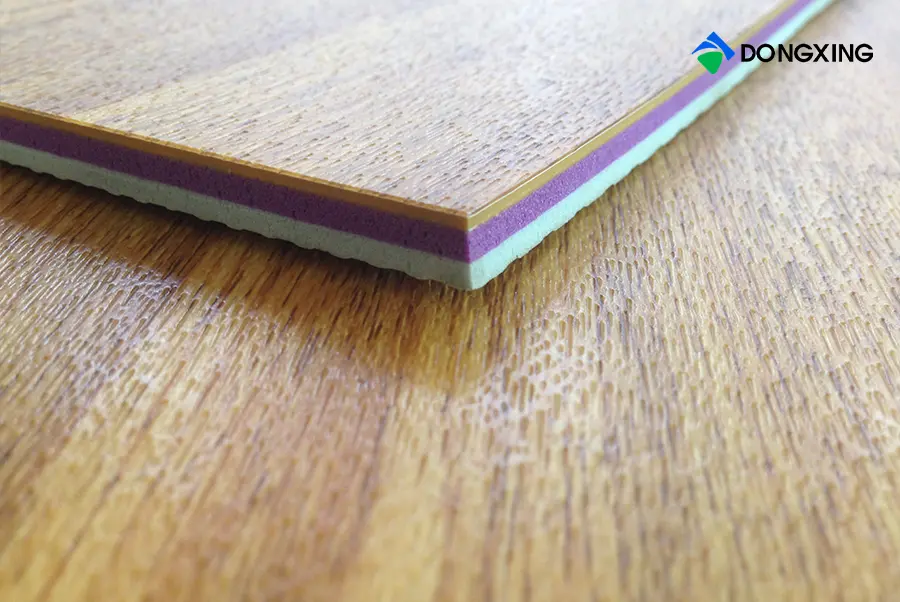
6.0mm and above: Professional competition-grade thickness, multi-layer composite foam structure, maximizing sports protection performance.
FIBA 7.5mm: If choosing FIBA certified flooring, our 7.5mm basketball court mat meets the requirements, suitable for professional basketball games and training halls. It has the highest unit price but a lifespan of over 10 years.
2.2 Installation Methods
Glue Down: The flooring is fully bonded to a flat subfloor using specialized sports flooring adhesive. This provides the highest stability, preventing warping and shifting, suitable for high-frequency professional venues. Labor and auxiliary material costs are the highest, accounting for approximately 20%-30% of the material cost.
Roll Installation: For whole rolls of PVC flooring, on-site cutting and heat welding create a seamless finish, making cleaning and maintenance easier. Labor costs are between adhesive bonding and floating installation, suitable for multi-purpose stadiums with high hygiene requirements.
Floating Floor: Primarily for outdoor interlocking court tiles, it is laid directly by interlocking or weight-bearing, requiring no glue. Construction is fast, and it can be disassembled and moved later. Labor costs are the lowest, approximately 50% of adhesive-based methods, making it suitable for temporary venues or projects with limited budgets.
2.3 Shipping Cost
Sea freight: Affected by international freight rate fluctuations and cargo volume and weight, full container purchases can significantly reduce unit logistics costs.
Customs fees: Includes import duties, customs declaration fees, commodity inspection fees, etc. Tax rates and policies vary significantly between different countries.
Local delivery: Inland transportation from the port to the project site; remote areas and oversized cargo will significantly increase delivery costs.
2.4 Maintenance Cost Over Time
Annual routine maintenance: PVC basketball flooring only requires cleaning with specialized cleaners and localized wear repairs annually, resulting in extremely low maintenance costs; solid wood flooring requires regular polishing and waxing, with annual maintenance costs approximately 3-5 times that of PVC.
Daily cleaning: PVC surfaces are dense and waterproof, and can be cleaned with a regular dust mop and neutral cleaner; solid wood flooring has strict requirements regarding environmental humidity and cleaning methods, requiring specialized equipment and maintenance agents.
Refinishing: Solid wood floors need to be sanded and refinished every 3-5 years, with each refinishing costing approximately 20%-30% of the initial flooring cost. PVC floors do not require refinishing and can be replaced locally when severely worn.
Complete Replacement: High-quality PVC flooring has a normal lifespan of 10-15 years, while solid wood flooring, with proper maintenance, can last over 20 years. However, the cumulative cost of multiple refinishings during this period is also high.
3. Indoor Basketball Court Flooring Cost by Facility Type
3.1 Primary and Secondary Schools, Community Centers, Sports Clubs
Recommended Material: PVC Sports Flooring
With moderate usage frequency, typically accommodating multiple sports such as basketball, badminton, and aerobics, PVC flooring stands out for its versatility, low maintenance costs, and high cost-effectiveness. Wood grain patterns are suitable not only for basketball but also for indoor futsal.
3.2 Higher Education Institutions, Professional Competition Venues
Recommended Material: Solid Wood Sports Flooring
University gymnasiums and professional competition venues have higher requirements for sports performance and competition standards, and therefore have larger budgets. Solid wood flooring offers a comfortable feel, rebound coefficient, and anti-slip performance that meets professional competition standards. While the material and installation cost per square meter is typically 2-3 times that of high-end PVC flooring, its professional feel and event suitability are irreplaceable, making it suitable for mid-to-high-end venues.
4. How to Reduce Basketball Court Flooring Costs
4.1 Direct Sourcing from Manufacturers
By bypassing intermediaries such as traders and brand agents, ordering directly from manufacturers can typically save 15%-35% of the markup. However, a minimum order quantity is required. Choosing a manufacturer with flexible minimum order quantities is important, but generally, the minimum order size should be at least the area of a standard-sized basketball court. The factory can also customize and cut the flooring according to the court dimensions, reducing waste and further lowering the actual material cost.
4.2 Thickness
Thicker is not necessarily better. For low-frequency community activity rooms, 4.5mm flooring is sufficient; there’s no need to pay for high-performance flooring that won’t be used. However, for professional venues with daily usage exceeding 6 hours, a flooring thickness of 6.0mm or higher is recommended to avoid increasing long-term costs due to short-term wear and tear requiring replacement.
4.3 Bulk Procurement
The unit price of flooring decreases significantly with increasing purchase volume. The price difference between single-item and full-container purchases can be over 20%. For multi-phase projects, joint purchases with neighboring venues can significantly reduce unit costs.
4.4 Consolidated Shipping Optimizes Logistics Costs
When procuring across borders, try to consolidate flooring, line marking paint, installation tools, and other related materials into one container to avoid additional customs and delivery fees from separate shipments. Prioritize full-container shipping over less-than-container shipping; unit logistics costs can be reduced by 30%-50%.
4.5 Simultaneous Construction at Multiple Sites
If multiple basketball courts are being built concurrently, the construction team can be deployed to each site at once, amortizing fixed costs such as labor, travel, and equipment costs. The construction cost per court can be reduced by 10%-20% compared to constructing them individually.
5. Get a Free Basketball Flooring Quote
If you are planning to build a school gymnasium, multi-purpose sports hall, basketball academy, recreational activity center, or indoor sports venue, we can provide full-process professional support to help you accurately calculate your budget and match the optimal products:
- Free site design and product recommendations
- Accurate quotations for various trade terms such as FOB and CIF
- Professional installation guidance and after-sales technical support
You only need to provide the site dimensions, usage scenario, and budget range to receive a customized cost plan and selection advice.