
For schools and tennis clubs, the tennis court flooring directly determines the consistency of ball bounce, the feel of the shot, the risk of sports injuries, and also the lifespan of the court, maintenance costs, and user experience.
For schools, the flooring needs to balance student safety, high-frequency use, reusability in multiple scenarios, and budget constraints; for commercial clubs, it must match professional sports standards, tournament-level experience, brand image, and long-term operational value.
1. Define Needs
The core attribute of school tennis courts is “public sports facilities,” with users ranging from primary and secondary school students to university students of varying skill levels. Minimizing the risk of falls, abrasions, and joint impact injuries is crucial. Schools have limited budgets, so low-maintenance, long-life products are preferred to avoid frequent renovations and additional expenses, and the flooring must meet the safety standards for sports venues in the education system.
For commercial tennis clubs, the court flooring is a core revenue generator; the choice directly affects pricing, member retention, and tournament hosting capacity. Even ball rebound, comfortable feel, and stable ball speed are fundamental requirements. High-end clubs must meet ITF (International Tennis Federation) certification standards and be able to host official tournaments. They must be open for more than 12 hours daily, and under high-frequency use, they should not easily powder, crack, or wear, ensuring an undiminished experience for 3-5 years. The surface texture, color uniformity, and comfort directly affect membership renewal rates and are a key differentiator for high-end clubs.
2. Tennis Court Flooring System
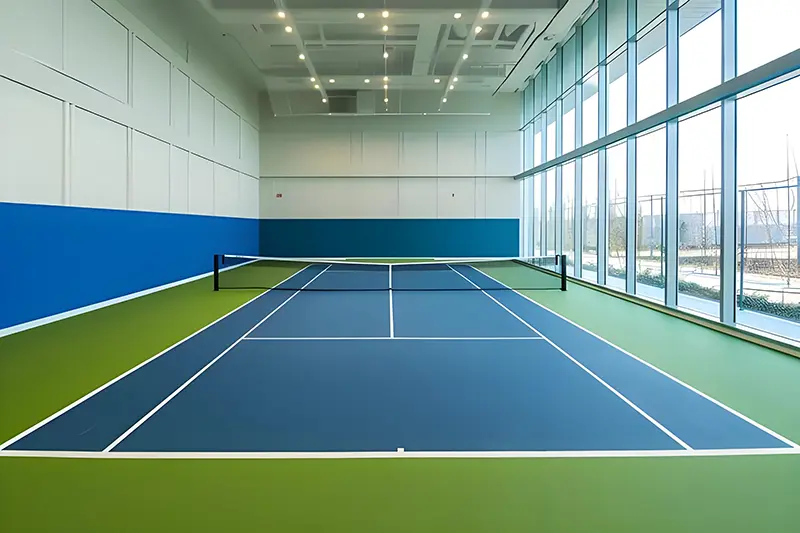
PVC Tennis Court Flooring is the preferred solution for indoor courts. Roll-type resilient sports flooring, made with PVC as the base material, features a professional anti-slip textured surface and a foamed or dense cushioning structure in the bottom layer. It offers excellent impact absorption and energy return, providing a soft feel underfoot and significantly reducing lower limb joint stress, making it suitable for extended training sessions. The rolls are laid directly on flat concrete surfaces, requiring no on-site mixing or drying, resulting in a short installation period. It exhibits strong consistency in ball speed and rebound height, meeting ITF professional training standards.
Tennis Modular Interlocking Court Flooring is suitable for outdoor and multi-functional flexible sports fields. Through interlocking connections, it is laid directly on flat concrete/asphalt surfaces without adhesive. It is the fastest-growing category of tennis court flooring systems in recent years for schools and multi-functional venues. A standard court can be installed in 1-2 days and can be easily disassembled, moved, and reassembled. The perforated surface structure allows for rapid drainage, preventing water accumulation after rain, and it is highly weather-resistant, suitable for both indoor and outdoor use. It can be quickly switched between tennis, basketball, badminton, and physical training functions, perfectly meeting the “multi-purpose” needs of schools.
3. Procurement Evaluation
Whether for schools or clubs, choosing tennis court flooring systems cannot be based solely on price. Professional tennis court surfaces must meet sports performance standards.
The International Tennis Federation (ITF) certification for court surfaces, divided into speed levels 1-5, is a core criterion for hosting official tournaments and demonstrating professionalism.
EN 14904 is the European safety standard for sports flooring, focusing on impact absorption, ball bounce, and coefficient of friction, and is a core reference for safety compliance in school venues.
For school and youth training courts, it is recommended that impact absorption be ≥20%, maintaining reasonable friction in both dry and wet conditions to minimize abrasions after falls.
For outdoor courts, focus on UV resistance, resistance to high and low temperatures, and drainage performance. In rainy areas, acrylic or interlocking sports flooring is preferred to avoid water accumulation and blistering. Club courts require products with thicker wear layers to ensure long-term stable performance and colorfastness.
For schools and community clubs, the reuse rate of the court directly determines the value of the facility. If it needs to be used for basketball, badminton, and physical training: modular interlocking flooring is preferred, allowing for quick switching of court lines; if used solely for tennis: acrylic or PVC roll flooring is preferred.
4. Conclusion
While tennis courts aren’t as popular globally as pickleball, they remain a very popular sport. Tennis courts are typically large enough to accommodate multiple pickleball courts, making multi-functional court construction more necessary nowadays. Regardless of the flooring material used, multiple courts can be reused. Dongxing Plastics can provide professional tennis court solutions with ITF certification.