
If you’re planning your indoor badminton court, material selection is a crucial step. Traditionally, wood flooring is considered exclusive to high-end tournaments, while synthetic flooring is seen as cheaper and less performant than solid wood. However, the distinction is more complex, and some misconceptions exist. The core difference lies in whether the material is suited to the performance and playing experience of badminton.
1. Meaning of the Two Materials
1.1 PVC Synthetic Flooring
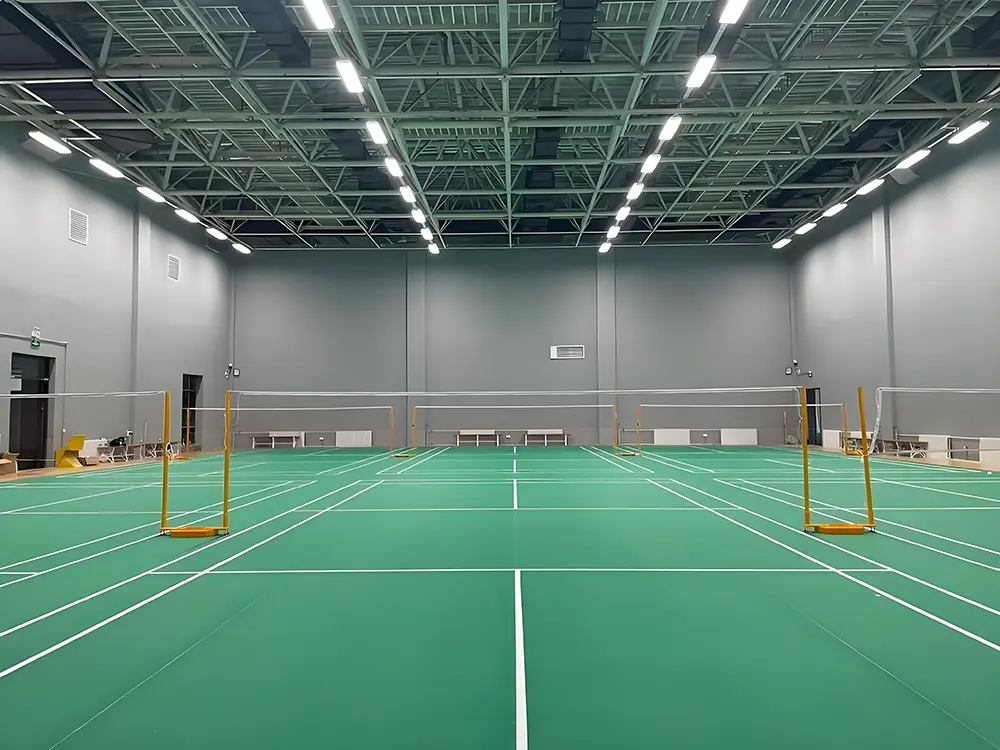
Multi-layer composite structure is also a core product type. Its advantage lies in the flexible selection of PVC mat thickness, adapting to both casual and professional sports requirements. 4.5-6.0mm is a common thickness for commercial venues, while 6.0-8.0mm is the preferred thickness for professional tournaments and BWF certification. The thickness of the wear layer and the density of the foam layer are the most important factors to consider when choosing this type of material, as they directly determine the quality of the badminton court mat, whether it meets requirements, and its lifespan.
1.2 Hardwood Badminton Court
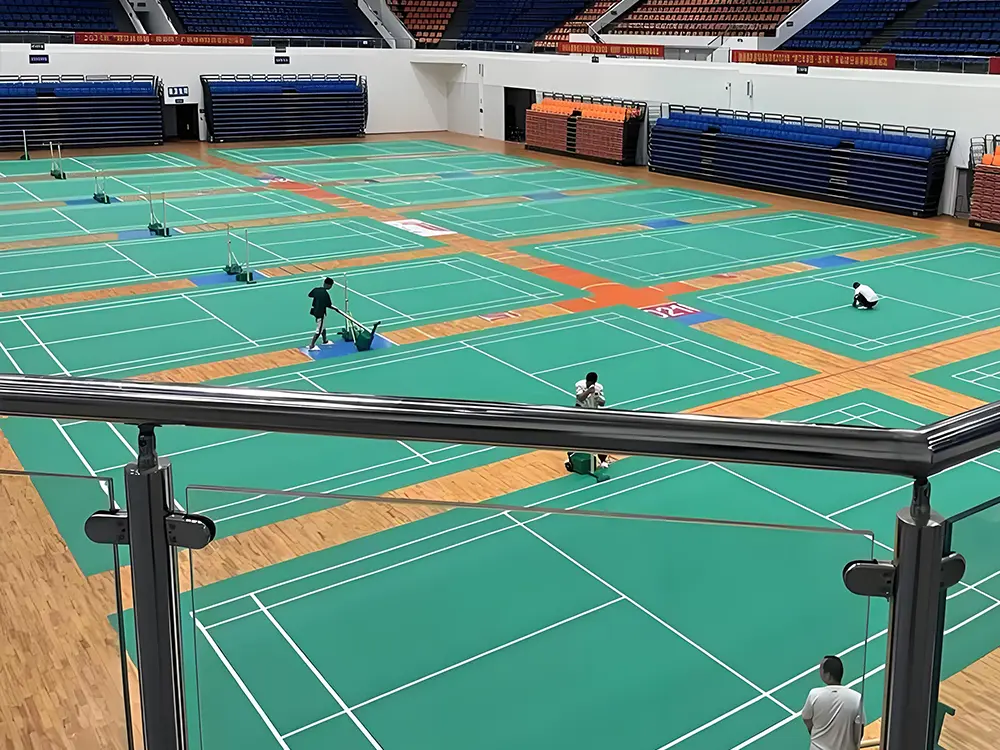
Utilizing a suspended joist structure, high-end sports wood flooring incorporates elastic rubber pads. It boasts moderate hardness, uniform texture, and excellent resilience. Solid wood is typically the most common material used in basketball courts, and professional badminton clubs also utilize it. However, pure wood flooring is rarely used in badminton courts; it usually needs to be combined with elastic synthetic sports flooring as a complete system.
2. Comparison of Two Materials
Synthetic flooring is described as PVC, while wood flooring is described as a high-end maple hardwood system, comparing differences in various dimensions.
2.1 Sports Performance
PVC: Shock absorption, rebound, and coefficient of friction are completely uniform. The hardness can be adjusted through the foam layer structure to suit players of different skill levels. BWF certification is available.
Hardwood: Natural and delicate rebound, precise foot feedback, and better adaptability to the footwork of professional players. Performance consistency is highly dependent on installation techniques; substandard joist installation can result in uneven hardness in certain areas.
2.2 Player Protection
PVC: The multi-layered foam structure provides stable vibration absorption, effectively cushioning the impact of landings. The load on knees and ankles is up to 20% lower than ordinary wood flooring. The surface texture has stable anti-slip properties; friction actually increases when wet, making it less slippery in damp environments.
Hardwood: Qualified joist structure wood flooring can meet shock absorption standards, but improper installation or aging of the joists can significantly reduce shock absorption performance, greatly increasing the risk of injury. If the surface becomes damp, friction decreases, making slips and falls more likely.
2.3 Service Life
Under normal use, professional-grade PVC flooring can last 8-15 years, while competition-grade products with a wear layer ≥1.5mm can last over 15 years. The UV wear layer has strong scratch and stain resistance, preventing permanent scratches from black-soled shoes and athletic shoes.
Hardwood flooring has a lifespan of 15-25 years.It is extremely sensitive to temperature and humidity, with the optimal operating environment being a temperature of 18-22℃ and a relative humidity of 50%-60%.
2.4 Installation and Construction
PVC Vinyl flooring has lower requirements for the subfloor; a flatness error of ≤3mm/2m is sufficient. Simple leveling is required, and for example, a 1000 square meter venue can be laid in 3-7 days. Installation is flexible, using adhesive for fixing or a movable installation method, allowing for easy disassembly and reuse, perfectly suited for rental venues.
Badminton wood flooring has extremely high requirements for the subfloor; a flatness error of ≤2mm/2m is required, necessitating professional moisture-proof and waterproof treatment; 2. The construction period is long, requiring 15-20 days for a 1000 square meter venue, and demanding a high level of professionalism from the installation personnel; 3. Fixed installation means it cannot be moved once laid, rendering it completely unusable when the venue is relocated, with no secondary value.
2.5 Operating and Investment Costs
PVC material requires minimal daily maintenance. Simply mop with water daily, and wipe away stains with a neutral detergent. No waxing or refinishing is needed. Its purchase cost is lower than wood flooring, and no additional moisture-proofing or waterproofing treatment is required.
Solid wood flooring requires professional maintenance. It needs to be waxed with a special sports floor wax every 3-6 months, partially sanded and refinished annually, and fully refinished every 3-5 years.
2.6 Functionality and Customization
PVC sports flooring can be customized with any color, pattern, brand logo, and court markings, offering a high degree of personalization and perfectly matching the branding of commercial sports venues. It can also be used in multi-functional courts, enhancing commercial value.
Wood flooring can only retain its natural wood color, and the depth can only be adjusted with paint. Personalization is extremely limited, and customizing complex patterns and logos is difficult.
3. Misconceptions about Selection
It is not true that only badminton flooring that meets BWF certification standards is a professional material with standard performance. For commercial and leisure venues, many products can meet the requirements even without BWF certification. However, BWF endorsement adds credibility and allows for quick procurement without excessive selection time and testing.
Furthermore, in terms of lifespan, wood flooring isn’t necessarily more durable than PVC badminton court flooring. This often depends on the frequency and method of installation and maintenance.
In the construction of outdoor badminton courts, Outdoor interlocking tiles is a popular choice. It’s also a synthetic material, although it doesn’t have clearly defined layers. However, it differs from PVC. It has the lowest cost and is suitable for outdoor use, but its shock absorption is not as good as indoor PVC or wood flooring.
4. Summary
Solid wood badminton flooring, as a traditional material, possesses natural linear rebound and a high-end competitive feel, and still holds irreplaceable value in top-tier tournament venues with fixed ownership and professional maintenance. Synthetic PVC, with its stable tournament-grade performance and lower procurement and installation costs, is the preferred choice for commercial badminton courts, public sports venues, and training grounds worldwide. If you are building a professional badminton court, we can provide the best solutions and recommend the most suitable flooring system for you.