
In the global indoor sports venue market, Vinyl Sports Flooring and Hardwood are the two mainstream solutions, accounting for over 90% of the market share. They are also the primary material choices for venue owners, sports facility builders, schools, and sports clubs. In many people’s minds, solid wood has always been synonymous with high-end professional sports flooring systems, while PVC offers a more cost-effective option, achieving standard sports performance at a reasonable price.
1. Core Definition
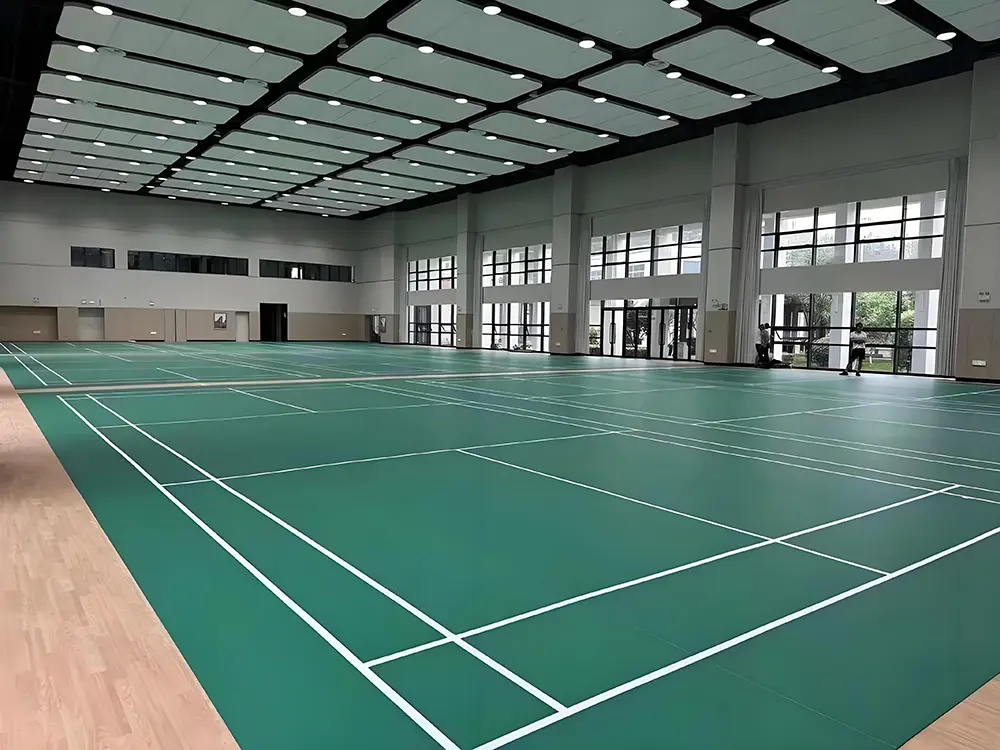
Sports Vinyl Flooring
Vinyl or PVC essentially refers to a material with a multi-layered composite structure, unlike the flooring commonly understood in residential and commercial settings. Although both are made of the same material, their processes and structures differ. It mainly consists of a wear-resistant layer, a surface printed pattern layer, a foam layer, and a fiberglass layer. Professional PVC flooring can meet certifications such as BWF, FIBA, and ITTF.
Hardwood Sports Flooring
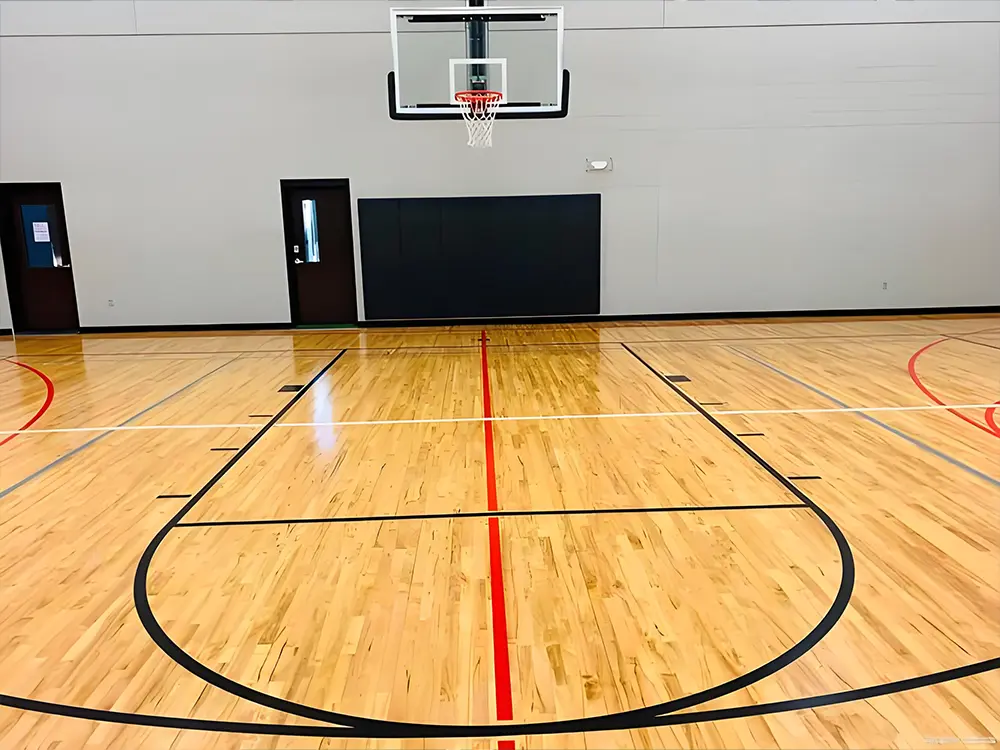
Among solid wood sports flooring materials, maple is the most popular due to its excellent impact resistance. Therefore, this material is most frequently used in high-end professional basketball stadiums. Even many basketball enthusiasts know that a solid wood sports flooring system is quite expensive. The structure consists of a solid wood surface layer, a joist layer, and rubber shock-absorbing pads, forming a hardwood system. Quality levels are categorized based on the different structural layers.
2. Performance Comparison
Solid wood sports flooring offers extremely stable ball rebound and linear energy return. 70% of this depends on the installation precision of the joist system. From materials to installation and maintenance, hardwood flooring has a relatively high cost.
Vinyl flooring, through its foamed cushioning layer, can achieve 35%-55% controllable impact absorption. With a thickness of over 8.0mm, its shock absorption effect can even surpass that of ordinary joist-structured solid wood flooring. More and more professional basketball and badminton clubs are installing Vinyl flooring in their training halls and using solid wood flooring in their competition halls.
Comfort
Generally speaking, the comfort of sports flooring, from highest to lowest, is: PVC sports flooring – acrylic (polyurethane) coating – rubber flooring – solid wood sports flooring. PVC offers the best comfort!
Vibration
Zone vibration refers to the area of deformation caused by impact on the floor. The larger the vibration area, the greater the risk of fractures. Solid wood sports flooring exhibits typical zone vibration. PVC sports flooring, due to its closed-cell honeycomb structure, has a smaller vibration area, classified as point vibration, which maximizes the protection of athletes’ bodies.
3. Cost-Effectiveness
Truly professional solid wood sports flooring is expensive. Due to differences in material quality and structure, the price of sports wood flooring varies significantly.
Generally, it can be roughly divided into three levels: high, medium, and low.
High-end sports wood flooring typically uses North American maple as the surface layer, priced around 1000 yuan/square meter; mid-range sports wood flooring typically uses domestic maple as the surface layer, priced around 600 yuan/square meter; low-end uses composite or engineered wood flooring such as oak as the surface layer, priced around 350 yuan/square meter.
For example, a standard 800-square-meter basketball court, if using mid-range sports wood flooring, would cost approximately 500,000 yuan. Therefore, many users who want professional sports wood flooring end up choosing ordinary wood flooring. Ordinary wood flooring has a simple structure and lacks the characteristics of sports flooring (impact absorption, resonance absorption, friction coefficient, resilience, rolling composite, etc.), which fundamentally increases the risk of injury to athletes. PVC sports flooring, on the other hand, undoubtedly provides a better option for users and fundamentally solves athletes’ concerns. The price is approximately between 50 and 250 yuan per square meter.
4. Installation Efficiency
Vinyl PVC sports flooring only requires a flat surface and can be fully glued, partially glued, or temporarily laid. It supports repeated disassembly and reassembly and reuse in different locations.
Solid wood flooring requires layering, including cushioning pads, joists, and surface layers, and is permanently fixed. The surface needs to be coated with water-based paint, making it difficult to disassemble and reuse.
5. Customizability
Vinyl sports flooring offers multi-purpose functionality, allowing for customization of any color, pattern, and logo. It can also be pre-printed with markings for various sports such as basketball, badminton, volleyball court, and tennis. Furthermore, it is suitable for almost all indoor sports settings, including gyms, children’s fitness centers, dance studios, poolside areas, and multi-purpose halls.
Solid wood flooring is mostly used in professional indoor basketball and volleyball courts, requiring high levels of moisture and water resistance.
6. Core Parameter Comparison
| Comparison Dimension | Vinyl PVC Sports Flooring | Solid Wood Sports Flooring |
|---|---|---|
| Core Shock Absorption | 35%-55%, highly controllable | 40%-60%, dependent on keel installation |
| Ball Rebound Rate | ≥90%, compliant with competition standards | ≥95%, professional competition-level stability |
| Coefficient of Friction | 0.4-0.6, stable in both dry and wet conditions | Meets standards in dry conditions, extremely slippery when wet |
| Initial Procurement & Installation Cost | Low (¥40-60/㎡ – ¥150-200/㎡) | High (¥200-300/㎡ – ¥800-1200/㎡) |
| 10-Year Full Life Cycle Cost | Extremely low, only 30%-50% of solid wood flooring | Extremely high, with endless maintenance and renovation costs |
| Installation Cycle | Fast: 2-3 days for standard venues, ready to use immediately after installation | Slow: 15-20 days for standard venues + 7 days of curing |
| Environmental Adaptability | Excellent: waterproof and temperature-resistant, suitable for dry and wet environments | Poor: sensitive to water/moisture, strict temperature and humidity requirements |
| Scenario Compatibility | Universal compatibility, supports multi-purpose use | Dedicated use only, suitable for professional large ball venues |
| Reusability | Detachable and reusable in different locations | One-time installation, non-reusable |
| Normal Service Life | 8-15 years | 15-20 years (requires continuous maintenance) |
7. Which Sports Flooring Material Should I Choose?
For creating a high-end, professional basketball court, solid wood is undoubtedly the best choice.
Besides professional competitions, PVC fully meets the needs of any scenario.
Another increasingly popular approach is to lay different types of PVC flooring over solid wood flooring in professional badminton or multi-purpose gymnasiums. This allows for multi-functional reuse and better performance, compensating for the shortcomings of both materials.